
Lawrence Rose: String Quartets – composer interview by Fanfare Magazine
An interview with composer Lawrence Rose, which first appeared in the Jan/Feb 2026 edition of Fanfare Magazine
26th November 2025
Lawrence Rose: String Quartets – composer interview by Fanfare Magazine
An interview with composer Lawrence Rose, which first appeared in the Jan/Feb 2026 edition of Fanfare Magazine
26th November 2025
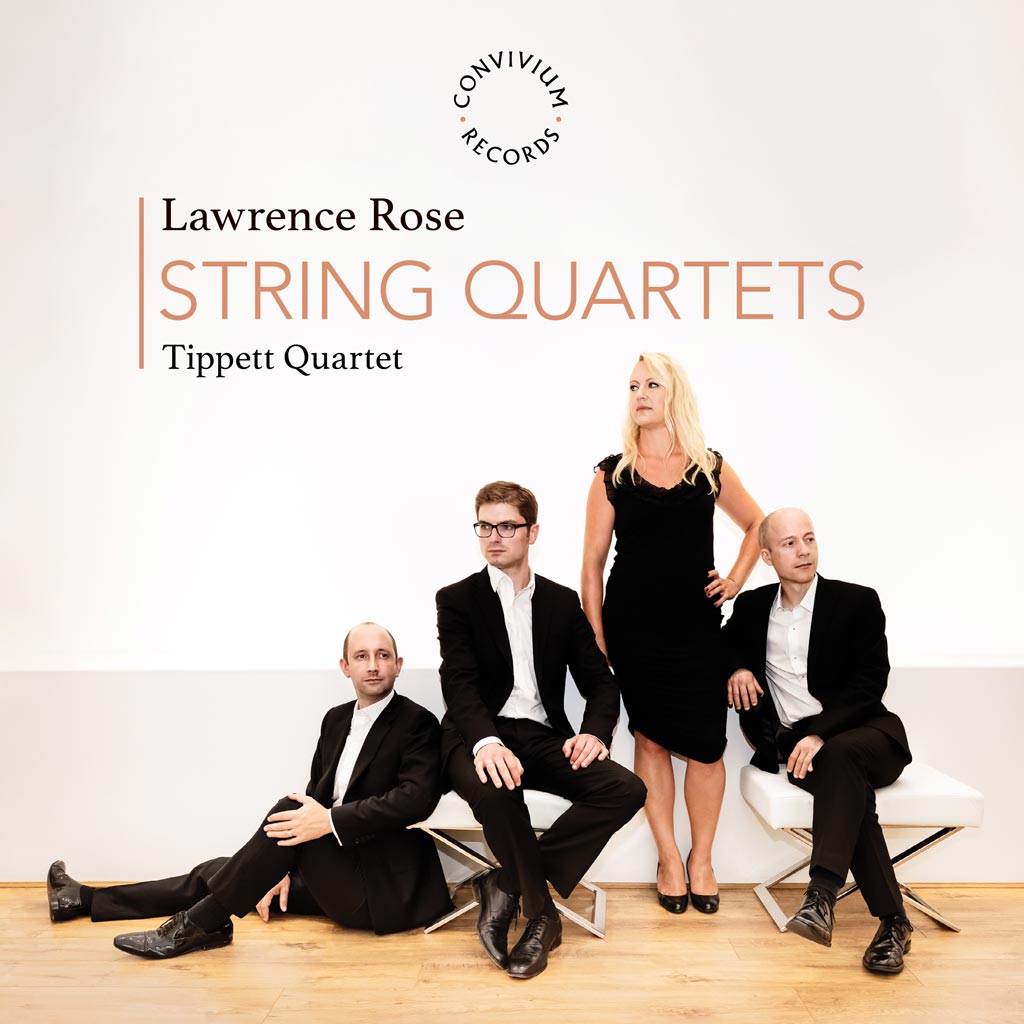
Listen or buy this album:
An Englishman by birth, Lawrence (“Lawrie”) Rose studied violin in his youth and developed an early taste for composing, but life led him to the practice of law, which he pursued until he was nearly 60 years old. At that moment, he retired from the legal profession, moved to Chicago, Illinois, and since then has devoted himself to composing. Over the past 24 years, he has amassed a considerable catalogue of compositions, which are listed on his website. These include four symphonies, three violin concertos, a concerto for orchestra, vocal and choral works, and a bevy of chamber music for various ensembles. In the course of preparing this interview, however, I learned from Lawrie that in 2023 he completed a fifth symphony, subtitled “Eroico,” which celebrates the lives and accomplishments of Lord Nelson and the Duke of Wellington (first movement), Vincent Van Gogh and Pablo Picasso (second movement), Rev. Martin Luther King, Jr. and Nelson Mandela (third movement), and Emmeline Pankhurst and Emily Davison, two famous British suffragettes (fourth movement).
Lawrie, some of your compositions have been reviewed in these pages, but you haven’t before been interviewed here. Welcome to Fanfare!
Thank you.
Tell us, first of all, about your early musical studies.
Unlike many composers, I was not born into a musical family. Neither of my parents played a musical instrument, and, while I am sure my father had musical ability, my mother herself confessed to having none. So I was not weaned on music of any sort and only became conscious of the phenomenon at the age of about three.
At about that time my parents acquired a radiogram [a piece of furniture, popular in the 1950s, that combined a radio, record player, and speaker(s)—KRF] but their musical tastes did not extend to classical music. They possessed 78 rpm shellac records of nursery rhymes aplenty and popular songs of the era. I suppose I was more taken with the heavy pick-up arm, steel needles, colorful record labels, and fast-spinning platters than the actual content!
In junior school [roughly the UK equivalent to what we call elementary school in the U.S., educating students from approximately our second grade to sixth or seventh grade—KRF], I became well acquainted with tonic sol-fa [a pedagogical technique for teaching sight singing that was invented in England in the 19th century—KRF] and clapping to different beats, so I gained a good sense of rhythm and pitch. After a few years one of the teachers who played violin played to us during some lessons and I was enthralled. I think he was the first to introduce me to classical music, Schubert in particular, via Marche Militaire and parts of the Rosamunde incidental music, all of which I loved. Thus inspired, I was eventually able to persuade my parents to let me learn violin.
By chance there was a violin teacher who lived just down the road. I think I was eight years old when I started on my three-quarter-size instrument. I was taught enough theory to be able to read simple music and I made good progress, soon graduating to a full-size violin and bow. I also joined our village church choir, which exposed me to the choral traditions of Protestantism. I remained with that choir until my voice broke. Meanwhile, my older brother added to my experience of classical music, after he was introduced to it by his headmaster. Bear in mind: we were still in the era of the shellac 78s!
Eventually my violin teacher was honest enough to say he had taught me all he could, so after a successful audition I was taken on as a student by a professional violist who also played the violin. By 1957, I had progressed enough that my new teacher entered me for the Associated Board of the Royal School of Music Grade V (Higher) practical exam, which I passed with distinction.
During this period music theory was a compulsory part of the school curriculum until the fourth year. However, school exams were now taking over my life with impending “O” levels and later, “A” levels, success in which would enable admission to university. Unfortunately, as a teenager, I discontinued my violin lessons in order to concentrate on academic studies. On the other hand, when the family acquired a new gramophone and LPs, I developed an interest in listening to classical music more broadly, particularly discs of Beethoven, Schumann, and Dvořák my brother had acquired.
The main catalyst, however, was a performance on the radio of Brahms’s First Symphony. This bowled me over to such an extent that I spent all my meager pocket money on LPs of Brahms.
After gaining entry to Manchester University, I joined the University orchestra and began to attend Hallé Orchestra concerts under Barbirolli, whose concerts introduced me to Nielsen and Sibelius. This led to another spree of LP purchases of their symphonies, in my opinion some of the greatest ever written.
As one who took my degree in music theory and composition before taking a different path, as a practicing lawyer and for some time now as a law professor, I have a good sense of what your career path was like. What originally attracted you to the law?
I think that I had developed an analytical and forensic ability during my studies at grammar school. I cannot elaborate in any detail, although one particular example springs to mind. For “A” level Latin we studied part of the Annals of the Roman historian Tacitus. Translating from the Latin was rather like solving a cryptic crossword in the sense that Tacitus delighted in concision of text, often omitting words so that considerable thought was needed to glean his meaning and intent. That really appealed to me. The idea of studying law, something completely new, was exciting even though I had no real idea of what it could entail.
Please briefly describe your legal career and any area of specialization?
While at University I decided that I wanted to become a solicitor in private practice but had no area of expertise in mind. That was determined by the law firms with which I was eventually engaged. The firm in which I became a partner needed someone to take over its probate and trusts practice, so that became my area of expertise. I must have drawn up hundreds of wills and wound up as many estates, during which I also did the conveyancing for any house sales needed. Administration of trusts was also involved but not to such a great degree.
A busy partner and tiredness notwithstanding, I started some serious composing in the evenings and at weekends. (I had composed some juvenilia and further efforts while at university, but none of this has survived critical scrutiny.) After retiring from law practice in 2001 I started composing in earnest. I also became chairman of Derby Chamber Music Society which still runs and promotes professional chamber music performances for the public.
Now that you have enjoyed careers in two areas that, perhaps superficially, are widely believed to rely on different parts of the brain (left-lobe logic vs. right-lobe creativity), can you identify skills from your music training that you could profitably adapt to legal work, and vice versa?
I would find it hard to think of any aspect of music study and training skills which had some sort of beneficial effect on my legal practice other than possibly the need for hard work! One aspect of my legal work that I really enjoyed was drafting some document for which there was no available precedent. This required detailed thought, analysis, and creativity. It is possible that this skill was absorbed by osmosis into my love for adapting long-established musical forms, (for example, fugue, sonata form, etc.) into something new but still recognizable. Also, the need for precise language may have had a bearing on my ideal of composing music with a natural and satisfying flow. All of this may well underlie my particular concerns—organic growth and development or transformation, rhythmic energy, and powerful expression. I ask myself if it was just a coincidence that my love of Sibelius was nurtured during my law student years.
How did it come about that you immigrated to the United States, and what brought you in particular to Chicago in pursuit of a musical career (as opposed to some other U.S. cultural center, such as New York or San Francisco)?
The answer is simple but has nothing to do with music or composition. In 2003, I met my future wife on a group hiking holiday in the English Lake District. She was from Chicago, and one thing led to another! It was easier for me to relocate than it was for her at that particular time.
Let’s switch gears to talk about the music. I was previously unfamiliar with your music, but I have listened to some of it online and have been very favorably impressed with the craftsmanship. With regard, first, to your symphonies and concertos, did you study orchestration formally or are you self-taught?
Not only am I self-taught in orchestration but also in composition. And this is something which has always been of concern to me. How does the musical establishment react to a self-taught composer? I am not for one moment comparing myself to the self-taught Elgar, for example, but he experienced considerable difficulty coming up against and overcoming the patronizing snobbery of the English musical establishment early on in his career. How can anyone who is self-taught presume to present his or her music to a public already versed in the oeuvres of the “properly” instructed composers? But I am pleased to say that, so far, I have experienced nothing but positive reaction to my music.
On your recent Convivium disc with the Tippett Quartet: while I have not heard enough of your music to draw too many conclusions, tell us about your attraction—natural enough, I suppose, with the violin being your instrument—to the string genre. Do you perceive any conscious (as opposed to unconscious) influences on your compositional style?
After graduating in law and later qualifying as a solicitor in 1967, I was able to attend the Dartington Summer School of Music where I heard Mozart’s “Dissonance” and D-Minor string quartets, my first real experience of the genre. This sowed the seed and inspired me to join with other players in string quartets whenever I could and get to know most of the repertoire from Haydn to Shostakovich and beyond. I also played in local orchestras, symphony and opera. Purchasing a reel-to-reel tape recorder enabled me to record just about every day from BBC Radio Three, anything from Josquin to Schoenberg. Listening to all the Beethoven string quartets and the then available Shostakovich string quartets in sequence was a seminal experience. Really, from the age of about 17 I just immersed myself in classical music via playing, listening, reading scores and appropriate books, and traveling to music festivals in England and Europe. I cannot imagine life without it.
I thought I detected some hints of Stravinsky’s string writing (another composer with some studies in law under his belt!) in the Rigaudon of the Danses pour Quatuor, and also some influence of the English pastoral tradition in the Adagio of your Fourth Quartet.
I think it is more for others to comment on perceived influences, but I find it really interesting when people compare some of my work with other composers; for example, you are not the first to mention Stravinsky. While I admire Stravinsky for his incredibly varied and original output, I find it hard to “hear” any similarities between his and my compositions.
I certainly do not try to sound like any other composer. Having said that, while I love just about all classical music, the composers I most admire are Haydn, Beethoven, Brahms, Sibelius, Nielsen, Elgar, and Shostakovich, and I have no doubt that they have all influenced certain aspects of my style and processes both consciously and subconsciously.
Unlike Elgar I do not hear music whispering in the reeds by a riverbank. My starting points are more prosaic—the choices of genre, instrumentation, number of movements, form, etc. Once I get going, it all just seems to flow from a first musical idea arrived at from “doodling” on the piano or my violin.
In your program notes for the disc, you mentioned a theme “characterised by the twelve-note principle without being strictly serial” To be sure, I did not hear anything characteristic of strict serial technique. Perhaps 12-tone rows are simply a part of your melodic or motivic vocabulary and not any kind of a systematic approach to composing. Is that what you meant by “the twelve-note principle”?
You are referring to “Blue Foxtrot” from Danses pour Quatuor. I do often indulge in chromaticism, which may well have had a bearing on the sinuous, almost sleazy nature of this particular movement. The progression from chromaticism to atonality and thence to serialism seems a natural one, but, other than in this instance, I cannot say that tone rows form any common part of my processes.
What’s next on the drawing board for Lawrie Rose?
I recently made some revisions to my second and third string quartets before approaching the Tippett Quartet, who, I am delighted to say, have agreed to record them for Convivium Records. I am also working on a fourth violin concerto. Apart from that I hope to continue to compose for as long as possible.
Review written by:
Review published in:
Other reviews by this author:
No other reviews found
An Englishman by birth, Lawrence (“Lawrie”) Rose studied violin in his youth and developed an early taste for composing, but life led him to the practice of law, which he pursued until he was nearly 60 years old. At that moment, he retired from the legal profession, moved to Chicago, Illinois, and since then has devoted himself to composing. Over the past 24 years, he has amassed a considerable catalogue of compositions, which are listed on his website. These include four symphonies, three violin concertos, a concerto for orchestra, vocal and choral works, and a bevy of chamber music for various ensembles. In the course of preparing this interview, however, I learned from Lawrie that in 2023 he completed a fifth symphony, subtitled “Eroico,” which celebrates the lives and accomplishments of Lord Nelson and the Duke of Wellington (first movement), Vincent Van Gogh and Pablo Picasso (second movement), Rev. Martin Luther King, Jr. and Nelson Mandela (third movement), and Emmeline Pankhurst and Emily Davison, two famous British suffragettes (fourth movement).
Lawrie, some of your compositions have been reviewed in these pages, but you haven’t before been interviewed here. Welcome to Fanfare!
Thank you.
Tell us, first of all, about your early musical studies.
Unlike many composers, I was not born into a musical family. Neither of my parents played a musical instrument, and, while I am sure my father had musical ability, my mother herself confessed to having none. So I was not weaned on music of any sort and only became conscious of the phenomenon at the age of about three.
At about that time my parents acquired a radiogram [a piece of furniture, popular in the 1950s, that combined a radio, record player, and speaker(s)—KRF] but their musical tastes did not extend to classical music. They possessed 78 rpm shellac records of nursery rhymes aplenty and popular songs of the era. I suppose I was more taken with the heavy pick-up arm, steel needles, colorful record labels, and fast-spinning platters than the actual content!
In junior school [roughly the UK equivalent to what we call elementary school in the U.S., educating students from approximately our second grade to sixth or seventh grade—KRF], I became well acquainted with tonic sol-fa [a pedagogical technique for teaching sight singing that was invented in England in the 19th century—KRF] and clapping to different beats, so I gained a good sense of rhythm and pitch. After a few years one of the teachers who played violin played to us during some lessons and I was enthralled. I think he was the first to introduce me to classical music, Schubert in particular, via Marche Militaire and parts of the Rosamunde incidental music, all of which I loved. Thus inspired, I was eventually able to persuade my parents to let me learn violin.
By chance there was a violin teacher who lived just down the road. I think I was eight years old when I started on my three-quarter-size instrument. I was taught enough theory to be able to read simple music and I made good progress, soon graduating to a full-size violin and bow. I also joined our village church choir, which exposed me to the choral traditions of Protestantism. I remained with that choir until my voice broke. Meanwhile, my older brother added to my experience of classical music, after he was introduced to it by his headmaster. Bear in mind: we were still in the era of the shellac 78s!
Eventually my violin teacher was honest enough to say he had taught me all he could, so after a successful audition I was taken on as a student by a professional violist who also played the violin. By 1957, I had progressed enough that my new teacher entered me for the Associated Board of the Royal School of Music Grade V (Higher) practical exam, which I passed with distinction.
During this period music theory was a compulsory part of the school curriculum until the fourth year. However, school exams were now taking over my life with impending “O” levels and later, “A” levels, success in which would enable admission to university. Unfortunately, as a teenager, I discontinued my violin lessons in order to concentrate on academic studies. On the other hand, when the family acquired a new gramophone and LPs, I developed an interest in listening to classical music more broadly, particularly discs of Beethoven, Schumann, and Dvořák my brother had acquired.
The main catalyst, however, was a performance on the radio of Brahms’s First Symphony. This bowled me over to such an extent that I spent all my meager pocket money on LPs of Brahms.
After gaining entry to Manchester University, I joined the University orchestra and began to attend Hallé Orchestra concerts under Barbirolli, whose concerts introduced me to Nielsen and Sibelius. This led to another spree of LP purchases of their symphonies, in my opinion some of the greatest ever written.
As one who took my degree in music theory and composition before taking a different path, as a practicing lawyer and for some time now as a law professor, I have a good sense of what your career path was like. What originally attracted you to the law?
I think that I had developed an analytical and forensic ability during my studies at grammar school. I cannot elaborate in any detail, although one particular example springs to mind. For “A” level Latin we studied part of the Annals of the Roman historian Tacitus. Translating from the Latin was rather like solving a cryptic crossword in the sense that Tacitus delighted in concision of text, often omitting words so that considerable thought was needed to glean his meaning and intent. That really appealed to me. The idea of studying law, something completely new, was exciting even though I had no real idea of what it could entail.
Please briefly describe your legal career and any area of specialization?
While at University I decided that I wanted to become a solicitor in private practice but had no area of expertise in mind. That was determined by the law firms with which I was eventually engaged. The firm in which I became a partner needed someone to take over its probate and trusts practice, so that became my area of expertise. I must have drawn up hundreds of wills and wound up as many estates, during which I also did the conveyancing for any house sales needed. Administration of trusts was also involved but not to such a great degree.
A busy partner and tiredness notwithstanding, I started some serious composing in the evenings and at weekends. (I had composed some juvenilia and further efforts while at university, but none of this has survived critical scrutiny.) After retiring from law practice in 2001 I started composing in earnest. I also became chairman of Derby Chamber Music Society which still runs and promotes professional chamber music performances for the public.
Now that you have enjoyed careers in two areas that, perhaps superficially, are widely believed to rely on different parts of the brain (left-lobe logic vs. right-lobe creativity), can you identify skills from your music training that you could profitably adapt to legal work, and vice versa?
I would find it hard to think of any aspect of music study and training skills which had some sort of beneficial effect on my legal practice other than possibly the need for hard work! One aspect of my legal work that I really enjoyed was drafting some document for which there was no available precedent. This required detailed thought, analysis, and creativity. It is possible that this skill was absorbed by osmosis into my love for adapting long-established musical forms, (for example, fugue, sonata form, etc.) into something new but still recognizable. Also, the need for precise language may have had a bearing on my ideal of composing music with a natural and satisfying flow. All of this may well underlie my particular concerns—organic growth and development or transformation, rhythmic energy, and powerful expression. I ask myself if it was just a coincidence that my love of Sibelius was nurtured during my law student years.
How did it come about that you immigrated to the United States, and what brought you in particular to Chicago in pursuit of a musical career (as opposed to some other U.S. cultural center, such as New York or San Francisco)?
The answer is simple but has nothing to do with music or composition. In 2003, I met my future wife on a group hiking holiday in the English Lake District. She was from Chicago, and one thing led to another! It was easier for me to relocate than it was for her at that particular time.
Let’s switch gears to talk about the music. I was previously unfamiliar with your music, but I have listened to some of it online and have been very favorably impressed with the craftsmanship. With regard, first, to your symphonies and concertos, did you study orchestration formally or are you self-taught?
Not only am I self-taught in orchestration but also in composition. And this is something which has always been of concern to me. How does the musical establishment react to a self-taught composer? I am not for one moment comparing myself to the self-taught Elgar, for example, but he experienced considerable difficulty coming up against and overcoming the patronizing snobbery of the English musical establishment early on in his career. How can anyone who is self-taught presume to present his or her music to a public already versed in the oeuvres of the “properly” instructed composers? But I am pleased to say that, so far, I have experienced nothing but positive reaction to my music.
On your recent Convivium disc with the Tippett Quartet: while I have not heard enough of your music to draw too many conclusions, tell us about your attraction—natural enough, I suppose, with the violin being your instrument—to the string genre. Do you perceive any conscious (as opposed to unconscious) influences on your compositional style?
After graduating in law and later qualifying as a solicitor in 1967, I was able to attend the Dartington Summer School of Music where I heard Mozart’s “Dissonance” and D-Minor string quartets, my first real experience of the genre. This sowed the seed and inspired me to join with other players in string quartets whenever I could and get to know most of the repertoire from Haydn to Shostakovich and beyond. I also played in local orchestras, symphony and opera. Purchasing a reel-to-reel tape recorder enabled me to record just about every day from BBC Radio Three, anything from Josquin to Schoenberg. Listening to all the Beethoven string quartets and the then available Shostakovich string quartets in sequence was a seminal experience. Really, from the age of about 17 I just immersed myself in classical music via playing, listening, reading scores and appropriate books, and traveling to music festivals in England and Europe. I cannot imagine life without it.
I thought I detected some hints of Stravinsky’s string writing (another composer with some studies in law under his belt!) in the Rigaudon of the Danses pour Quatuor, and also some influence of the English pastoral tradition in the Adagio of your Fourth Quartet.
I think it is more for others to comment on perceived influences, but I find it really interesting when people compare some of my work with other composers; for example, you are not the first to mention Stravinsky. While I admire Stravinsky for his incredibly varied and original output, I find it hard to “hear” any similarities between his and my compositions.
I certainly do not try to sound like any other composer. Having said that, while I love just about all classical music, the composers I most admire are Haydn, Beethoven, Brahms, Sibelius, Nielsen, Elgar, and Shostakovich, and I have no doubt that they have all influenced certain aspects of my style and processes both consciously and subconsciously.
Unlike Elgar I do not hear music whispering in the reeds by a riverbank. My starting points are more prosaic—the choices of genre, instrumentation, number of movements, form, etc. Once I get going, it all just seems to flow from a first musical idea arrived at from “doodling” on the piano or my violin.
In your program notes for the disc, you mentioned a theme “characterised by the twelve-note principle without being strictly serial” To be sure, I did not hear anything characteristic of strict serial technique. Perhaps 12-tone rows are simply a part of your melodic or motivic vocabulary and not any kind of a systematic approach to composing. Is that what you meant by “the twelve-note principle”?
You are referring to “Blue Foxtrot” from Danses pour Quatuor. I do often indulge in chromaticism, which may well have had a bearing on the sinuous, almost sleazy nature of this particular movement. The progression from chromaticism to atonality and thence to serialism seems a natural one, but, other than in this instance, I cannot say that tone rows form any common part of my processes.
What’s next on the drawing board for Lawrie Rose?
I recently made some revisions to my second and third string quartets before approaching the Tippett Quartet, who, I am delighted to say, have agreed to record them for Convivium Records. I am also working on a fourth violin concerto. Apart from that I hope to continue to compose for as long as possible.
Review written by:
Review published in:
Other reviews by this author:
No other reviews found
