
Easter Rising – Review by Classical Notes
“The importance of the environment, community and political issues also shines through once again here, making for another fascinating and diverse selection of [Hugh Shrapnel's] music”
3rd August 2026
Easter Rising – Review by Classical Notes
“The importance of the environment, community and political issues also shines through once again here, making for another fascinating and diverse selection of [Hugh Shrapnel's] music”
3rd August 2026
Listen or buy this album:
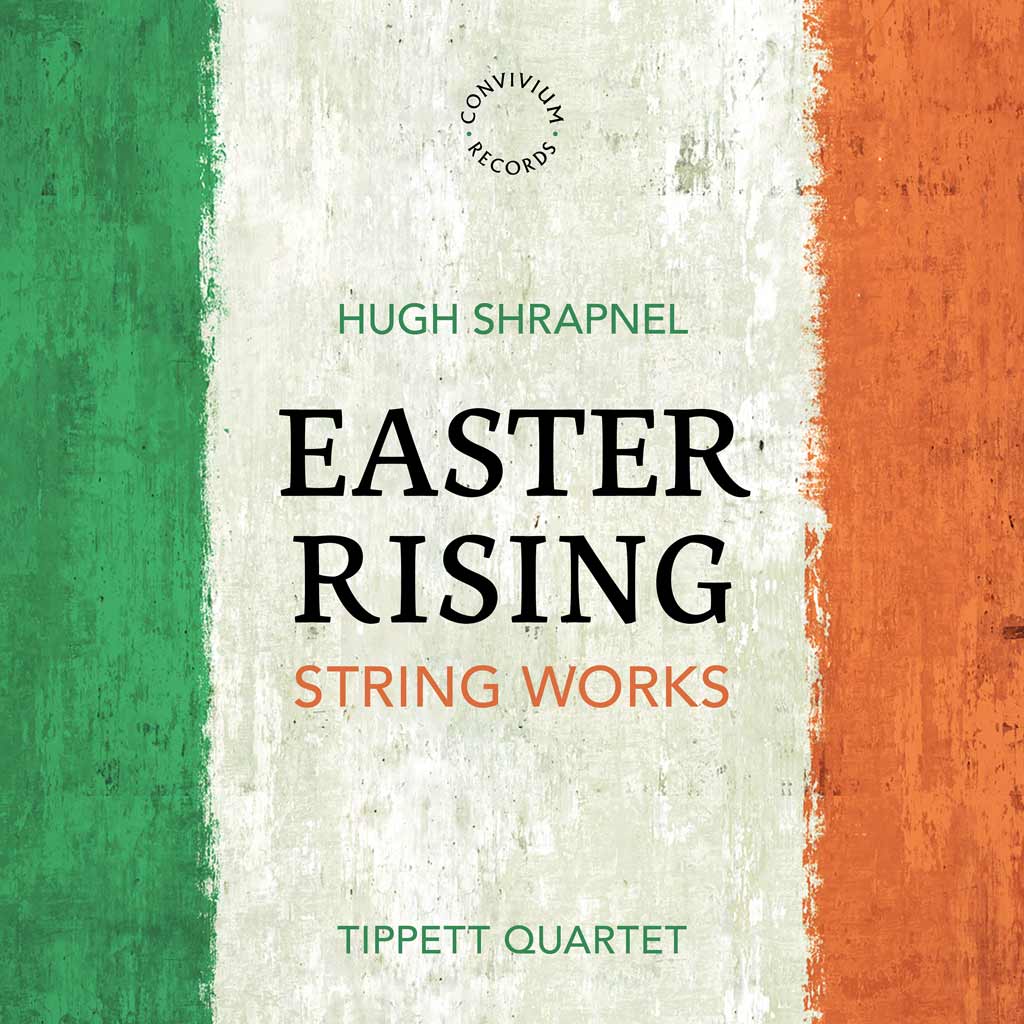
Last summer I had the pleasure of meeting with composer Hugh Shrapnel to discuss his music, and he talked then of his next project, a recording of string works with the Tippett Quartet. The recording, Easter Rising, is now out on Convivium Records, and contains four works, with a thread of protest, political struggle and striving for social justice and peace connecting them. Easter Rising 1916, which gives the recording its title, is the most overtly political piece, and has an additional part for the Irish fiddle, played her by Jo Cooper. It was composed in 2016 for Cornelius Cardew Concerts Trust at Morley College London to mark the centenary of the Easter Rising, a rebellion by Irish Republicans that was brutally suppressed by the British. The subsequent execution of sixteen of the leaders of the Rising, as well as the civilian casualties, and internment of prisoners, galvanised support for independence, leading to the Irish War of Independence (1919-21) and the creation of the Irish Free State in 1921. Shrapnel’s piece, in five sections, begins with a mournful Irish song melody on the violin, over drones from the lower music, evoking the long Irish history of Irish struggle and song. The other instruments join and entwine with the melody, and then more insistent repeated rhythmic figures increase the intensity, as if in debate, as the preparations are made for the Rising. The swirling tune of the song We Only Want the Earth by James Connolly, one of the Rising’s leaders, dominates the middle section depicting the Rising itself, before the music subsides into sadness for the Aftermath, a lament for the executed leaders (including James Connolly). Then the folk tune, The Foggy Dew emerges on the Irish fiddle, with simple background from the other instruments, save the occasional echo from the quartet’s first violin. The reemergence of Irish song takes the work full circle, with a quiet defiance and recognition of Ireland’s history of struggle, with an equally defiant energy from the quartet to finish. Overall, this is a highly engaging and striking piece, somehow capturing feelings of frustration, despair and loss, as well as anger, defiance and hope. Appropriately, the work is followed on the recording by a new work, For Peace, written for and dedicated to the Tippett Quartet for this recording. It is described as ‘an expression for yearning for peace in our increasingly troubled and divided world’, signalling that the struggle for justice and peace goes on. It begins quietly, and a long sustained violin line emerges over even longer notes from the lower instruments. Yearning and crying comes from insistent, rising repetitive figures. Rather than a soothing, peaceful piece, in its brief five and a half minutes, this is an elegiac yet pained plea for much needed peace.
The disc opens with another work composed for a CCCT concert at Morley College, for which the theme was One World, with two accompanying poems writte by Carol Rumens, this time for piano quintet. The first, The Hazel Nut (Posing The Problem) draws on one of Julian of Norwich’s Revelations of Divine Love, in which she dreamt that the world was contained in a hazel nut in the palm of her hand. Her second poem, Circling the Square (posing the Solution) expresses a hope that people rediscover the importance of all matter and reconnect with the world and each other. Shrapnel’s piece opens with dancing, circling rhythms from the strings, then the piano enters with ethereal chords over a drone from the cello, as the violins continue to skitter above. Then the energy slows, with the piano taking over the role of skittering about. The piano takes up the repeated figures and the violins sing more lyrically above, before the piano shatters the mood with more dramatic stabbing, with the strings following. String harmonics over low piano and cello drone add to the overall sense of mystery, before the opening dancing material returns, before being finally transformed into a more joyful folk dance with ringing bells from the piano which ultimately subsides into a gently peaceful conclusion. Again, Shrapnel successfully captures moods and emotions without being tied down to anything too literal in terms of the poetry.
Nascence, for string quartet and piano, was composed for the CCCT concert at Morley College in 2017, the theme being Born to Society, a poem written by Canadian communist Hardial Bains, which calls for a ‘world which is humanised’, with an end to ‘anger and strife’. Shrapnel’s work is driving and energetic, and in fact opens full of ‘anger and strife’, with driving rhythmic figures and astringent harmonies. Whilst the central section hints at calmer waters, it soon regains the frenzy of the opening section. It is only as the piano’s repeated low tolling reins the strings into calmness that lyricism from the violins and then the rest of the quartet can emerge, yet the piano continues to toll defiantly to the end. It’s a subtle shift perhaps from ‘anger and strife’ to ‘the expression of what is alive’ – but then, in the context of some of the other themes on this recording, maybe an element of anger is still needed to keep the struggle for peace and justice alive.
Throughout this recording, the Tippett Quartet play with incision and energy, as well as warm tone in the more lyrical moments. Lynn Arnold brings resonance and authority to the piano parts in the two opening works, and Jo Cooper’s contribution on the Irish fiddle at the close of Easter Rising 1916 adds a beautifully evocative touch. Clearly, some of these pieces have direct roots in poetry, and in his interview with me, Hugh described his work as often ‘descriptive, of a mood – poems in music’. The importance of the environment, community and political issues also shines through once again here, making for another fascinating and diverse selection of his music, a welcome addition to previous recordings of his piano and chamber works.
Review written by:
Review published in:
Other reviews by this author:
Featured artists:
Featured composers:
Last summer I had the pleasure of meeting with composer Hugh Shrapnel to discuss his music, and he talked then of his next project, a recording of string works with the Tippett Quartet. The recording, Easter Rising, is now out on Convivium Records, and contains four works, with a thread of protest, political struggle and striving for social justice and peace connecting them. Easter Rising 1916, which gives the recording its title, is the most overtly political piece, and has an additional part for the Irish fiddle, played her by Jo Cooper. It was composed in 2016 for Cornelius Cardew Concerts Trust at Morley College London to mark the centenary of the Easter Rising, a rebellion by Irish Republicans that was brutally suppressed by the British. The subsequent execution of sixteen of the leaders of the Rising, as well as the civilian casualties, and internment of prisoners, galvanised support for independence, leading to the Irish War of Independence (1919-21) and the creation of the Irish Free State in 1921. Shrapnel’s piece, in five sections, begins with a mournful Irish song melody on the violin, over drones from the lower music, evoking the long Irish history of Irish struggle and song. The other instruments join and entwine with the melody, and then more insistent repeated rhythmic figures increase the intensity, as if in debate, as the preparations are made for the Rising. The swirling tune of the song We Only Want the Earth by James Connolly, one of the Rising’s leaders, dominates the middle section depicting the Rising itself, before the music subsides into sadness for the Aftermath, a lament for the executed leaders (including James Connolly). Then the folk tune, The Foggy Dew emerges on the Irish fiddle, with simple background from the other instruments, save the occasional echo from the quartet’s first violin. The reemergence of Irish song takes the work full circle, with a quiet defiance and recognition of Ireland’s history of struggle, with an equally defiant energy from the quartet to finish. Overall, this is a highly engaging and striking piece, somehow capturing feelings of frustration, despair and loss, as well as anger, defiance and hope. Appropriately, the work is followed on the recording by a new work, For Peace, written for and dedicated to the Tippett Quartet for this recording. It is described as ‘an expression for yearning for peace in our increasingly troubled and divided world’, signalling that the struggle for justice and peace goes on. It begins quietly, and a long sustained violin line emerges over even longer notes from the lower instruments. Yearning and crying comes from insistent, rising repetitive figures. Rather than a soothing, peaceful piece, in its brief five and a half minutes, this is an elegiac yet pained plea for much needed peace.
The disc opens with another work composed for a CCCT concert at Morley College, for which the theme was One World, with two accompanying poems writte by Carol Rumens, this time for piano quintet. The first, The Hazel Nut (Posing The Problem) draws on one of Julian of Norwich’s Revelations of Divine Love, in which she dreamt that the world was contained in a hazel nut in the palm of her hand. Her second poem, Circling the Square (posing the Solution) expresses a hope that people rediscover the importance of all matter and reconnect with the world and each other. Shrapnel’s piece opens with dancing, circling rhythms from the strings, then the piano enters with ethereal chords over a drone from the cello, as the violins continue to skitter above. Then the energy slows, with the piano taking over the role of skittering about. The piano takes up the repeated figures and the violins sing more lyrically above, before the piano shatters the mood with more dramatic stabbing, with the strings following. String harmonics over low piano and cello drone add to the overall sense of mystery, before the opening dancing material returns, before being finally transformed into a more joyful folk dance with ringing bells from the piano which ultimately subsides into a gently peaceful conclusion. Again, Shrapnel successfully captures moods and emotions without being tied down to anything too literal in terms of the poetry.
Nascence, for string quartet and piano, was composed for the CCCT concert at Morley College in 2017, the theme being Born to Society, a poem written by Canadian communist Hardial Bains, which calls for a ‘world which is humanised’, with an end to ‘anger and strife’. Shrapnel’s work is driving and energetic, and in fact opens full of ‘anger and strife’, with driving rhythmic figures and astringent harmonies. Whilst the central section hints at calmer waters, it soon regains the frenzy of the opening section. It is only as the piano’s repeated low tolling reins the strings into calmness that lyricism from the violins and then the rest of the quartet can emerge, yet the piano continues to toll defiantly to the end. It’s a subtle shift perhaps from ‘anger and strife’ to ‘the expression of what is alive’ – but then, in the context of some of the other themes on this recording, maybe an element of anger is still needed to keep the struggle for peace and justice alive.
Throughout this recording, the Tippett Quartet play with incision and energy, as well as warm tone in the more lyrical moments. Lynn Arnold brings resonance and authority to the piano parts in the two opening works, and Jo Cooper’s contribution on the Irish fiddle at the close of Easter Rising 1916 adds a beautifully evocative touch. Clearly, some of these pieces have direct roots in poetry, and in his interview with me, Hugh described his work as often ‘descriptive, of a mood – poems in music’. The importance of the environment, community and political issues also shines through once again here, making for another fascinating and diverse selection of his music, a welcome addition to previous recordings of his piano and chamber works.
