
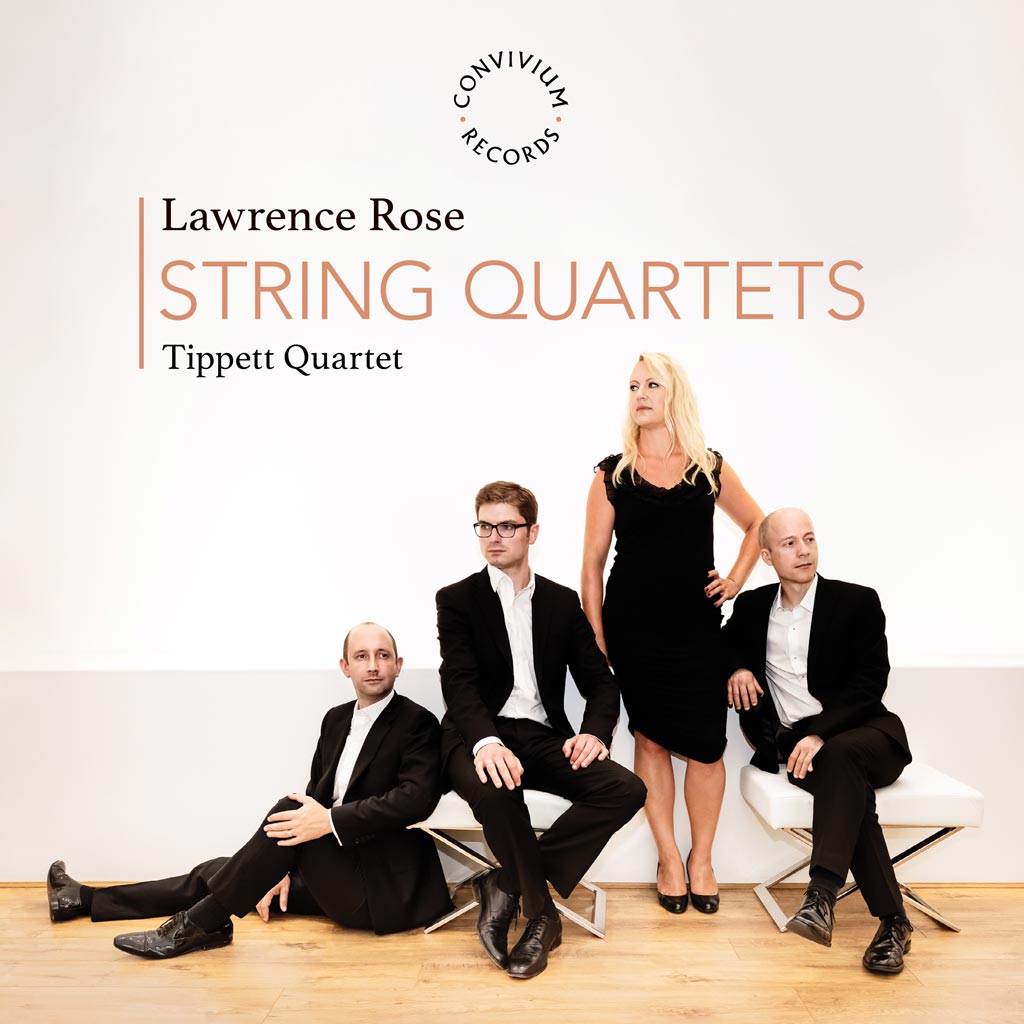
Lawrence Rose: String Quartets – Review by Fanfare Magazine
“Rose has a gift for development / transformation without losing the thread. He is greatly aided by the committed, all-in performances from the Tippett Quartet and by vivid recorded sound.”
23rd September 2025
Lawrence Rose: String Quartets – Review by Fanfare Magazine
“Rose has a gift for development / transformation without losing the thread. He is greatly aided by the committed, all-in performances from the Tippett Quartet and by vivid recorded sound.”
23rd September 2025
Listen or buy this album:
English composer Lawrence Rose doesn’t attract major media attention, but his music is unusually rewarding. I first encountered him through a piano trio that appeared on a mixed disc of chamber works in 2022 where Rose’s piece was sandwiched between the famous piano trios of Smetana and Rachmaninoff. In my review I wrote that Rose, who was born in 1943, “exemplifies the enduring tradition of the English amateur, having pursued a career in law until 2001, at which point he retired to become a composer full time” (Fanfare 46:2). Notwithstanding, he has composed most of his music since immigrating to Chicago.
Although Rose has written across a wide range of genres, including instrumental concertos and symphonies, this new release continues the theme of chamber music with two substantial works for string quartet. His Piano Trio was in seven movements, nodding to the precedent provided by Beethoven’s late String Quartet, op. 131. A similar takeoff point applies to Danses pour quatuor on this release, not to a specific composer but to the Baroque genre of the dance suite. As the composer’s cogent, well-written program notes point out, the evolution of the dance suite went from dancing more and more to listening, and correspondingly, composers offered more sophisticated treatments of dances that often had simple folk origins before moving to court.
Rose has only peripherally written a neo-Baroque suite, however, since his intention centers on the dances’ cultivation as complex music. He has devised his own version of the Rigaudon in the first of six movements, and only the second movement “Sarabande (quasi ciaccona)” offers another typical Baroque dance, with suitably modern twists. For example, Rose picks up from the chaconne its trait of continuous development, which he then applies to seven variants in the Sarabande without taking up the repetition in eight-bar segments of the typical chaconne structure. Similarly adroit things happen in the remaining four movements titled “Walzer,” “Tango (quasi habanera),” “Blue Foxtrot,” and “Invention.”
Commenting on the Piano Trio on the earlier release, I thought that Rose seamlessly handled the transition into his own voice from the Romantic idiom of Smetana and Rachmaninoff. Here, however, the Baroque inspiration for Danses pour quatuor shouldn’t be oversold. This time Rose has transitioned into his own voice in imaginative ways. I realize that Borodin was a chemist, Rimsky-Korsakov a naval officer, Chausson a lawyer, and even Stravinsky was compelled by his family to study law before he gave it up, but this doesn’t diminish my admiration for how assured Rose is given his amateur background.
The rhythmic force and raw propulsion that begin the “Rigaudon” made me think that we were being plunged directly into the Bartók of the Second or Third String Quartet, but Rose isn’t out to convey an eclecticism based on famous models. He has a magpie ear (in the most complimentary sense of the word) that picks up seeds of a waltz or tango before developing them his own way. One feature, it occurs to me, arises from his mention of continuous development, which was not only found in the Baroque chaconne but in Bartók’s scheme as well. Rose’s themes are interested in each other and keep making comments and sidelong glances.
As a result, Danses pour quatuor has a live, fresh quality that holds your attention whether a particular passage is tonal or spiced with dissonance. “Blue Foxtrot” looks back at how the flow across the floor of a social dance from the 1930s evolved into the slow blues. Rose imparts a bluesy flavor to the variants he devises based on a 12-note theme that is not quite a serial tone row. The foxtrot, which lasts six minutes, has a sliding, gliding momentum with hints of nostalgia, but the ear is always kept alert.
One aspect is that there are no extended performance techniques for the strings. Rose is being conservative in his aesthetic, which is made explicit in a comment: “The composer feels strongly that because of their perfect inner logic there is still a place for old-established musical forms.” Danses pour quatuor is a winning way to prove his point. If more widely heard, it has the potential for enthusiastic audience response.
String Quartet No. 4 from 2024 represents a jump of 17 years from when Rose began Danses pour quatuor. The shape of the five movements is archlike, following a model also found in Bartók. The notes mention that this is absolute music, in that there is no association with anything like the Baroque dances heard before. Instead, themes are unfolded continuously through development and transformation. The five movements consist of two important outer movements, a central Adagio, and two flanking Scherzos. Both outer movements feature a long fugue. But I find that success, when it comes to the general listener, depends on whether the ear can follow how the score is evolving.
Rose is helped in several ways to achieve success in Quartet No. 4. First, his thematic material is warm and often heartfelt. Whether he uses melody or quasi-melody, the lyrical intent is unmissable. Transitions are natural, and rhythms are more often connected to walking or breathing than to abrupt, arbitrary patterns. All of this keeps the listener engaged even in a quartet 36 minutes long. I don’t mean to reach for a comparison, but Rose’s Quartet No. 4 unfolds dramatically with every gesture found in Verklärte Nacht, including moods of pathos and neurosis, but the result isn’t imitative. Without advancing his harmonies beyond early Schoenberg and middle Bartók, Rose has extracted the essence of what they impart.
When I speak of music the ear can follow, I’m speaking of essence, not compositional details, and here both works on this program are strong. Rose has a gift for development/transformation without losing the thread. He is greatly aided by the committed, all-in performances from the Tippett Quartet and by vivid recorded sound that captures the luminous string tone often called for. On that basis, I can offer the warmest recommendation.
Review written by:
Review published in:
Other reviews by this author:
English composer Lawrence Rose doesn’t attract major media attention, but his music is unusually rewarding. I first encountered him through a piano trio that appeared on a mixed disc of chamber works in 2022 where Rose’s piece was sandwiched between the famous piano trios of Smetana and Rachmaninoff. In my review I wrote that Rose, who was born in 1943, “exemplifies the enduring tradition of the English amateur, having pursued a career in law until 2001, at which point he retired to become a composer full time” (Fanfare 46:2). Notwithstanding, he has composed most of his music since immigrating to Chicago.
Although Rose has written across a wide range of genres, including instrumental concertos and symphonies, this new release continues the theme of chamber music with two substantial works for string quartet. His Piano Trio was in seven movements, nodding to the precedent provided by Beethoven’s late String Quartet, op. 131. A similar takeoff point applies to Danses pour quatuor on this release, not to a specific composer but to the Baroque genre of the dance suite. As the composer’s cogent, well-written program notes point out, the evolution of the dance suite went from dancing more and more to listening, and correspondingly, composers offered more sophisticated treatments of dances that often had simple folk origins before moving to court.
Rose has only peripherally written a neo-Baroque suite, however, since his intention centers on the dances’ cultivation as complex music. He has devised his own version of the Rigaudon in the first of six movements, and only the second movement “Sarabande (quasi ciaccona)” offers another typical Baroque dance, with suitably modern twists. For example, Rose picks up from the chaconne its trait of continuous development, which he then applies to seven variants in the Sarabande without taking up the repetition in eight-bar segments of the typical chaconne structure. Similarly adroit things happen in the remaining four movements titled “Walzer,” “Tango (quasi habanera),” “Blue Foxtrot,” and “Invention.”
Commenting on the Piano Trio on the earlier release, I thought that Rose seamlessly handled the transition into his own voice from the Romantic idiom of Smetana and Rachmaninoff. Here, however, the Baroque inspiration for Danses pour quatuor shouldn’t be oversold. This time Rose has transitioned into his own voice in imaginative ways. I realize that Borodin was a chemist, Rimsky-Korsakov a naval officer, Chausson a lawyer, and even Stravinsky was compelled by his family to study law before he gave it up, but this doesn’t diminish my admiration for how assured Rose is given his amateur background.
The rhythmic force and raw propulsion that begin the “Rigaudon” made me think that we were being plunged directly into the Bartók of the Second or Third String Quartet, but Rose isn’t out to convey an eclecticism based on famous models. He has a magpie ear (in the most complimentary sense of the word) that picks up seeds of a waltz or tango before developing them his own way. One feature, it occurs to me, arises from his mention of continuous development, which was not only found in the Baroque chaconne but in Bartók’s scheme as well. Rose’s themes are interested in each other and keep making comments and sidelong glances.
As a result, Danses pour quatuor has a live, fresh quality that holds your attention whether a particular passage is tonal or spiced with dissonance. “Blue Foxtrot” looks back at how the flow across the floor of a social dance from the 1930s evolved into the slow blues. Rose imparts a bluesy flavor to the variants he devises based on a 12-note theme that is not quite a serial tone row. The foxtrot, which lasts six minutes, has a sliding, gliding momentum with hints of nostalgia, but the ear is always kept alert.
One aspect is that there are no extended performance techniques for the strings. Rose is being conservative in his aesthetic, which is made explicit in a comment: “The composer feels strongly that because of their perfect inner logic there is still a place for old-established musical forms.” Danses pour quatuor is a winning way to prove his point. If more widely heard, it has the potential for enthusiastic audience response.
String Quartet No. 4 from 2024 represents a jump of 17 years from when Rose began Danses pour quatuor. The shape of the five movements is archlike, following a model also found in Bartók. The notes mention that this is absolute music, in that there is no association with anything like the Baroque dances heard before. Instead, themes are unfolded continuously through development and transformation. The five movements consist of two important outer movements, a central Adagio, and two flanking Scherzos. Both outer movements feature a long fugue. But I find that success, when it comes to the general listener, depends on whether the ear can follow how the score is evolving.
Rose is helped in several ways to achieve success in Quartet No. 4. First, his thematic material is warm and often heartfelt. Whether he uses melody or quasi-melody, the lyrical intent is unmissable. Transitions are natural, and rhythms are more often connected to walking or breathing than to abrupt, arbitrary patterns. All of this keeps the listener engaged even in a quartet 36 minutes long. I don’t mean to reach for a comparison, but Rose’s Quartet No. 4 unfolds dramatically with every gesture found in Verklärte Nacht, including moods of pathos and neurosis, but the result isn’t imitative. Without advancing his harmonies beyond early Schoenberg and middle Bartók, Rose has extracted the essence of what they impart.
When I speak of music the ear can follow, I’m speaking of essence, not compositional details, and here both works on this program are strong. Rose has a gift for development/transformation without losing the thread. He is greatly aided by the committed, all-in performances from the Tippett Quartet and by vivid recorded sound that captures the luminous string tone often called for. On that basis, I can offer the warmest recommendation.
