
The Eule Organ of Magdalen College, Oxford – Review by RSCM (Church Music Quarterly)
"Alexander Pott knows this organ well: he imaginatively shows off its range of romantic tone colours."
23rd December 2025
The Eule Organ of Magdalen College, Oxford – Review by RSCM (Church Music Quarterly)
"Alexander Pott knows this organ well: he imaginatively shows off its range of romantic tone colours."
23rd December 2025
Listen or buy this album:
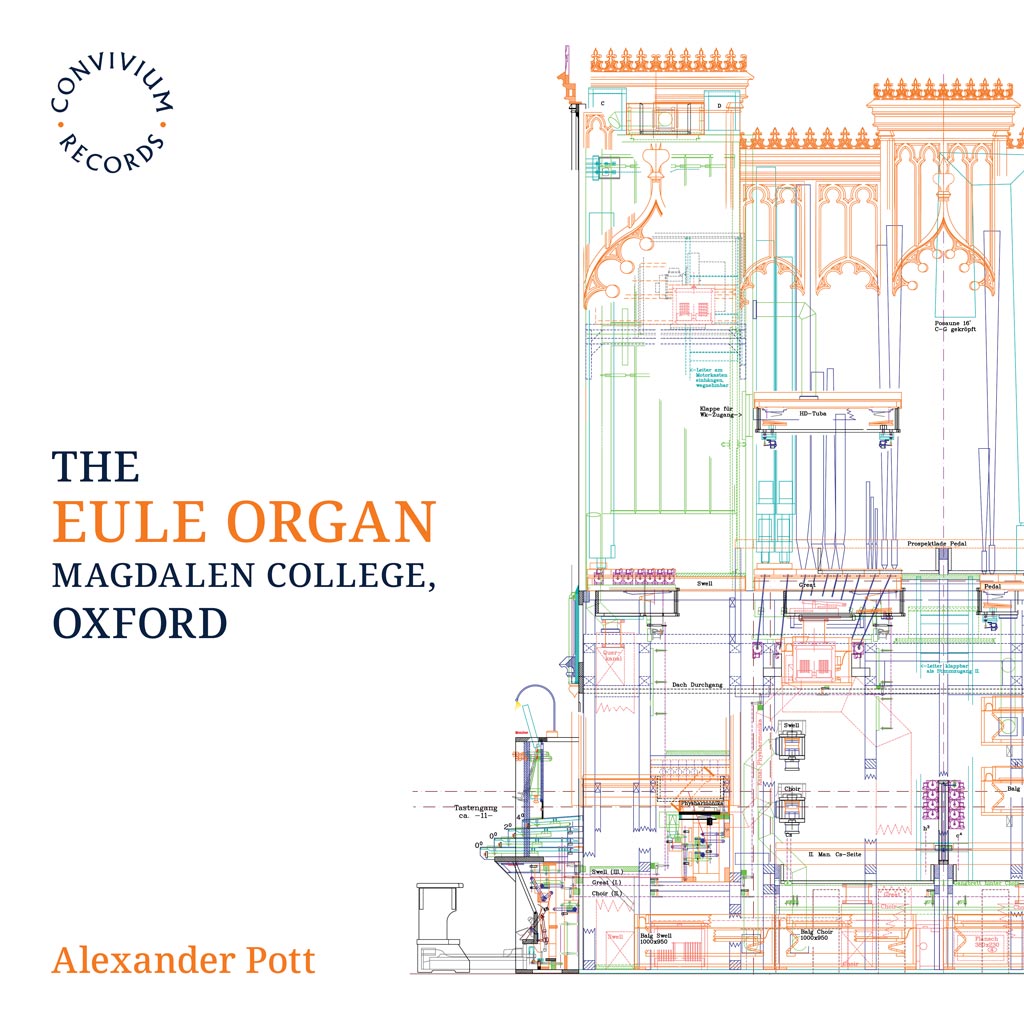
The 2023 Eule organ replaced an earlier Mander instrument at Magdalen College. Its 45 stops reflect a German Saxon heritage, and this, its first commercial recording, features music with connections to Leipzig and wider Saxony, from the middle of the 19th into the early 20th century. The disc opens with transcriptions, Jeanne Demessieux’s of Liszt’s Funérailles (originally for piano) and Liszt’s transcription of Wagner’s ‘Pilgrim’s Chorus’ from Tannhäuser.
Original organ music starts with Reinecke’s Organ Sonata in G minor, which culminates with the chorale ‘Wie schön leuchtet der Morgenstern’. Ethel Smyth studied in Leipzig and shortly after wrote her Prelude and Fugue on ‘O Traurigkeit, O Herzeleid’. Sigfrid Karg-Elert’s The Reed-grown Waters gives an opportunity to hear the only example in the UK of a Physharmonica stop. We move on through Delius as arranged by Eric Fenby and Percy Whitlock, to Percy Grainger with The Immovable Do, where the note C is sustained throughout by a pencil jammed between the keys. The organist on this disc, Alexander Pott, has arranged Peter Warlock’s five Folk-Song Preludes(originally for piano), which are followed by the first recording of Frederic Austin’s Organ Sonata to conclude the recital.
Alexander Pott knows this organ well: he imaginatively shows off its range of romantic tone colours. The packaging is generous, with notes that include a history and specification of the instrument.
Review written by:
Review published in:
Other reviews by this author:
The 2023 Eule organ replaced an earlier Mander instrument at Magdalen College. Its 45 stops reflect a German Saxon heritage, and this, its first commercial recording, features music with connections to Leipzig and wider Saxony, from the middle of the 19th into the early 20th century. The disc opens with transcriptions, Jeanne Demessieux’s of Liszt’s Funérailles (originally for piano) and Liszt’s transcription of Wagner’s ‘Pilgrim’s Chorus’ from Tannhäuser.
Original organ music starts with Reinecke’s Organ Sonata in G minor, which culminates with the chorale ‘Wie schön leuchtet der Morgenstern’. Ethel Smyth studied in Leipzig and shortly after wrote her Prelude and Fugue on ‘O Traurigkeit, O Herzeleid’. Sigfrid Karg-Elert’s The Reed-grown Waters gives an opportunity to hear the only example in the UK of a Physharmonica stop. We move on through Delius as arranged by Eric Fenby and Percy Whitlock, to Percy Grainger with The Immovable Do, where the note C is sustained throughout by a pencil jammed between the keys. The organist on this disc, Alexander Pott, has arranged Peter Warlock’s five Folk-Song Preludes(originally for piano), which are followed by the first recording of Frederic Austin’s Organ Sonata to conclude the recital.
Alexander Pott knows this organ well: he imaginatively shows off its range of romantic tone colours. The packaging is generous, with notes that include a history and specification of the instrument.
