
The Eule Organ of Magdalen College, Oxford – Review by The Delius Society Journal
"[The playing] is consistently superb and shows off the extraordinary range of the instrument – just turn up the volume and enjoy!"
14th May 2026
The Eule Organ of Magdalen College, Oxford – Review by The Delius Society Journal
"[The playing] is consistently superb and shows off the extraordinary range of the instrument – just turn up the volume and enjoy!"
14th May 2026
Listen or buy this album:
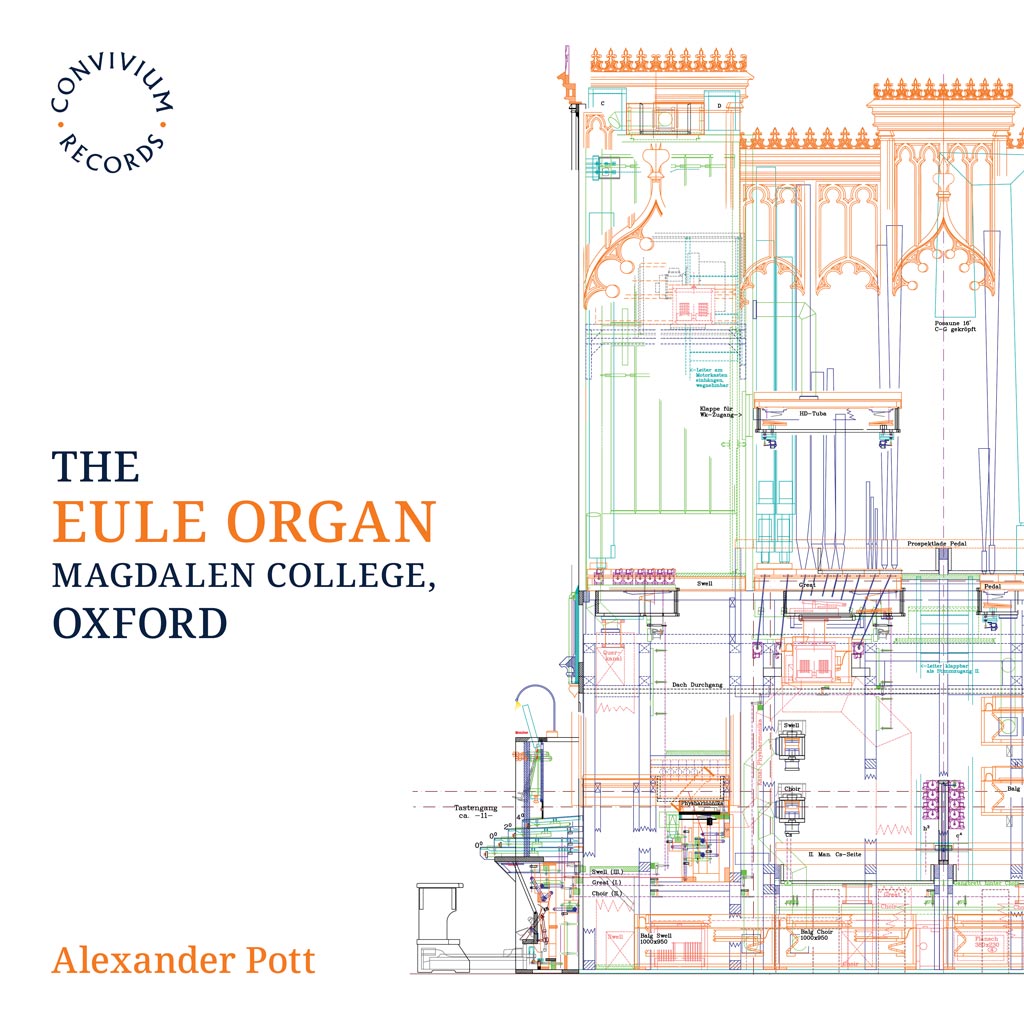
My memories of studying the organ in the 1970s are inevitably linked with the relentless move towards the installation of Baroque-style organs. Indeed, a crisp, clear, highly articulated style dominated our playing. Even Mendelssohn was, in my view rightly, rediscovered as an organ composer best termed post-Baroque. Out with the mushy Victorian cathedral organs, and in with the sparkling Germanic Rückpositiv! Times have moved on. We now witness an Oxford college commissioning an organ from a leading builder (Hermann Eule Orgelbau) in the German Romantic style, something which – to the best of my knowledge – is unique in Oxford, where Baroque/Classical instruments predominate. And what an amazing tone palette it has, fully revealed in this miscellany of works by composers associated in some way with Leipzig, including Delius who plays a pivotal role in the repertory, though only represented by one piece. We hear the Organ Sonata in G minor by Carl Reinecke, Delius’s former teacher, for whom he had little respect – the feeling was indeed mutual. Dame Ethel Smyth, a fellow Leipzig student, is represented with a Prelude and Fugue on ‘O Traurigkeit, O Herzeleid’. And then the music choice allows us to track Delius’s influences and friendships: Whitlock’s Carol is dedicated to Delius and quotes from On Hearing the First Cuckoo in Spring. Grainger and Warlock also both make an appearance, Grainger with a humorous, somewhat weird piece imitating an organ cipher, while the latter is represented when Alexander Pott applies the full gamut of organ colour to his own arrangement of Warlock’s Folk-Song Preludes.
Regarding Reinecke, the most substantial work in this collection, I am inclined to agree with Delius. I looked at his Sonata myself some months back. It seemed an appropriate idea to look at Delius’s teacher since I live in Limpsfield and am involved with playing the organ at the church where Delius is buried. In my view, musically, it did not seem to repay the effort. However, on this CD, it provides a spectacular way of showing off the (to use a cliché) majestic sound of this instrument in a captivating performance by Alexander Pott.
As for Delius, it has been a pleasure for me, on several occasions, to perform On Hearing the First Cuckoo in Spring in the Fenby arrangement in Limpsfield, where the organ stands on the same spot as Beecham’s orchestra was positioned for the service marking Delius’s reburial in 1935. On this romantic instrument at Magdalen College, the effect is stunning: the orchestral colours come through clearly on this instrument, while at the same time it has the sense of a genuine organ work. We are safe to assume that this and similar arrangements were made with Delius’s blessing. The one included on this recording was published in 1934, and therefore could well have been on paper, if not already typeset at the time of the composer’s death. Fenby’s organ reworking of the Serenade from Hassan appeared in the same year, and the Prelude from Irmelin in 1938. Already in 1929, we find Fenby arranging Delius’s works for other forces, such as the Serenade from Hassan reworked for solo cello (Beatrice Harrison) and chamber orchestra in manuscript in the British Library.
The Delius work list shows few examples of works for keyboard, let alone the organ. Indeed, after leaving Leipzig, he may scarcely have ever heard the instrument. The church in Grez-sur-Loing, if my memory serves me, now only has a dusty harmonium, so there may well have been no distant organ music over the garden wall. And his views on churchgoing are well documented. While playing these pieces, I have long wondered whether Delius permitted the arrangements employing an instrument for which he had little sympathy, as a kind gesture to establish Fenby as a musician, to enhance his reputation through publications and thus provide a means of support after his death. It would be interesting to know whether any reader of the DSJ knows of documentary evidence regarding the arrangements, particularly the organ ones. It is also worth noting at this point, the mysterious Fenby organ arrangement of A Song before Sunrise, which occurs in the work list, but which I have been unable to locate. Surely someone can help with that.
If the romantic, orchestral organ was unfashionable in my youth, then arrangements were beyond the pale. Things have certainly moved on and become more diverse. However, it was still a bold step on the part of Alexander Pott to celebrate the new Magdalen College instrument with this imaginative selection of lesser-known repertory, including arrangements, which shows off the new instrument so excellently. Writing a review conventionally obliges me to pass some judgement on the actual playing. What can I say? It is consistently superb and shows off the extraordinary range of the instrument – just turn up the volume and enjoy!
Review written by:
Review published in:
Other reviews by this author:
No other reviews found
My memories of studying the organ in the 1970s are inevitably linked with the relentless move towards the installation of Baroque-style organs. Indeed, a crisp, clear, highly articulated style dominated our playing. Even Mendelssohn was, in my view rightly, rediscovered as an organ composer best termed post-Baroque. Out with the mushy Victorian cathedral organs, and in with the sparkling Germanic Rückpositiv! Times have moved on. We now witness an Oxford college commissioning an organ from a leading builder (Hermann Eule Orgelbau) in the German Romantic style, something which – to the best of my knowledge – is unique in Oxford, where Baroque/Classical instruments predominate. And what an amazing tone palette it has, fully revealed in this miscellany of works by composers associated in some way with Leipzig, including Delius who plays a pivotal role in the repertory, though only represented by one piece. We hear the Organ Sonata in G minor by Carl Reinecke, Delius’s former teacher, for whom he had little respect – the feeling was indeed mutual. Dame Ethel Smyth, a fellow Leipzig student, is represented with a Prelude and Fugue on ‘O Traurigkeit, O Herzeleid’. And then the music choice allows us to track Delius’s influences and friendships: Whitlock’s Carol is dedicated to Delius and quotes from On Hearing the First Cuckoo in Spring. Grainger and Warlock also both make an appearance, Grainger with a humorous, somewhat weird piece imitating an organ cipher, while the latter is represented when Alexander Pott applies the full gamut of organ colour to his own arrangement of Warlock’s Folk-Song Preludes.
Regarding Reinecke, the most substantial work in this collection, I am inclined to agree with Delius. I looked at his Sonata myself some months back. It seemed an appropriate idea to look at Delius’s teacher since I live in Limpsfield and am involved with playing the organ at the church where Delius is buried. In my view, musically, it did not seem to repay the effort. However, on this CD, it provides a spectacular way of showing off the (to use a cliché) majestic sound of this instrument in a captivating performance by Alexander Pott.
As for Delius, it has been a pleasure for me, on several occasions, to perform On Hearing the First Cuckoo in Spring in the Fenby arrangement in Limpsfield, where the organ stands on the same spot as Beecham’s orchestra was positioned for the service marking Delius’s reburial in 1935. On this romantic instrument at Magdalen College, the effect is stunning: the orchestral colours come through clearly on this instrument, while at the same time it has the sense of a genuine organ work. We are safe to assume that this and similar arrangements were made with Delius’s blessing. The one included on this recording was published in 1934, and therefore could well have been on paper, if not already typeset at the time of the composer’s death. Fenby’s organ reworking of the Serenade from Hassan appeared in the same year, and the Prelude from Irmelin in 1938. Already in 1929, we find Fenby arranging Delius’s works for other forces, such as the Serenade from Hassan reworked for solo cello (Beatrice Harrison) and chamber orchestra in manuscript in the British Library.
The Delius work list shows few examples of works for keyboard, let alone the organ. Indeed, after leaving Leipzig, he may scarcely have ever heard the instrument. The church in Grez-sur-Loing, if my memory serves me, now only has a dusty harmonium, so there may well have been no distant organ music over the garden wall. And his views on churchgoing are well documented. While playing these pieces, I have long wondered whether Delius permitted the arrangements employing an instrument for which he had little sympathy, as a kind gesture to establish Fenby as a musician, to enhance his reputation through publications and thus provide a means of support after his death. It would be interesting to know whether any reader of the DSJ knows of documentary evidence regarding the arrangements, particularly the organ ones. It is also worth noting at this point, the mysterious Fenby organ arrangement of A Song before Sunrise, which occurs in the work list, but which I have been unable to locate. Surely someone can help with that.
If the romantic, orchestral organ was unfashionable in my youth, then arrangements were beyond the pale. Things have certainly moved on and become more diverse. However, it was still a bold step on the part of Alexander Pott to celebrate the new Magdalen College instrument with this imaginative selection of lesser-known repertory, including arrangements, which shows off the new instrument so excellently. Writing a review conventionally obliges me to pass some judgement on the actual playing. What can I say? It is consistently superb and shows off the extraordinary range of the instrument – just turn up the volume and enjoy!
Review written by:
Review published in:
Other reviews by this author:
No other reviews found
