
Dan Locklair: Sing to the World – Review by Cultural Voice of North Carolina
“This veritable celebration of music – literally and metaphorically – is in deft hands with Adam Whitmore, the excellent singers of the Phoenix Consort, and pianist Iain Farrington.”
9th March 2026
Dan Locklair: Sing to the World – Review by Cultural Voice of North Carolina
“This veritable celebration of music – literally and metaphorically – is in deft hands with Adam Whitmore, the excellent singers of the Phoenix Consort, and pianist Iain Farrington.”
9th March 2026
Listen or buy this album:
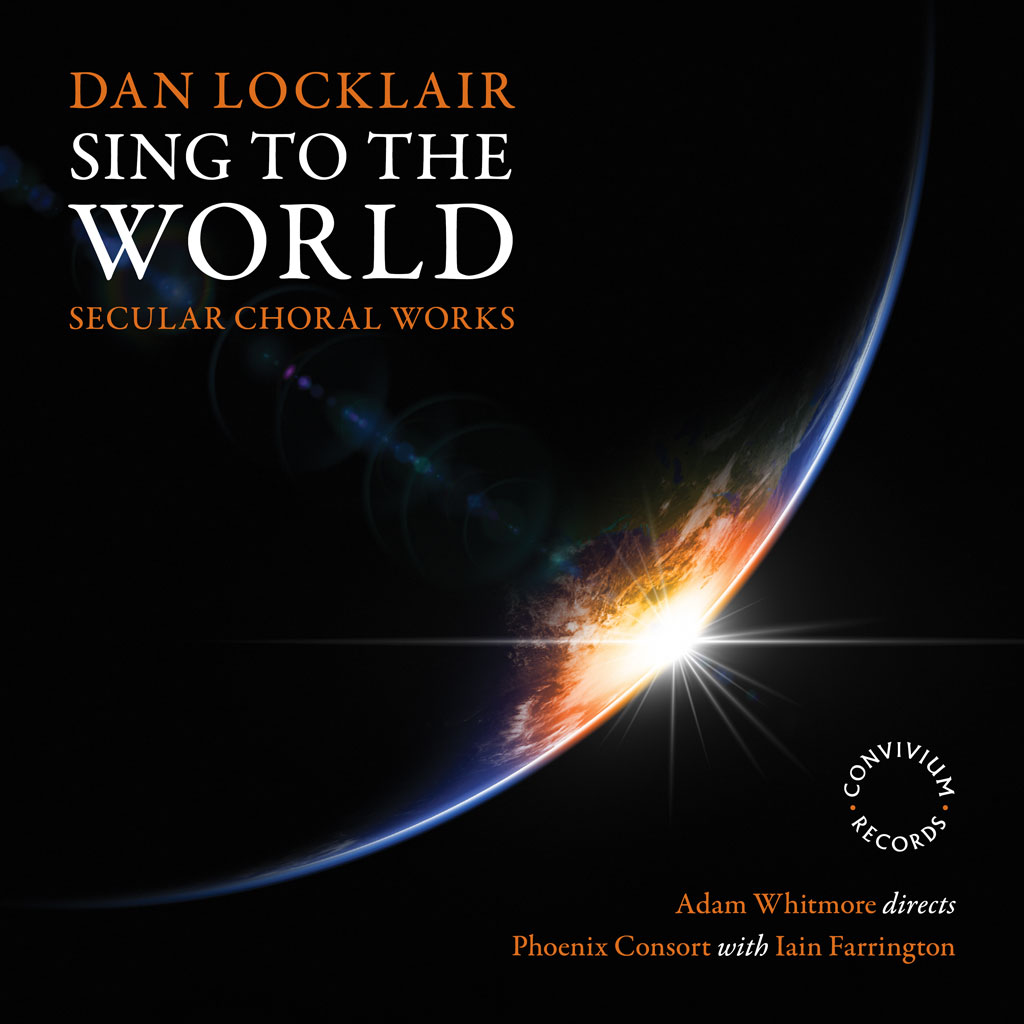
Following up on 2024’s excellent release From East to West, Sing to the World is something of a companion album from Winston-Salem, NC-based Dan Locklair and the Phoenix Consort: a survey of secular choral music from a versatile and engaging composer. This record serves as a showcase for what I’ve come to appreciate about Locklair’s works: evocative and well-chosen poetry, a sense of compositional voice that is in service of those texts, and an ingenious use of harmony and choral texture to achieve a unified whole. Throughout this record, we see how Locklair finds a way to write music that sits at the nexus of academic and affecting, utilizing a wide color palette. He makes use of neo-Shaker hymn Americana, atmospheric pseudo-mysticism, and full-bodied and harmonically wandering polychoral writing reminiscent of the Victorian greats or the Italian Renaissance masters. This veritable celebration of music – literally and metaphorically – is in deft hands with Adam Whitmore, the excellent singers of the Phoenix Consort, and pianist Iain Farrington.
It is easy to see why Sing to the World lends its title to the record: aside from being the longest work at 22 minutes, it also serves as an exemplar for Locklair’s gift of sensitive text setting and meticulously crafted choral writing. In the composer’s words, it is “a setting of five poems that, in one way or another, celebrate music.” Locklair deftly adopts a slightly different style for each movement, though his unique blend of harmonic development and modal inflection weaves a common thread. The first, third, and fifth movements draw heavily on what we might consider an “American” sound world: rooted in, but not restricted to, pentatonic melodic material. The central one, “An Hymn to the Morning,” even quotes the African American spiritual “My Lord! What a Morning.” The second and fourth movements make more creative use of the choral forces, with imitative sections for double choir of mixed and same voice variety. They call to mind the magisterial works of Charles Villiers Stanford or C. Hubert H. Parry, with their meandering harmonies, expressive range of dynamics and color, and attention to detail of text setting, articulation, and mood.
Two other major works anchor the album: The Lilacs Bloomed and changing perceptions & EPITAPH, both of a decidedly different tone musically and textually. The shorter of the two, The Lilacs Bloomed is quite compositionally taut, with unifying thematic material between the outer movements. In the opening movement, the choir comes in and out of unison, sitting above a piano part that swirls almost incessantly until suddenly dropping out, leaving the choir to hang on the text “and thought of him I love” in one of the most stunning moments of the album. As for changing perceptions & EPITAPH, rather than a dark and brooding piece, Locklair turns to a generally more meditative sound-world for this memorializing work. Again showing his penchant for architectural construction, changing perceptions opens with a kaleidoscopic piano ostinato with whistles and hums from the choir, and closes with a slightly transformed version of the same. Written to immediately follow a performance of changing perceptions, but after the audience has acknowledged it, “EPITAPH” intentionally breaks the mood with a jauntier, more tongue-in-cheek tone that brings levity at the end – much like “The Musical Ass” does in Sing to the World. It would be remiss, though, to overlook the standalone works, of which “Tapestries” and “Bond and Free” are strong contributions.
Locklair clearly expects an extremely high level of musicianship from his performers, and the Phoenix Consort rises to the task without question. The crystalline soprano section soars in many moments, buoyed (though occasionally overpowered) by the fervent tenors and basses, and the soloists in “An Hymn to the Morning” do a fine job, with special mention of Matthew Holloway-Strong’s lovely and dulcet tenor. Iain Farrington brings particularly wonderful sensitivity and gusto to Locklair’s expressive piano writing. Clearly, this young choir, formed just five years ago, has a bright future, as well as an accomplished present. We listeners are the beneficiaries who get to hear Locklair’s attractive music sung and played at such a high level.
Review written by:
Review published in:
Other reviews by this author:
Featured artists:
Featured composers:
Following up on 2024’s excellent release From East to West, Sing to the World is something of a companion album from Winston-Salem, NC-based Dan Locklair and the Phoenix Consort: a survey of secular choral music from a versatile and engaging composer. This record serves as a showcase for what I’ve come to appreciate about Locklair’s works: evocative and well-chosen poetry, a sense of compositional voice that is in service of those texts, and an ingenious use of harmony and choral texture to achieve a unified whole. Throughout this record, we see how Locklair finds a way to write music that sits at the nexus of academic and affecting, utilizing a wide color palette. He makes use of neo-Shaker hymn Americana, atmospheric pseudo-mysticism, and full-bodied and harmonically wandering polychoral writing reminiscent of the Victorian greats or the Italian Renaissance masters. This veritable celebration of music – literally and metaphorically – is in deft hands with Adam Whitmore, the excellent singers of the Phoenix Consort, and pianist Iain Farrington.
It is easy to see why Sing to the World lends its title to the record: aside from being the longest work at 22 minutes, it also serves as an exemplar for Locklair’s gift of sensitive text setting and meticulously crafted choral writing. In the composer’s words, it is “a setting of five poems that, in one way or another, celebrate music.” Locklair deftly adopts a slightly different style for each movement, though his unique blend of harmonic development and modal inflection weaves a common thread. The first, third, and fifth movements draw heavily on what we might consider an “American” sound world: rooted in, but not restricted to, pentatonic melodic material. The central one, “An Hymn to the Morning,” even quotes the African American spiritual “My Lord! What a Morning.” The second and fourth movements make more creative use of the choral forces, with imitative sections for double choir of mixed and same voice variety. They call to mind the magisterial works of Charles Villiers Stanford or C. Hubert H. Parry, with their meandering harmonies, expressive range of dynamics and color, and attention to detail of text setting, articulation, and mood.
Two other major works anchor the album: The Lilacs Bloomed and changing perceptions & EPITAPH, both of a decidedly different tone musically and textually. The shorter of the two, The Lilacs Bloomed is quite compositionally taut, with unifying thematic material between the outer movements. In the opening movement, the choir comes in and out of unison, sitting above a piano part that swirls almost incessantly until suddenly dropping out, leaving the choir to hang on the text “and thought of him I love” in one of the most stunning moments of the album. As for changing perceptions & EPITAPH, rather than a dark and brooding piece, Locklair turns to a generally more meditative sound-world for this memorializing work. Again showing his penchant for architectural construction, changing perceptions opens with a kaleidoscopic piano ostinato with whistles and hums from the choir, and closes with a slightly transformed version of the same. Written to immediately follow a performance of changing perceptions, but after the audience has acknowledged it, “EPITAPH” intentionally breaks the mood with a jauntier, more tongue-in-cheek tone that brings levity at the end – much like “The Musical Ass” does in Sing to the World. It would be remiss, though, to overlook the standalone works, of which “Tapestries” and “Bond and Free” are strong contributions.
Locklair clearly expects an extremely high level of musicianship from his performers, and the Phoenix Consort rises to the task without question. The crystalline soprano section soars in many moments, buoyed (though occasionally overpowered) by the fervent tenors and basses, and the soloists in “An Hymn to the Morning” do a fine job, with special mention of Matthew Holloway-Strong’s lovely and dulcet tenor. Iain Farrington brings particularly wonderful sensitivity and gusto to Locklair’s expressive piano writing. Clearly, this young choir, formed just five years ago, has a bright future, as well as an accomplished present. We listeners are the beneficiaries who get to hear Locklair’s attractive music sung and played at such a high level.
