
O Maria, virgo pia – Review by American Record Guide
“The mixed choir of 31 singers is impressively accomplished, especially in music that poses formidable difficulties in execution.”
15th July 2026
O Maria, virgo pia – Review by American Record Guide
“The mixed choir of 31 singers is impressively accomplished, especially in music that poses formidable difficulties in execution.”
15th July 2026
Listen or buy this album:
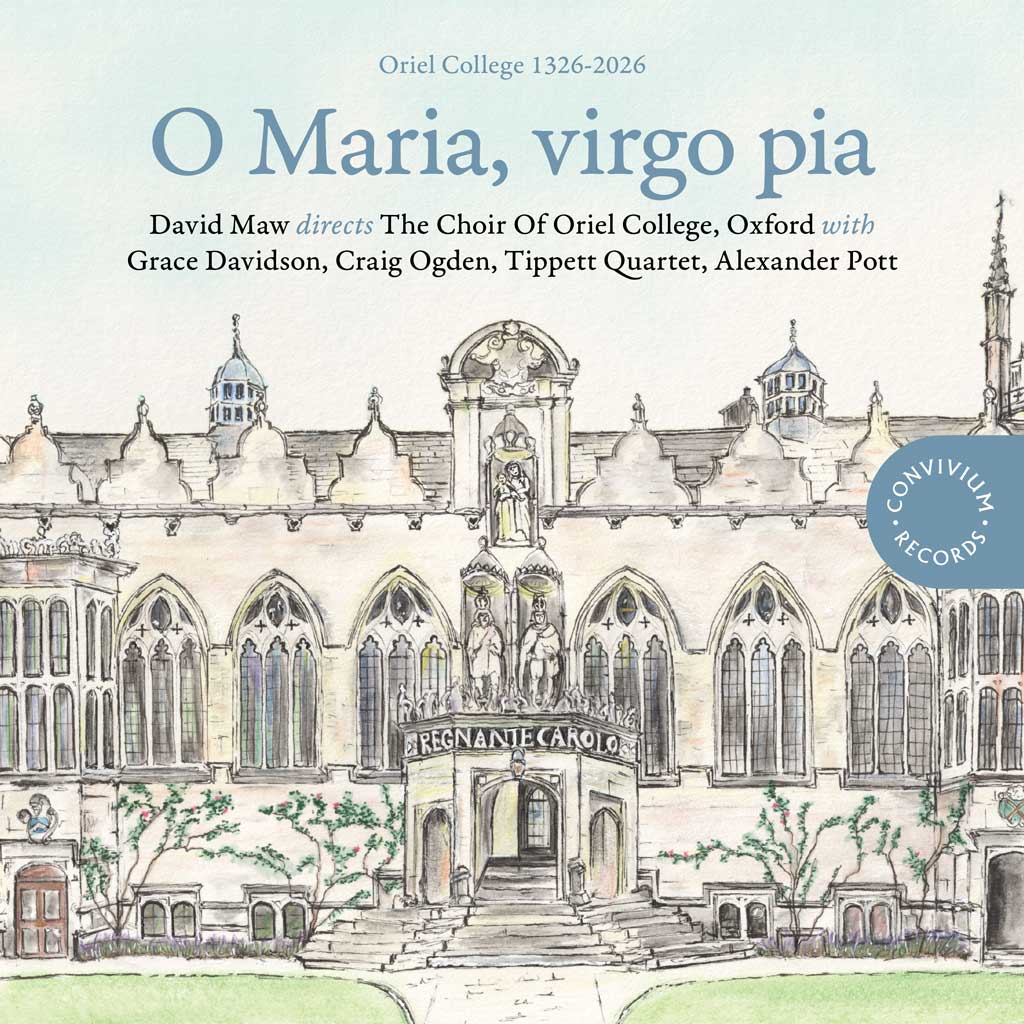
This recording marks the 700th anniversary of the founding of Oriel College, Oxford, in 1326. The college was founded as “the House of the Blessed Virgin Mary”, hence the title of the recording—the opening text of an anonymous 13th-Century liturgical sequence, sung according to its medieval sources. The program ends with a 2025 setting of the text by Cheryl Frances-Hoad to commemorate the 40th anniversary of the admission of women to the college.
As college music director David Maw points out in his notes, Oriel was not noted for music until recently. The college archives record the payment of a fee to an organist in the early years of the 16th Century, and provision for an organ in the renovated college chapel in the 19th, but little else for most of the college’s history. There was probably a good deal of informal music making. For example St John Henry Newman (fellow of the college from 1822 to 1830) was a keen amateur violinist and organized musical evenings with his friends. The establishment of an organ scholarship in the 1920s marked a change, but music undergraduates were not admitted until the 1950s. One of them, Herbert Chappell, is represented here with a stentorian setting of Psalm 150 written for the Oriel choir in 1958.
Probably the most familiar name among the composers here is Edmund H Fellowes (1870–1951), who studied theology as an undergraduate at Oriel and was ordained in 1894. He is still highly respected as a scholar and editor of choral music of the Tudor and Jacobean periods. He is hardly known as a composer, and the pieces on this program may help to explain why. In 1896 he supplicated for the degree of BMus (traditionally a composition degree) with a 4-movement cantata for voices and strings on verses from Newman’s Dream of Gerontius. That is included here as well as the Benedictus from his Morning and Evening Service in D. Much of it sounds like imitation Stanford—and rather prosaic imitation at that. The cantata ends with a proper academic fugue.
Most of the music dates from the first 2 decades of the 21st Century, all with connections to the college. Some of it was officially commissioned, some was more informally produced for the chapel choir. It would be unwieldy to discuss every piece. A variety of stylistic personalities come through. Some of the music is eclectic. Judith Bingham’s Oriel Service (Magnificat and Nunc Dimittis, 2015 & 2017) has a misty quality and harmonic flavor that could only have been derived from Herbert Howells. It may be impossible for a modern composer with Anglican connections to write a setting of ‘Hail, Gladdening Light’ (John Keble’s translation of an ancient Greek evening hymn) without the influence of Charles Wood’s 1919 setting for double choir. One can hear Wood in the background of the settings by David Briggs (2013) and John Caldwell (2011). Among the more unusual pieces is James Whitbourn’s 2019 setting of Newman’s poem ‘Solitude’ (1818) for choir and guitar. It was written in the year of guitarist Craig Ogden’s residency at the college as Distinguished Visiting Musician. He is the guitarist in this recording. The musical style in that piece is not at all churchly. Sung texts are given in the booklet.
The mixed choir of 31 singers is impressively accomplished, especially in music that poses formidable difficulties in execution. That would include the added-note intonation thickets of pieces like Mark R. Taylor’s ‘Say Not the Struggle Naught Availeth’ (2010) to a poem by Arthur Hugh Clough and the vocal gymnastics of David Maw’s Latin Magnificat (2017). Any music lover with a connection to Oriel College will want to acquire this disc—as will other readers with an interest in contemporary English church music.
Review written by:
Review published in:
Other reviews by this author:
No other reviews found
Featured artists:
Featured composers:
This recording marks the 700th anniversary of the founding of Oriel College, Oxford, in 1326. The college was founded as “the House of the Blessed Virgin Mary”, hence the title of the recording—the opening text of an anonymous 13th-Century liturgical sequence, sung according to its medieval sources. The program ends with a 2025 setting of the text by Cheryl Frances-Hoad to commemorate the 40th anniversary of the admission of women to the college.
As college music director David Maw points out in his notes, Oriel was not noted for music until recently. The college archives record the payment of a fee to an organist in the early years of the 16th Century, and provision for an organ in the renovated college chapel in the 19th, but little else for most of the college’s history. There was probably a good deal of informal music making. For example St John Henry Newman (fellow of the college from 1822 to 1830) was a keen amateur violinist and organized musical evenings with his friends. The establishment of an organ scholarship in the 1920s marked a change, but music undergraduates were not admitted until the 1950s. One of them, Herbert Chappell, is represented here with a stentorian setting of Psalm 150 written for the Oriel choir in 1958.
Probably the most familiar name among the composers here is Edmund H Fellowes (1870–1951), who studied theology as an undergraduate at Oriel and was ordained in 1894. He is still highly respected as a scholar and editor of choral music of the Tudor and Jacobean periods. He is hardly known as a composer, and the pieces on this program may help to explain why. In 1896 he supplicated for the degree of BMus (traditionally a composition degree) with a 4-movement cantata for voices and strings on verses from Newman’s Dream of Gerontius. That is included here as well as the Benedictus from his Morning and Evening Service in D. Much of it sounds like imitation Stanford—and rather prosaic imitation at that. The cantata ends with a proper academic fugue.
Most of the music dates from the first 2 decades of the 21st Century, all with connections to the college. Some of it was officially commissioned, some was more informally produced for the chapel choir. It would be unwieldy to discuss every piece. A variety of stylistic personalities come through. Some of the music is eclectic. Judith Bingham’s Oriel Service (Magnificat and Nunc Dimittis, 2015 & 2017) has a misty quality and harmonic flavor that could only have been derived from Herbert Howells. It may be impossible for a modern composer with Anglican connections to write a setting of ‘Hail, Gladdening Light’ (John Keble’s translation of an ancient Greek evening hymn) without the influence of Charles Wood’s 1919 setting for double choir. One can hear Wood in the background of the settings by David Briggs (2013) and John Caldwell (2011). Among the more unusual pieces is James Whitbourn’s 2019 setting of Newman’s poem ‘Solitude’ (1818) for choir and guitar. It was written in the year of guitarist Craig Ogden’s residency at the college as Distinguished Visiting Musician. He is the guitarist in this recording. The musical style in that piece is not at all churchly. Sung texts are given in the booklet.
The mixed choir of 31 singers is impressively accomplished, especially in music that poses formidable difficulties in execution. That would include the added-note intonation thickets of pieces like Mark R. Taylor’s ‘Say Not the Struggle Naught Availeth’ (2010) to a poem by Arthur Hugh Clough and the vocal gymnastics of David Maw’s Latin Magnificat (2017). Any music lover with a connection to Oriel College will want to acquire this disc—as will other readers with an interest in contemporary English church music.
Review written by:
Review published in:
Other reviews by this author:
No other reviews found
