
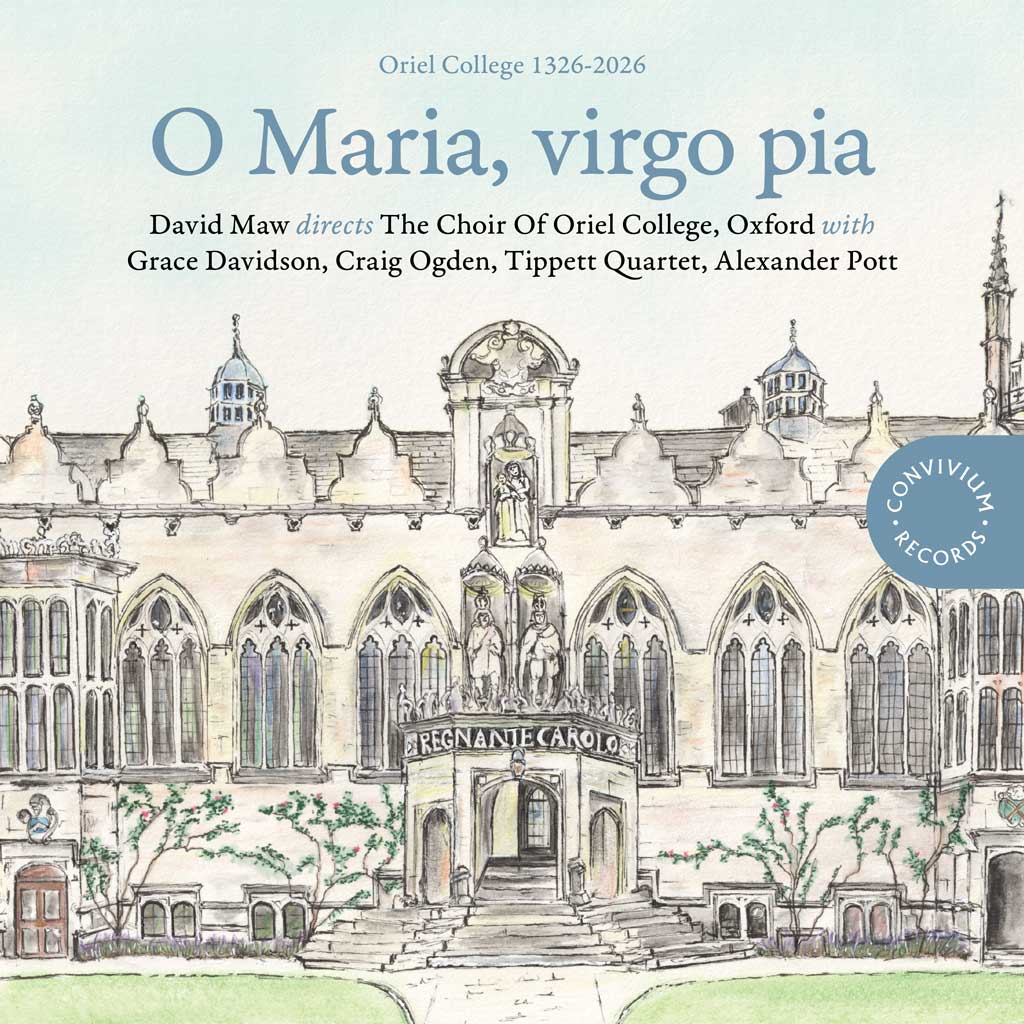
O Maria, virgo pia – Review by Laudate Magazine
“This varied and interesting CD celebrates the 700th Anniversary of Oriel College... Congratulations to all the participants, including the impressive Oriel College choir.”
27th January 2026
O Maria, virgo pia – Review by Laudate Magazine
“This varied and interesting CD celebrates the 700th Anniversary of Oriel College... Congratulations to all the participants, including the impressive Oriel College choir.”
27th January 2026
Listen or buy this album:
This varied and interesting CD celebrates the 700th Anniversary of Oriel College, and its increasingly vibrant musical tradition. Congratulations to all the participants, including the impressive Oriel College choir.
The founder of Oriel was Edward II (1284–1327), who reigned from 1307 until deposition early in the year of his death. Edward has tended to be thought of as a ‘bad king’, but the picture is not quite so simple. For example, he ‘supported the expansion of the universities during his reign, establishing King’s Hall in Cambridge to promote training in religious and civil law, Oriel College in Oxford and a shortlived university in Dublin’.
Appropriately most of the composers and performers represented on this CD are or have been members of Oriel College. David Maw is Fellow and Director of Music, and the choir is drawn from the student body. Craig Ogden has been one of the college’s Distinguished Visiting Musicians.
Of particular fascination at least to myself – as one who has worked extensively on Tudor church music – are the two items by Edmund Fellowes (1870–1951), one of the early editors of such music, to whom we still owe a great debt today.
Fellowes’s Hymn of the Third Choir of Angelicals is a cantata in four movements, with text from The Dream of Gerontius by former chaplain and fellow John Henry Newman, submitted for the degree of BMus in the mid 1890s. The work is much more than a mere ‘exercise’, although the concluding fugal movement must have ticked certain academic boxes. (Do not expect, in view of the date, to hear any musical links between this cantata and Elgar’s later oratorio.)
Fellowes’s Benedictus (part of a service in D composed when he was precentor of Bristol Cathedral at the end of the 1890s) is, as David Maw writes in his programme note, ‘less ambitious technically than the earlier cantata but shar[ing] its gifts for melodic vitality and clearly defined mood’.
The CD begins and ends with its title tracks: ‘O Maria, virgo pia’ – in a cappella plainsong (track 1) and in a setting by Cheryl Frances-Hoad (track 18) – appropriately for a college founded in honour of the Blessed Virgin Mary. Mary’s song ‘Magnificat’ is heard twice, first in an Evening Service pairing with ‘Nunc Dimittis’ (the ‘Oriel Service’) by Judith Bingham, and second as a stand-alone work by David Maw. This latter is, to my mind, particularly appealing: there is great freshness and luminosity of melody, texture and harmony. The opening vocal phrase for soprano solo (Grace Davidson) – ‘Magnificat’ with melisma on ‘Ma-’ – is heard various times in various guises, an interesting interpretation of the widely observed ‘soprano = Mary’ convention. Maw’s ‘I sing of a maiden’, a medieval lyric much beloved of 20th- and 21st-century composers, extends the Marian theme.
The remaining tracks will all reward attentive listening. Very distinctive is ‘Solitude’, a setting (2019) by James Whitbourn (d. 2024) of a poem that John Henry Newman wrote as a student in 1818 (‘There is in stillness oft a magic power / To calm the breast, when struggling passions lower’). It was composed for Craig Ogden (guitar) during the latter’s residency at Oriel and soloist.
Several items have been composed in the past 15 years or so for use in the college, all full of character: Phillip Cooke’s ‘The Glory of Zion’; Hugh Collins Rice’s ‘Verbum caro’ and Mark R. Taylor’s ‘Say not the struggle nought availeth’ (poem by Arthur Hugh Clough, fellow of Oriel in the 1840s). Herbert Chappell was the college’s second music graduate in 1956: his ‘Psalm 150’, for the Chapel Choir, dates from 1958.
Listeners also have two contrasting a cappella settings of an ancient text, which in the translation by John Keble (fellow from 1811 to 1823) ‘serves in Oriel chapel as an unofficial college anthem’. As Track 5 we hear David Briggs’s vigorous setting of this text (‘Hail, gladdening light’), while Professor John Caldwell’s very different and less expansive setting of the Greek text (‘Phos hilarion’) is at Track 12: in a way it’s a pity that the two pieces were not placed side-by-side.
Altogether this is a project that should appeal immediately and strongly to anyone with a connection to Oriel College. However, I recommend it also for a much wider circulation among those who love church music composed between the end of the 19th century and the last ten years.
Review written by:
Review published in:
Other reviews by this author:
Featured artists:
Featured composers:
This varied and interesting CD celebrates the 700th Anniversary of Oriel College, and its increasingly vibrant musical tradition. Congratulations to all the participants, including the impressive Oriel College choir.
The founder of Oriel was Edward II (1284–1327), who reigned from 1307 until deposition early in the year of his death. Edward has tended to be thought of as a ‘bad king’, but the picture is not quite so simple. For example, he ‘supported the expansion of the universities during his reign, establishing King’s Hall in Cambridge to promote training in religious and civil law, Oriel College in Oxford and a shortlived university in Dublin’.
Appropriately most of the composers and performers represented on this CD are or have been members of Oriel College. David Maw is Fellow and Director of Music, and the choir is drawn from the student body. Craig Ogden has been one of the college’s Distinguished Visiting Musicians.
Of particular fascination at least to myself – as one who has worked extensively on Tudor church music – are the two items by Edmund Fellowes (1870–1951), one of the early editors of such music, to whom we still owe a great debt today.
Fellowes’s Hymn of the Third Choir of Angelicals is a cantata in four movements, with text from The Dream of Gerontius by former chaplain and fellow John Henry Newman, submitted for the degree of BMus in the mid 1890s. The work is much more than a mere ‘exercise’, although the concluding fugal movement must have ticked certain academic boxes. (Do not expect, in view of the date, to hear any musical links between this cantata and Elgar’s later oratorio.)
Fellowes’s Benedictus (part of a service in D composed when he was precentor of Bristol Cathedral at the end of the 1890s) is, as David Maw writes in his programme note, ‘less ambitious technically than the earlier cantata but shar[ing] its gifts for melodic vitality and clearly defined mood’.
The CD begins and ends with its title tracks: ‘O Maria, virgo pia’ – in a cappella plainsong (track 1) and in a setting by Cheryl Frances-Hoad (track 18) – appropriately for a college founded in honour of the Blessed Virgin Mary. Mary’s song ‘Magnificat’ is heard twice, first in an Evening Service pairing with ‘Nunc Dimittis’ (the ‘Oriel Service’) by Judith Bingham, and second as a stand-alone work by David Maw. This latter is, to my mind, particularly appealing: there is great freshness and luminosity of melody, texture and harmony. The opening vocal phrase for soprano solo (Grace Davidson) – ‘Magnificat’ with melisma on ‘Ma-’ – is heard various times in various guises, an interesting interpretation of the widely observed ‘soprano = Mary’ convention. Maw’s ‘I sing of a maiden’, a medieval lyric much beloved of 20th- and 21st-century composers, extends the Marian theme.
The remaining tracks will all reward attentive listening. Very distinctive is ‘Solitude’, a setting (2019) by James Whitbourn (d. 2024) of a poem that John Henry Newman wrote as a student in 1818 (‘There is in stillness oft a magic power / To calm the breast, when struggling passions lower’). It was composed for Craig Ogden (guitar) during the latter’s residency at Oriel and soloist.
Several items have been composed in the past 15 years or so for use in the college, all full of character: Phillip Cooke’s ‘The Glory of Zion’; Hugh Collins Rice’s ‘Verbum caro’ and Mark R. Taylor’s ‘Say not the struggle nought availeth’ (poem by Arthur Hugh Clough, fellow of Oriel in the 1840s). Herbert Chappell was the college’s second music graduate in 1956: his ‘Psalm 150’, for the Chapel Choir, dates from 1958.
Listeners also have two contrasting a cappella settings of an ancient text, which in the translation by John Keble (fellow from 1811 to 1823) ‘serves in Oriel chapel as an unofficial college anthem’. As Track 5 we hear David Briggs’s vigorous setting of this text (‘Hail, gladdening light’), while Professor John Caldwell’s very different and less expansive setting of the Greek text (‘Phos hilarion’) is at Track 12: in a way it’s a pity that the two pieces were not placed side-by-side.
Altogether this is a project that should appeal immediately and strongly to anyone with a connection to Oriel College. However, I recommend it also for a much wider circulation among those who love church music composed between the end of the 19th century and the last ten years.
