
Leaps in Time – Article by International Piano
“This album is a reminder that even when transporting us to the past, music is also showing us the present and imagining the future.”
18th September 2026
Leaps in Time – Article by International Piano
“This album is a reminder that even when transporting us to the past, music is also showing us the present and imagining the future.”
18th September 2026
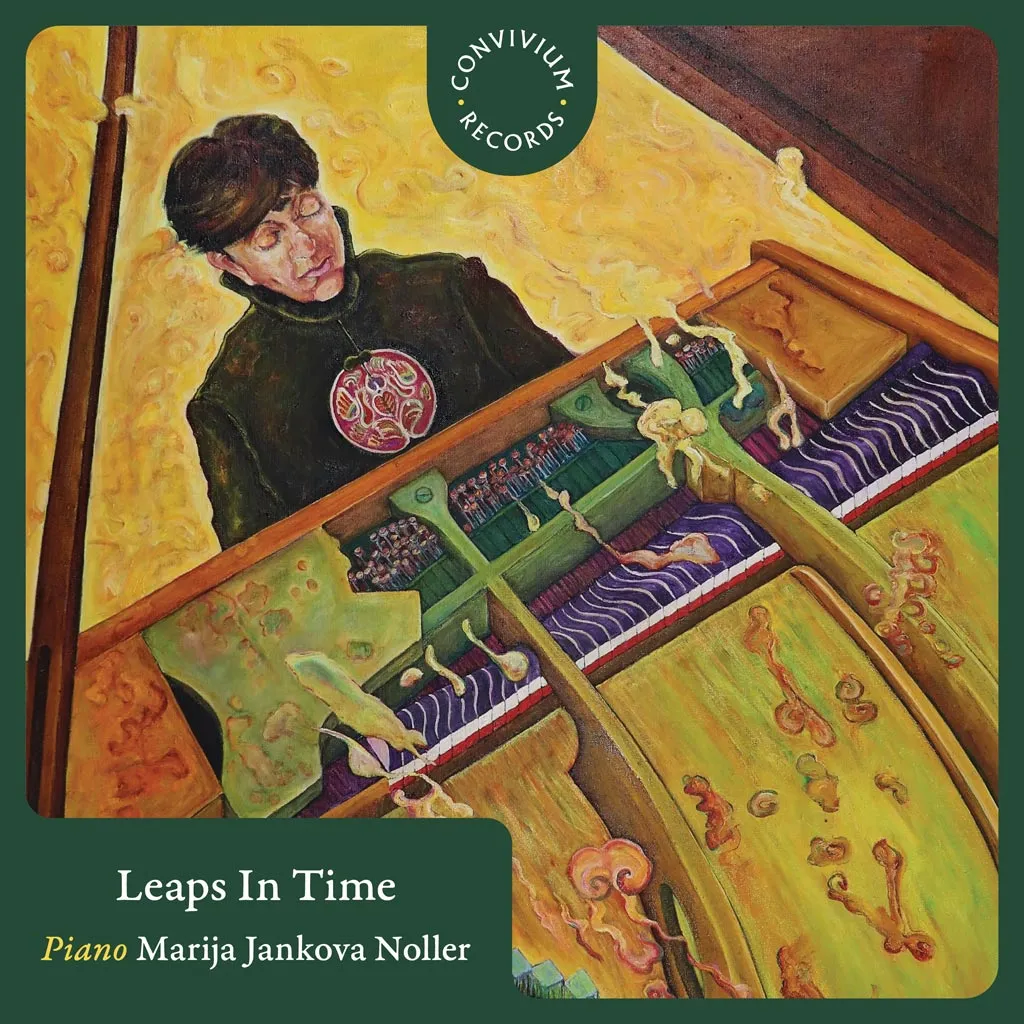
Listen or buy this album:
How can the music of the past help us understand the music of the present?
Can the avant-garde sounds of today shed new light on music from centuries ago we thought we knew? To what degree do all composers carry traces of their own musical history – the sonic DNA of all our countries, our continents and our species?
Pianist Marija Jankova Noller has spent her career exploring these questions, as well as the faultlines, convergences and echoes that criss-cross European music, a process that delivered her remarkable first album for Convivium Records in 2024, European Soundscapes. That album constituted a journey across the continent and across time, uniting piano music by 16 composers from Joseph Haydn to George Benjamin.
Noller’s new album for Convivium takes listeners on a further journey of discovery by homing in on a specific area of European geography. Leaps in Time pairs piano works by Bulgarian and Italian composers across three generations, emphasising the significant shifts in compositional style that took root over the course of a century. But it also goes further, drilling into the composer Luciano Berio’s idea that all music carries traces of the past’ by including works that reimagine or respond to music written centuries earlier. The result is a rich dialogue between tradition and innovation.
The album’s first pairing is of Bulgarian composer Pancho Vladigerov (1899-1978) with his Italian counterpart Luigi Dallapiccola (1904-75). It is a combination with added significance for Noller, given Vladigerov was a family friend since childhood. The composer’s Rhapsody Vardar of 1922 consciously appropriates a 19th-century style to argue the case for Bulgaria as a proud European state (it only achieved full independence in 1908).
Vladigerov’s work has added pertinence when heard against Dallapiccola’s own retrospective Sonatina canonica su ‘Capricci’ di Niccolò Paganini, written in 1943 after nationalistic pride had driven Italy towards a fascism that was beginning to crumble.
Dallapiccola’s piece imagines the world of the great violinist-composer Paganini through the lens not just of war-ravaged 1940s Italy, but of the aesthetics of great composers who also refracted the Genoa-born virtuosos material in their own work – Liszt, Schumann and Brahms. The result is Paganini double-filtered and celebrated in a work whose surface joy and effervescence conceal rigorous contrapuntal structures.
The next generation is represented by pupils of Vladigerov and Dallapiccola: Julia Tsenova (1948-2010) and Luciano Berio (1925-2003). Both wrote in an era that ostensibly sought to cast off tradition.
Tsenova’s Triptych (1996), like a cleansing ritual complete with the evocation of bells, feels like an attempt to step out of time altogether, while Berios Six Encores (1965-90) brings us vivid images of earthly phenomena lined with epigrammatic mystery.
And so we come to works from the postmodern era. In Sei Preludi romantici, Marino Baratello (born 1951) chases the shadow of Liszt in order to urge his listeners to be ‘present’ in the musical moment.
Vladimir Djambazov (born 1954) uses ancient Bulgarian dance rhythms in Rapido e secco, compounding them with complex add-ons before rendering them almost inaudible behind the driving pulse of our prevailing popular culture, to thrilling effect.
Music may transcend time, and yet fundamentally music is time. Perhaps the one composer who understood the intersection of aesthetics and progress more than any other, who can make sense of the cross-references, reactions and influences explored on the rest of this album, is Alfred Schnittke. His Hommage à Stravinsky, Prokofieff et Shostakovich serves as the album’s epilogue, and as the album’s booklet note puts it, the work sets a fundamental question mark over temporality itself.
Noller takes on a particular challenge in Schnittke’s piece, playing all six hands herself, recorded separately and drawn back together – a pianist in conversation with her own past. The pianist, who is a laureate of several international competitions and studied in Sofia, has the technique to pull that off and to master the programme’s huge range of stylistic challenges. The album captures her in pristine sound at the West Road Concert Hall, University of Cambridge.
Leaps in Time is not only about the piano or piano technique. It is also a sincere personal invitation to join Noller on a journey of discovery through a thoughtfully conceived sequence of music from countries with which she has a deep connection, from some of the most turbulent periods in European history.
More than anything, this album is a reminder that even when transporting us to the past, music is also showing us the present and imagining the future.
Review written by:
Review published in:
Other reviews by this author:
No other reviews found
Featured artists:
Featured composers:
How can the music of the past help us understand the music of the present?
Can the avant-garde sounds of today shed new light on music from centuries ago we thought we knew? To what degree do all composers carry traces of their own musical history – the sonic DNA of all our countries, our continents and our species?
Pianist Marija Jankova Noller has spent her career exploring these questions, as well as the faultlines, convergences and echoes that criss-cross European music, a process that delivered her remarkable first album for Convivium Records in 2024, European Soundscapes. That album constituted a journey across the continent and across time, uniting piano music by 16 composers from Joseph Haydn to George Benjamin.
Noller’s new album for Convivium takes listeners on a further journey of discovery by homing in on a specific area of European geography. Leaps in Time pairs piano works by Bulgarian and Italian composers across three generations, emphasising the significant shifts in compositional style that took root over the course of a century. But it also goes further, drilling into the composer Luciano Berio’s idea that all music carries traces of the past’ by including works that reimagine or respond to music written centuries earlier. The result is a rich dialogue between tradition and innovation.
The album’s first pairing is of Bulgarian composer Pancho Vladigerov (1899-1978) with his Italian counterpart Luigi Dallapiccola (1904-75). It is a combination with added significance for Noller, given Vladigerov was a family friend since childhood. The composer’s Rhapsody Vardar of 1922 consciously appropriates a 19th-century style to argue the case for Bulgaria as a proud European state (it only achieved full independence in 1908).
Vladigerov’s work has added pertinence when heard against Dallapiccola’s own retrospective Sonatina canonica su ‘Capricci’ di Niccolò Paganini, written in 1943 after nationalistic pride had driven Italy towards a fascism that was beginning to crumble.
Dallapiccola’s piece imagines the world of the great violinist-composer Paganini through the lens not just of war-ravaged 1940s Italy, but of the aesthetics of great composers who also refracted the Genoa-born virtuosos material in their own work – Liszt, Schumann and Brahms. The result is Paganini double-filtered and celebrated in a work whose surface joy and effervescence conceal rigorous contrapuntal structures.
The next generation is represented by pupils of Vladigerov and Dallapiccola: Julia Tsenova (1948-2010) and Luciano Berio (1925-2003). Both wrote in an era that ostensibly sought to cast off tradition.
Tsenova’s Triptych (1996), like a cleansing ritual complete with the evocation of bells, feels like an attempt to step out of time altogether, while Berios Six Encores (1965-90) brings us vivid images of earthly phenomena lined with epigrammatic mystery.
And so we come to works from the postmodern era. In Sei Preludi romantici, Marino Baratello (born 1951) chases the shadow of Liszt in order to urge his listeners to be ‘present’ in the musical moment.
Vladimir Djambazov (born 1954) uses ancient Bulgarian dance rhythms in Rapido e secco, compounding them with complex add-ons before rendering them almost inaudible behind the driving pulse of our prevailing popular culture, to thrilling effect.
Music may transcend time, and yet fundamentally music is time. Perhaps the one composer who understood the intersection of aesthetics and progress more than any other, who can make sense of the cross-references, reactions and influences explored on the rest of this album, is Alfred Schnittke. His Hommage à Stravinsky, Prokofieff et Shostakovich serves as the album’s epilogue, and as the album’s booklet note puts it, the work sets a fundamental question mark over temporality itself.
Noller takes on a particular challenge in Schnittke’s piece, playing all six hands herself, recorded separately and drawn back together – a pianist in conversation with her own past. The pianist, who is a laureate of several international competitions and studied in Sofia, has the technique to pull that off and to master the programme’s huge range of stylistic challenges. The album captures her in pristine sound at the West Road Concert Hall, University of Cambridge.
Leaps in Time is not only about the piano or piano technique. It is also a sincere personal invitation to join Noller on a journey of discovery through a thoughtfully conceived sequence of music from countries with which she has a deep connection, from some of the most turbulent periods in European history.
More than anything, this album is a reminder that even when transporting us to the past, music is also showing us the present and imagining the future.
Review written by:
Review published in:
Other reviews by this author:
No other reviews found
