
Gerald Finzi: Three Sacred Anthems – Review by Laudate Magazine
"Robinson College singers are in very good voice, and are well supported by the strings and organist."
20th May 2026
Gerald Finzi: Three Sacred Anthems – Review by Laudate Magazine
"Robinson College singers are in very good voice, and are well supported by the strings and organist."
20th May 2026
Listen or buy this album:
Recently I tried to interest someone in a particular CD, but she had no means of playing CDs. Instead, she listened to recorded music online. Convivium Records have recognised what is clearly a trend, and have issued several recordings that are available only online. As these involve less music than the average CD, the term ‘Digital E[xtended] P[lay]’ seems very appropriate.
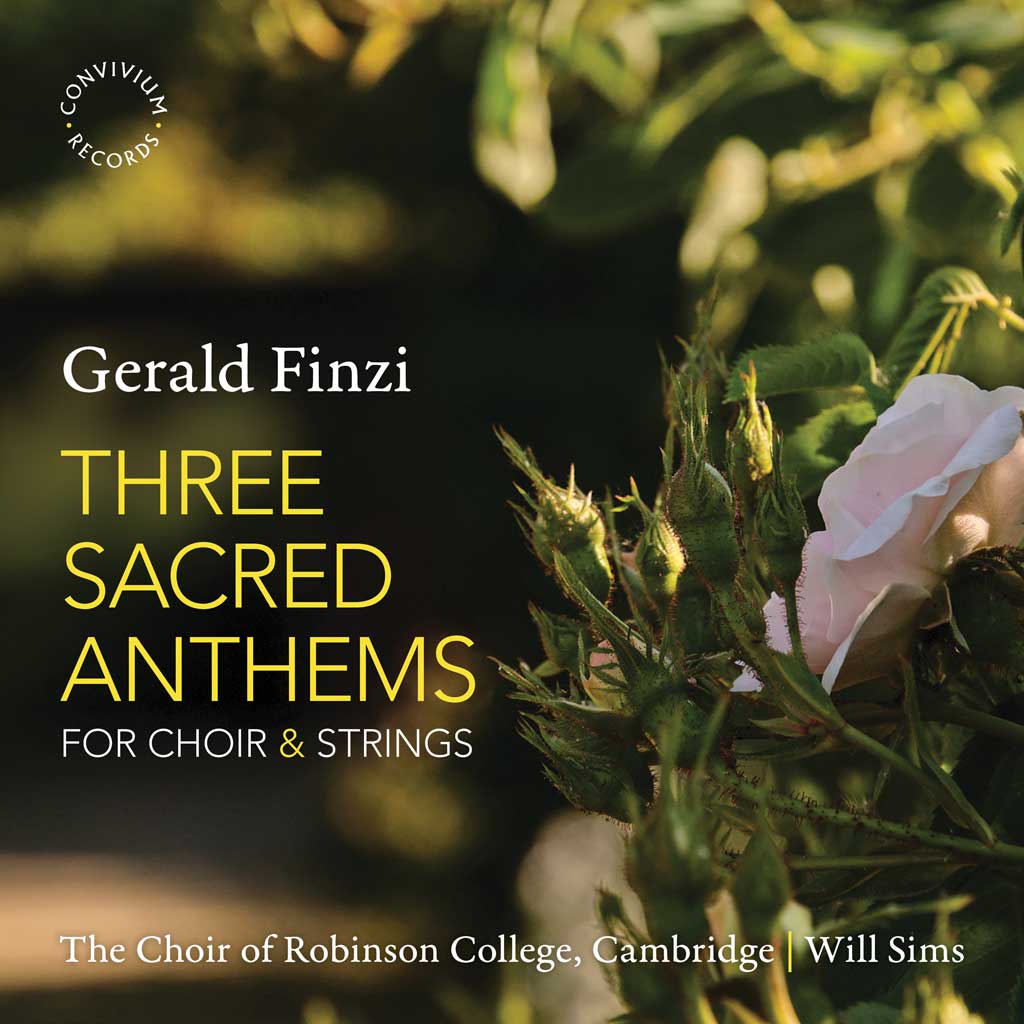
CR131 is a digital EP, to be released in June, which last 15 minutes and comprises three very fine sacred anthems by Gerald Finzi (1901–56). It is highly recommended, especially for those who appreciate Finzi’s wonderful sensitivity to word-setting, his love of 17th-century texts, and the distinctive Englishness of his voice as a composer.
‘My Lovely One’ was composed for the wedding of Finzi’s sister in 1946 and subtitled ‘Marriage Anthem’. It has text by Edward Taylor (1642–1729), an American Congregational minister, from his Preparatory Meditations before my Approach to the Lords Supper… The stanza used by Finzi is the final one from Meditation 12, whose point of departure is Isaiah 63: 1 (‘Who is this that cometh from Edom, with dyed garments from Bozrah…’), and which bears also the title ‘Glorious in his Apparell (1685)’. The final stanza clearly addresses Christ, and certainly doesn’t appear to be part of a wedding piece – despite Christ’s referring to himself in the Gospels as the Bridegroom. (see footnote 1)
The six-line text of ‘My Lovely One’ has generated a sensitive setting lasting about two-and-a-half minutes, although apparently one chorister felt less than entranced with its ‘yearning, almost haunting opening’ (Programme Note).
Most church musicians will have sung, played or heard the second anthem, ‘God is Gone Up with a Merry Noise’ (1951), a glorious Ascensiontide piece usually performed with choir and organ. The text is again from Taylor – in this case from Meditation 20 on Philippians 2: 9 (‘Wherefore God also hath highly exalted him’). Finzi has used the fifth of seven stanzas, which cries out for musical setting, not least with its wonderful ‘sounding Trumpets melodies’.
The version here has organ and strings accompanying. I understand that there is a version with strings, which I have never come across. Here we have organ and strings beautifully complementing each other. While Peter Hayward is listed as arranger ‘(arr. Peter Hayward)’ for the two other anthems, his role in ‘God is Gone up’ is uncertain.
The third anthem, after ‘God is Gone Up’ with accompaniment for organ and strings, returns to strings only. ‘Welcome Sweet and Sacred Feast’ is the longest piece at seven-and-a-half minutes, which may rather restrict its use liturgically. The text is from The Holy Communion by the Welsh physician and poet Henry Vaughan (1621–95), (see footnote 2) but omitting a passage in the middle. CR 131 is worth downloading if only for this beautiful example of Finzi’s response to texts dating back to a much earlier phase in church history.
Robinson College singers are in very good voice, and are well supported by the strings and organist. Do follow up this excellent new EP. You can pre-order before the June release if you wish.
1. As in Mark 2: 19–20. The first stanza of Taylor’s Meditation begins: ‘This Quest rapt at my Eares broad golden Doores / Who’s this that comes from Edom in this shine / In Died Robes from Bozrah?’. The text in full may be viewed by searching for ‘Taylor Preparatory Mediations University of Virginia Library’. (The internet link is too long to quote!).
2. It is part of a collection entitled Silex Scintillans, or Sacred Poems, first published in 1650. The significance of the word ‘silex’ and indeed of Vaughan’s self-designation ‘Silurist’ are too involved to explain here, but internet searches will provide relevant information.
Review written by:
Review published in:
Other reviews by this author:
Recently I tried to interest someone in a particular CD, but she had no means of playing CDs. Instead, she listened to recorded music online. Convivium Records have recognised what is clearly a trend, and have issued several recordings that are available only online. As these involve less music than the average CD, the term ‘Digital E[xtended] P[lay]’ seems very appropriate.
CR131 is a digital EP, to be released in June, which last 15 minutes and comprises three very fine sacred anthems by Gerald Finzi (1901–56). It is highly recommended, especially for those who appreciate Finzi’s wonderful sensitivity to word-setting, his love of 17th-century texts, and the distinctive Englishness of his voice as a composer.
‘My Lovely One’ was composed for the wedding of Finzi’s sister in 1946 and subtitled ‘Marriage Anthem’. It has text by Edward Taylor (1642–1729), an American Congregational minister, from his Preparatory Meditations before my Approach to the Lords Supper… The stanza used by Finzi is the final one from Meditation 12, whose point of departure is Isaiah 63: 1 (‘Who is this that cometh from Edom, with dyed garments from Bozrah…’), and which bears also the title ‘Glorious in his Apparell (1685)’. The final stanza clearly addresses Christ, and certainly doesn’t appear to be part of a wedding piece – despite Christ’s referring to himself in the Gospels as the Bridegroom. (see footnote 1)
The six-line text of ‘My Lovely One’ has generated a sensitive setting lasting about two-and-a-half minutes, although apparently one chorister felt less than entranced with its ‘yearning, almost haunting opening’ (Programme Note).
Most church musicians will have sung, played or heard the second anthem, ‘God is Gone Up with a Merry Noise’ (1951), a glorious Ascensiontide piece usually performed with choir and organ. The text is again from Taylor – in this case from Meditation 20 on Philippians 2: 9 (‘Wherefore God also hath highly exalted him’). Finzi has used the fifth of seven stanzas, which cries out for musical setting, not least with its wonderful ‘sounding Trumpets melodies’.
The version here has organ and strings accompanying. I understand that there is a version with strings, which I have never come across. Here we have organ and strings beautifully complementing each other. While Peter Hayward is listed as arranger ‘(arr. Peter Hayward)’ for the two other anthems, his role in ‘God is Gone up’ is uncertain.
The third anthem, after ‘God is Gone Up’ with accompaniment for organ and strings, returns to strings only. ‘Welcome Sweet and Sacred Feast’ is the longest piece at seven-and-a-half minutes, which may rather restrict its use liturgically. The text is from The Holy Communion by the Welsh physician and poet Henry Vaughan (1621–95), (see footnote 2) but omitting a passage in the middle. CR 131 is worth downloading if only for this beautiful example of Finzi’s response to texts dating back to a much earlier phase in church history.
Robinson College singers are in very good voice, and are well supported by the strings and organist. Do follow up this excellent new EP. You can pre-order before the June release if you wish.
1. As in Mark 2: 19–20. The first stanza of Taylor’s Meditation begins: ‘This Quest rapt at my Eares broad golden Doores / Who’s this that comes from Edom in this shine / In Died Robes from Bozrah?’. The text in full may be viewed by searching for ‘Taylor Preparatory Mediations University of Virginia Library’. (The internet link is too long to quote!).
2. It is part of a collection entitled Silex Scintillans, or Sacred Poems, first published in 1650. The significance of the word ‘silex’ and indeed of Vaughan’s self-designation ‘Silurist’ are too involved to explain here, but internet searches will provide relevant information.
