
Carson Cooman: Elephant & Castle – Review by Fanfare
"[Carson Cooman's] own distinctive voice, musical assurance, and relaxed mastery comes through very clearly."
28th May 2026
Carson Cooman: Elephant & Castle – Review by Fanfare
"[Carson Cooman's] own distinctive voice, musical assurance, and relaxed mastery comes through very clearly."
28th May 2026
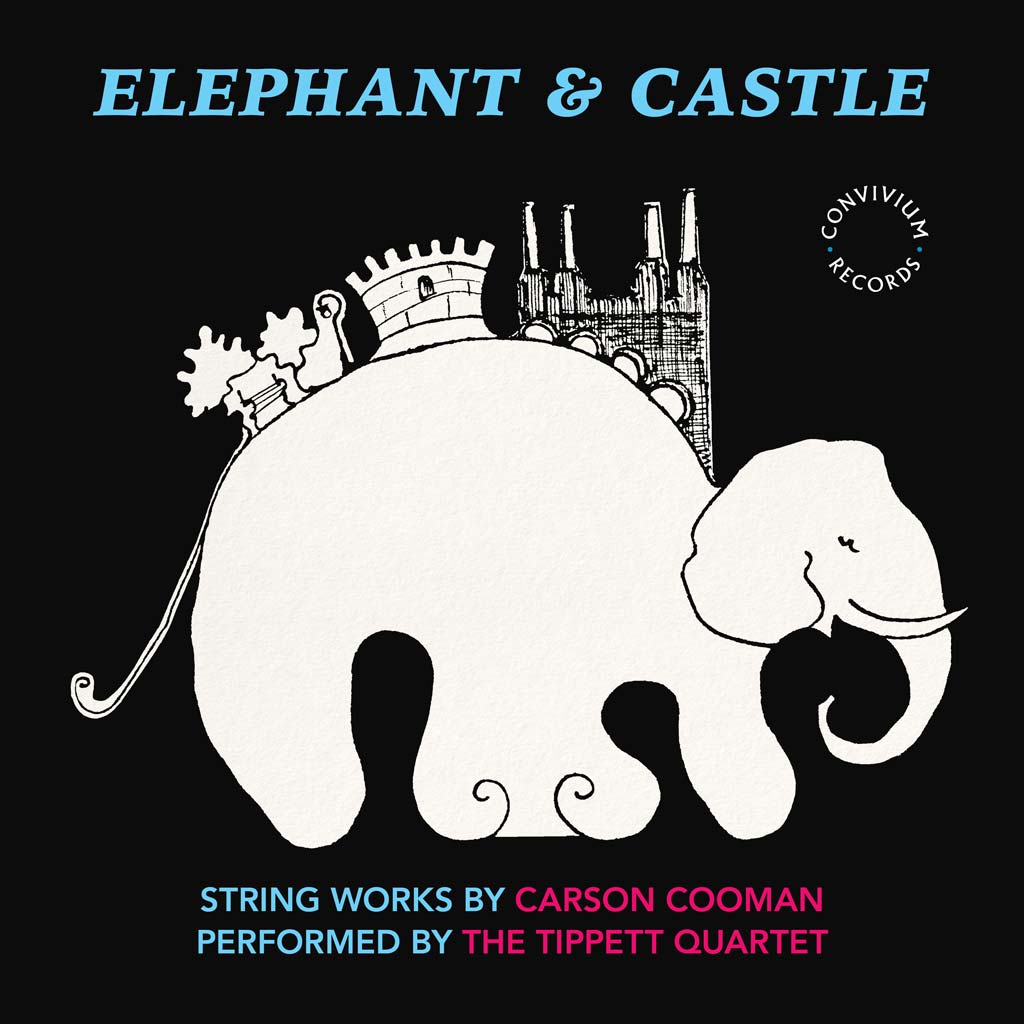
Listen or buy this album:
I’ll begin with highlights from the booklet bio of the highly accomplished American composer Carson Cooman (b. 1982), not so much because his music is new to me but for some staggering statistics. We are told that he “has a catalogue of hundreds of works in many forms … His music has been performed on all six inhabited continents in venues that range from the stage of Carnegie Hall to the basket of a hot-air balloon.” Of the 40 CDs that feature his music, 25 are completely devoted to Cooman. Finally, he is an organist who specializes in playing and commissioning modern works for the instrument, which has led to 300 commissions from 100 composers, and, as the clincher, some 7,500 online recordings of music by 800 composers.
Bach found time to father 20 children, but how does Cooman find time to breathe, much less to travel to London and see the sights, which is the core of this new release by the admired Tippett Quartet? The four movements of String Quartet No. 5 take the names of places in greater London: Elephant and Castle, Embankment, Kennington Park, and Battersea. Before getting to the music, which is never less than adroit and appealing, a word about these places. As far as Londoners are concerned, these are stops on the tube, not much more. Only the Embankment, a Victorian roadworks by the River Thames, is on the north side of the river; the other three are on the South Bank well beyond where visitors typically go.
Nor did Cooman go to them except for idyllic Kennington Park, which he recalls nostalgically from his visit. The other locales are depicted from imaginary images. I suspect it was their names that caught his eye, and who wouldn’t be enticed by Elephant and Castle, an otherwise featureless traffic hub that acquired its name from a historic coaching inn? Each movement revolves around one or two singular ideas, all expressive and readily engaged with.
In “Elephant and Castle,” which opens the quartet, the germinal idea involves the cello, easily imagined as the elephant in the room, who acts as a disruptive voice against serene sustained chords from the other instruments. “Embankment” connotes nothing about the Thames but resembles nothing so much as the quarrelsome “Samuel Goldenberg and Schmuÿle” from Pictures at an Exhibition. Here we get four disputants instead of two, and the mood is more quizzical, eyebrows lifted, than antagonistic.
“Kennington Park” is built on a hymn-like melody interrupted by agitated comments; this shows a kinship with the first movement’s formal setup. The overall effect nods toward English pastoralism but with strong diversions. “Battersea” grows from the seed of an extended, fast-moving passage in unison with the feeling of moto perpetuo, except that once again there are disruptive elements, this time in pauses and syncopations.
At a fraction under 18 minutes, Cooman’s Quartet No. 5 stays just long enough for its striking gestures to make a compressed, dramatic impression, and the chosen idiom—traditional tonality spiked with dissonance for effect—is confidently handled. The British accepted at least one London work from a foreigner, Haydn’s “London” Symphony No. 104, and Cooman’s quartet deserves to be the American contribution.
At 33 minutes, this release is almost an EP (extended play), filled out with two occasional pieces for string quartet, Embrace and Embrace II, composed for friends’ weddings. At 12 minutes Embrace is the more substantial. In the composer’s words, it “unfolds entirely placidly, with a slow and quiet surface throughout.” The music is infused with tender intimacy; the hymnal mood treats marriage sacramentally. Embrace II is a two-minute miniature that “arcs upward fervently before a very brief codetta.” The mood is warm and aspirational. I imagine both wedding couples were very touched.
The Tippett Quartet has carved out a niche for itself by recording a wide range of quartets in the legacy of British chamber music, and their performances here are musical, poised, and tonally lovely. It would be easy at first glance, particularly because Convivium is a London-based label, to think that this release came from an English composer. Cooman’s ear does incline toward the pastoral more than a little in these string quartet works, but there’s no pictorialism involved. His own distinctive voice, musical assurance, and relaxed mastery come through very clearly.
Review written by:
Review published in:
Other reviews by this author:
I’ll begin with highlights from the booklet bio of the highly accomplished American composer Carson Cooman (b. 1982), not so much because his music is new to me but for some staggering statistics. We are told that he “has a catalogue of hundreds of works in many forms … His music has been performed on all six inhabited continents in venues that range from the stage of Carnegie Hall to the basket of a hot-air balloon.” Of the 40 CDs that feature his music, 25 are completely devoted to Cooman. Finally, he is an organist who specializes in playing and commissioning modern works for the instrument, which has led to 300 commissions from 100 composers, and, as the clincher, some 7,500 online recordings of music by 800 composers.
Bach found time to father 20 children, but how does Cooman find time to breathe, much less to travel to London and see the sights, which is the core of this new release by the admired Tippett Quartet? The four movements of String Quartet No. 5 take the names of places in greater London: Elephant and Castle, Embankment, Kennington Park, and Battersea. Before getting to the music, which is never less than adroit and appealing, a word about these places. As far as Londoners are concerned, these are stops on the tube, not much more. Only the Embankment, a Victorian roadworks by the River Thames, is on the north side of the river; the other three are on the South Bank well beyond where visitors typically go.
Nor did Cooman go to them except for idyllic Kennington Park, which he recalls nostalgically from his visit. The other locales are depicted from imaginary images. I suspect it was their names that caught his eye, and who wouldn’t be enticed by Elephant and Castle, an otherwise featureless traffic hub that acquired its name from a historic coaching inn? Each movement revolves around one or two singular ideas, all expressive and readily engaged with.
In “Elephant and Castle,” which opens the quartet, the germinal idea involves the cello, easily imagined as the elephant in the room, who acts as a disruptive voice against serene sustained chords from the other instruments. “Embankment” connotes nothing about the Thames but resembles nothing so much as the quarrelsome “Samuel Goldenberg and Schmuÿle” from Pictures at an Exhibition. Here we get four disputants instead of two, and the mood is more quizzical, eyebrows lifted, than antagonistic.
“Kennington Park” is built on a hymn-like melody interrupted by agitated comments; this shows a kinship with the first movement’s formal setup. The overall effect nods toward English pastoralism but with strong diversions. “Battersea” grows from the seed of an extended, fast-moving passage in unison with the feeling of moto perpetuo, except that once again there are disruptive elements, this time in pauses and syncopations.
At a fraction under 18 minutes, Cooman’s Quartet No. 5 stays just long enough for its striking gestures to make a compressed, dramatic impression, and the chosen idiom—traditional tonality spiked with dissonance for effect—is confidently handled. The British accepted at least one London work from a foreigner, Haydn’s “London” Symphony No. 104, and Cooman’s quartet deserves to be the American contribution.
At 33 minutes, this release is almost an EP (extended play), filled out with two occasional pieces for string quartet, Embrace and Embrace II, composed for friends’ weddings. At 12 minutes Embrace is the more substantial. In the composer’s words, it “unfolds entirely placidly, with a slow and quiet surface throughout.” The music is infused with tender intimacy; the hymnal mood treats marriage sacramentally. Embrace II is a two-minute miniature that “arcs upward fervently before a very brief codetta.” The mood is warm and aspirational. I imagine both wedding couples were very touched.
The Tippett Quartet has carved out a niche for itself by recording a wide range of quartets in the legacy of British chamber music, and their performances here are musical, poised, and tonally lovely. It would be easy at first glance, particularly because Convivium is a London-based label, to think that this release came from an English composer. Cooman’s ear does incline toward the pastoral more than a little in these string quartet works, but there’s no pictorialism involved. His own distinctive voice, musical assurance, and relaxed mastery come through very clearly.
