
Lawrence Rose: String Quartets – Review by Fanfare Magazine
“[The] music is instantly likable and clearly both well-constructed and heartfelt. Not to mention imaginative. Lawrence Rose’s music is clearly well worth investigation. The Tippett Quartet can do no wrong.”
26th November 2025
Lawrence Rose: String Quartets – Review by Fanfare Magazine
“[The] music is instantly likable and clearly both well-constructed and heartfelt. Not to mention imaginative. Lawrence Rose’s music is clearly well worth investigation. The Tippett Quartet can do no wrong.”
26th November 2025
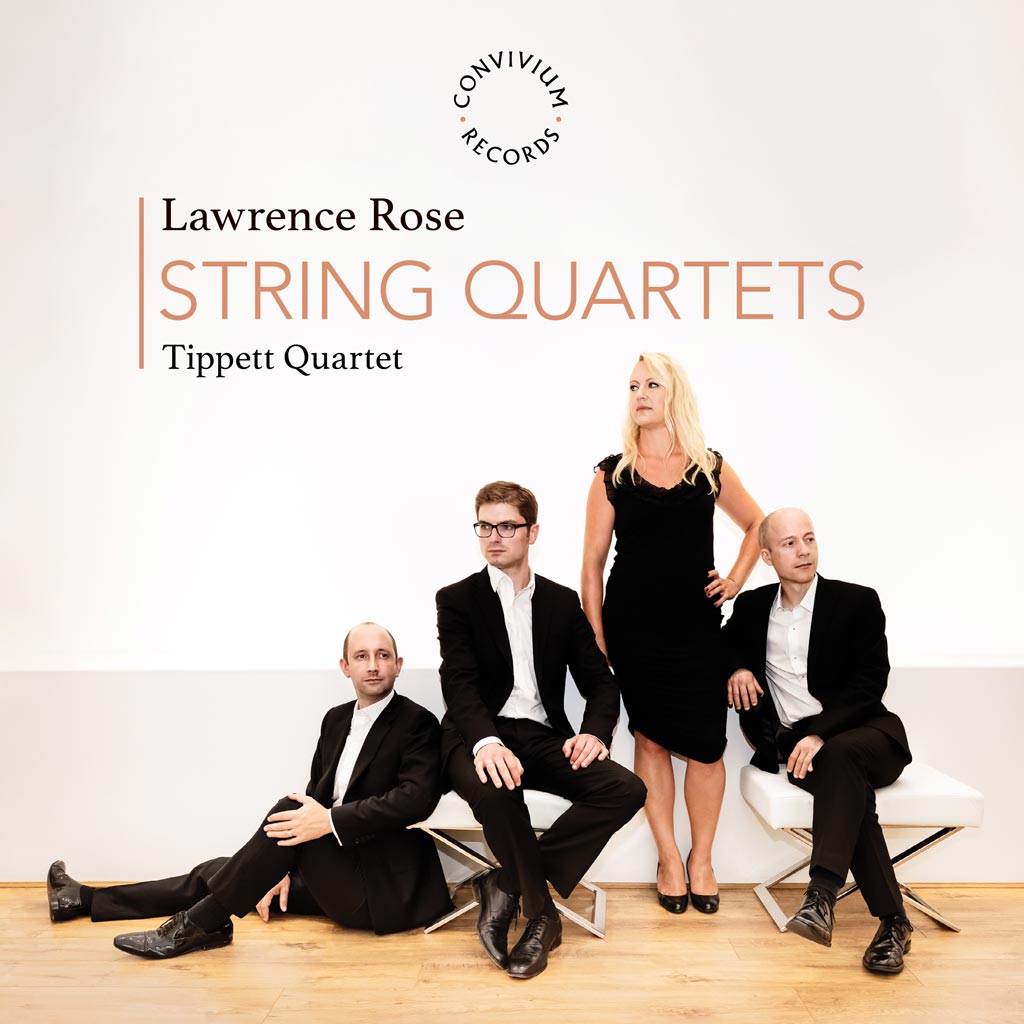
Listen or buy this album:
UK-born Lawrence Rose is not a household name either here or in his adopted Chicago, and yet his music is instantly likable and clearly both well-constructed and heartfelt. Not to mention imaginative. His music shows various sides; it is stylistically diverse, in other words. Over on Stone Records, Katherine Jenkinson and Alison Farr deliver his Cello Sonata of 2015, with clear points of contact with Shostakovich (whose own D-Minor Cello Sonata, op. 40 shares disc space). There is also Rose’s expressive Piano Trio, op. 26 (2018/19), recorded superbly by the Aquinas Piano Trio on Stone Records (and reviewed in Fanfare 46:2). Rose’s website lists four symphonies, a Concerto for Orchestra, and three violin concertos among other works.
The venue for the present recording was All Saints’ Church, East Finchley, London; the Tippett Quartet, one of the UK’s finest ensembles and one I have been privileged to hear on a number of occasions live, is caught in superb sound by engineer Adaq Khan and producer (and editor) James Unwin.
The disc is slightly misleading, however. The front cover and the inside front cover both give String Quartets as the overall title; we actually have one numbered quartet (No. 4) and a suite (the Danses pour Quatuor, op. 5): the String Quartet No. 1 is op. 10; No. 2, op. 18; and No. 3, op. 22. String Quartet No. 4, op. 33 has not quite made it to the composer’s website at the time of accessing.
Written in 2007 and revised in 2024 (one assumes in connection with this recording), the Danses presents a sequence of movements designed to be in historical sequence. No Overture; instead, a “Rigaudon,” a form especially popular with Rameau. There are some folkish tinges to the writing (the dance was originally from southern France); a central section is in slower tempo, with a really quite slinky and seductive melody. The Tippett Quartet’s performance is exemplary; the players capture the melancholy of the “Sarabanda (quasi ciaccona)” well, too. Rose takes the Franco-Germanic style of sarabande married to the chaconne’s ongoing variations in a format of theme and seven variations (the second and third are repeated as a single cell). Bozidar Vukotic’s cello seems to ground the music, the strummings full, resonant. John Mills and Jeremy Isaac are the completely equal violins; Lydia Lowndes-Northcott is a sterling viola player; but it is the sum of the parts that is so impressive. The third movement is a “Walzer”; there is a supplementary performance of this available on the composer’s website, a private recording by the Iuventus Quartet that is worth hearing, for all of its “place holder” provenance: the sense of the waltz is well conveyed. This is a sonata-form waltz, but a neutered sonata form: there are none of the vital key relationships between the various areas. I do like the way Rose overlaps and segments material at the movement’s close: it feels quite Bartókian. The Convivium recording is obviously more professional, and their take is no less dancelike, but more sophisticated. We move closer to our own times, then, with a Tango (quasi habanera), like the second movement a clever combination or juxtaposition of two forms. It is a lot of fun, and the members of the Tippett Quartet certainly seem to enjoy themselves, accents characterfully thrust at the listener. On, then, to a Blue Foxtrot, which in its title acknowledges the intertwining roles of the foxtrot and blues. It is very cleverly, neatly composed, including a set of seven “variants” (including an imitation of the banjo by the violins). Lowndes-Northcott shines in this movement, too. The final Invention refers to “an original product of the imagination implying no particular musical characteristics.” It is the spirit of dance that is celebrated; and the Tippett Quartet delivers a notably light-of-foot account. Fragments of previous dances are incorporated into Rose’s fabric. It is all very clever, and Rose could not ask for a better performance. Taken as a whole, though, I was left unsatisfied. The piece is of substantial duration, around half an hour; perhaps some trimming is in order.
The Fourth Quartet is absolute music and in its five-movement arch form again references Bartók. The first five measures of the score are reproduced as part of the product (behind the disc itself). The pacing of this Andante in this recoding is perfect (quarter note = 76), and the Tippett Quartet realizes Rose’s idea of the second subject group occupying a different “plane,” a higher register, superbly. A formal feint is to present a false recapitulation that actually is a continuation of the ongoing development. This is music that rewards close attention, sometimes veering into a sort of tenderly haunting space. A tripartite scherzo follows, an Allegretto with waltz-like tendencies, suavely delivered here. At the heart of the piece, though, is the Adagio, the central pivot based around a four-note ascending motif. The movement owes much to late Beethoven in its fragile, slow unfolding (all credit to the Tippett Quartet for sustaining this). This is fine music indeed, unhurried, even transcendent at times. The fourth movement, an Allegro, sort of extricates itself from the Adagio, as if pulling up its socks, a scherzo, but a lighter one than the first. Staccato is beautifully done here by the upper instruments, while Rose’s melodic invention, whether in the mercurial upper or the slower-moving lower voices, seems at its height. A Moderato finale might in itself imply Shostakovich, perhaps. Intended as a “counterblance” to the preceding four movements, Rose here uses a doctored fugue (no exposition in which all four voices give the subject). This is more like a skeleton of a fugue, and very effective for it. Each section is heard in a different key area and is demarcated via its characteristics, bringing in a touch of variation form to the mix. It does work well; the effect here is of a satisfyingly demanding work that holds much coherence.
Lawrence Rose’s music is clearly well worth investigation. The Tippett Quartet can do no wrong.
Review written by:
Review published in:
Other reviews by this author:
UK-born Lawrence Rose is not a household name either here or in his adopted Chicago, and yet his music is instantly likable and clearly both well-constructed and heartfelt. Not to mention imaginative. His music shows various sides; it is stylistically diverse, in other words. Over on Stone Records, Katherine Jenkinson and Alison Farr deliver his Cello Sonata of 2015, with clear points of contact with Shostakovich (whose own D-Minor Cello Sonata, op. 40 shares disc space). There is also Rose’s expressive Piano Trio, op. 26 (2018/19), recorded superbly by the Aquinas Piano Trio on Stone Records (and reviewed in Fanfare 46:2). Rose’s website lists four symphonies, a Concerto for Orchestra, and three violin concertos among other works.
The venue for the present recording was All Saints’ Church, East Finchley, London; the Tippett Quartet, one of the UK’s finest ensembles and one I have been privileged to hear on a number of occasions live, is caught in superb sound by engineer Adaq Khan and producer (and editor) James Unwin.
The disc is slightly misleading, however. The front cover and the inside front cover both give String Quartets as the overall title; we actually have one numbered quartet (No. 4) and a suite (the Danses pour Quatuor, op. 5): the String Quartet No. 1 is op. 10; No. 2, op. 18; and No. 3, op. 22. String Quartet No. 4, op. 33 has not quite made it to the composer’s website at the time of accessing.
Written in 2007 and revised in 2024 (one assumes in connection with this recording), the Danses presents a sequence of movements designed to be in historical sequence. No Overture; instead, a “Rigaudon,” a form especially popular with Rameau. There are some folkish tinges to the writing (the dance was originally from southern France); a central section is in slower tempo, with a really quite slinky and seductive melody. The Tippett Quartet’s performance is exemplary; the players capture the melancholy of the “Sarabanda (quasi ciaccona)” well, too. Rose takes the Franco-Germanic style of sarabande married to the chaconne’s ongoing variations in a format of theme and seven variations (the second and third are repeated as a single cell). Bozidar Vukotic’s cello seems to ground the music, the strummings full, resonant. John Mills and Jeremy Isaac are the completely equal violins; Lydia Lowndes-Northcott is a sterling viola player; but it is the sum of the parts that is so impressive. The third movement is a “Walzer”; there is a supplementary performance of this available on the composer’s website, a private recording by the Iuventus Quartet that is worth hearing, for all of its “place holder” provenance: the sense of the waltz is well conveyed. This is a sonata-form waltz, but a neutered sonata form: there are none of the vital key relationships between the various areas. I do like the way Rose overlaps and segments material at the movement’s close: it feels quite Bartókian. The Convivium recording is obviously more professional, and their take is no less dancelike, but more sophisticated. We move closer to our own times, then, with a Tango (quasi habanera), like the second movement a clever combination or juxtaposition of two forms. It is a lot of fun, and the members of the Tippett Quartet certainly seem to enjoy themselves, accents characterfully thrust at the listener. On, then, to a Blue Foxtrot, which in its title acknowledges the intertwining roles of the foxtrot and blues. It is very cleverly, neatly composed, including a set of seven “variants” (including an imitation of the banjo by the violins). Lowndes-Northcott shines in this movement, too. The final Invention refers to “an original product of the imagination implying no particular musical characteristics.” It is the spirit of dance that is celebrated; and the Tippett Quartet delivers a notably light-of-foot account. Fragments of previous dances are incorporated into Rose’s fabric. It is all very clever, and Rose could not ask for a better performance. Taken as a whole, though, I was left unsatisfied. The piece is of substantial duration, around half an hour; perhaps some trimming is in order.
The Fourth Quartet is absolute music and in its five-movement arch form again references Bartók. The first five measures of the score are reproduced as part of the product (behind the disc itself). The pacing of this Andante in this recoding is perfect (quarter note = 76), and the Tippett Quartet realizes Rose’s idea of the second subject group occupying a different “plane,” a higher register, superbly. A formal feint is to present a false recapitulation that actually is a continuation of the ongoing development. This is music that rewards close attention, sometimes veering into a sort of tenderly haunting space. A tripartite scherzo follows, an Allegretto with waltz-like tendencies, suavely delivered here. At the heart of the piece, though, is the Adagio, the central pivot based around a four-note ascending motif. The movement owes much to late Beethoven in its fragile, slow unfolding (all credit to the Tippett Quartet for sustaining this). This is fine music indeed, unhurried, even transcendent at times. The fourth movement, an Allegro, sort of extricates itself from the Adagio, as if pulling up its socks, a scherzo, but a lighter one than the first. Staccato is beautifully done here by the upper instruments, while Rose’s melodic invention, whether in the mercurial upper or the slower-moving lower voices, seems at its height. A Moderato finale might in itself imply Shostakovich, perhaps. Intended as a “counterblance” to the preceding four movements, Rose here uses a doctored fugue (no exposition in which all four voices give the subject). This is more like a skeleton of a fugue, and very effective for it. Each section is heard in a different key area and is demarcated via its characteristics, bringing in a touch of variation form to the mix. It does work well; the effect here is of a satisfyingly demanding work that holds much coherence.
Lawrence Rose’s music is clearly well worth investigation. The Tippett Quartet can do no wrong.
