
A Light Has Dawned – Review by Fanfare
"Luminatus under David Bray offers some fine performances."
1st May 2026
A Light Has Dawned – Review by Fanfare
"Luminatus under David Bray offers some fine performances."
1st May 2026
Listen or buy this album:
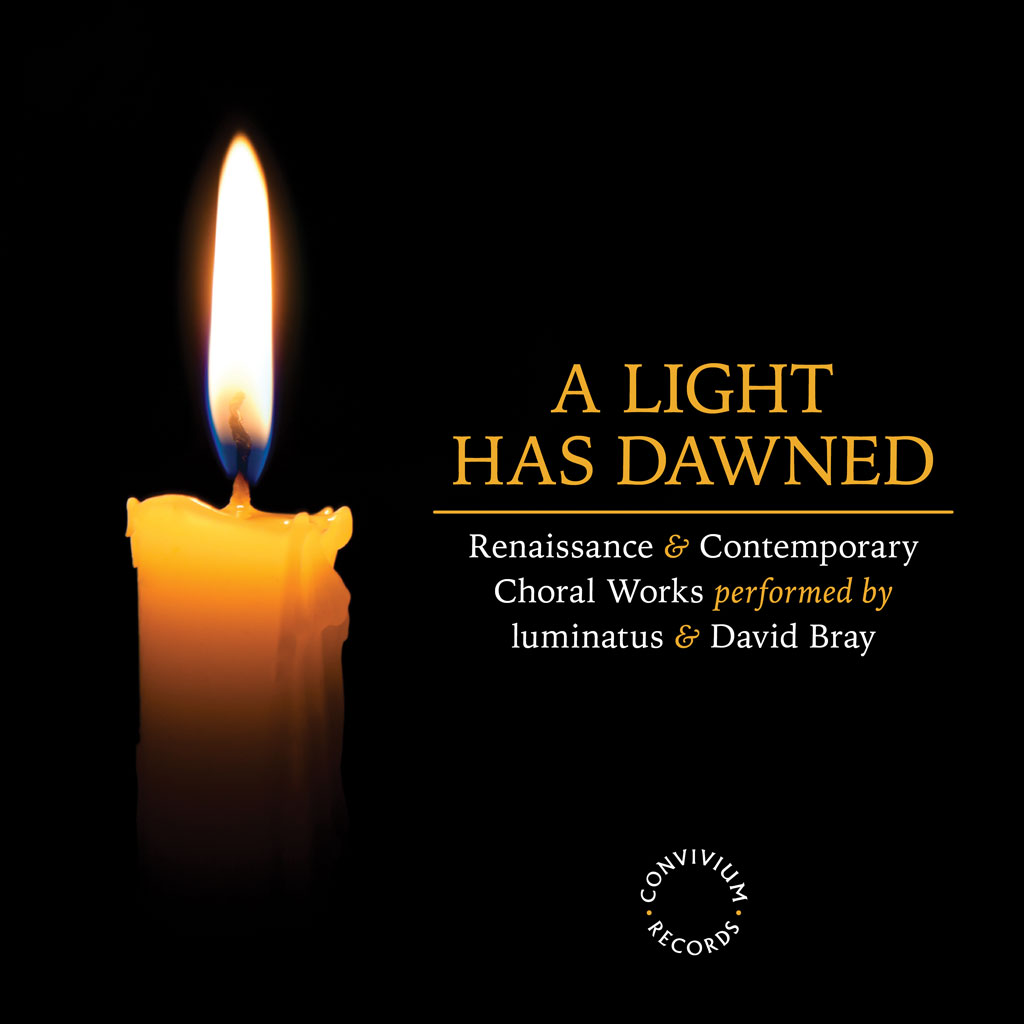
Taking its title from its last track by Rosa Elliot, this disc bravely juxtaposes some of the great names of early choral music with the music of our time. Both periods make profound demands on their executants: Luminatus under David Bray offers some fine performances here, balanced by some that lack polish.
It is good to hear Cipriano de Rore’s Ancor che col partire in the original immediately prior to Philippe de Monte’s Mass of that title. It was de Rore’s piece that gave L’Achéron’s magnificent all-de Rore disc on Ricercar its title, and from the very first entry to the gorgeously decorated final cadence, that account is absolutely perfect (Fanfare 39:2). The first entry on Luminatus’ performance is a touch indistinct, unfortunately, which hardly gets things off to a good start. Nevertheless, the performance has atmosphere, and is preparatory to one of several parody Masses on de Rore by Philippe de Monte, one of that composer’s 48 Masses (including a Requiem in that number); another is the Missa Quando lieta sperai. The slow-moving Kyrie here is of real beauty, and Luminatus offers richness when required against linear clarity elsewhere. The madrigal (which talks of love, and by implication erotic love) underpins the Mass as a sort of shadow that zooms in and out of focus. The Mass follows each motif in the madrigal in order, transferring them across linearly (so, Kyrie I the first motif, Christe the second, Kyrie II the third and so on), although the three-voice Benedictus is freely composed. Luminatus is without doubt well prepared by David Bray; I just miss that extra bit of elevation, and even of sonic glow, to the sound. Nice to have a resonantly intoned “Gloria in excelsis Deo” prior to the contrapuntal textures of the Gloria proper. Interestingly, the madrigal’s harmonic profile in terms of brightness remains in the liturgical response. Lumiatus’ finest movement is the Credo, which does attain a sense of elevation at times; only the occasional hesitancy at exposed entries as the music progresses militates against this. The slowly unfolding Sanctus holds much power here, those interior descending lines decidedly lachrymose. Finally, an Agnus Dei opening with an extended plainchant line before the blissful counterpoint arrives (perhaps a cleaner upper-line entry on “miserere” early on would have helped). It is de Rore that, aptly, frames the Mass: his Da Pacem, Dominedates from his Ferrarese period and is a deeply interior meditation on the peace found with a deity that “fights for us.” De Rore’s music portrays that very peace, although, interestingly, Weser-Renaissance Bremen’s performance under Manfred Cortes seems to project an undercurrent of disquiet, as if the human failing of fear remains even through faith (that recording was rightly lauded by J. F. Weber in Fanfare 43:3, and is quite frankly on a different level).
Francesco Stivori marks his Fanfare debut here with his Dominus Illuminatio Mea. Born in Venice around 1560 and died, probably in Graz, Austria in 1605, Stivori studied with Merulo. He was known as an organist, and he was important in introducing polychoralism to Austria. He is responsible for seven books of madrigals, six of motets, and three of instrumental pieces, and it is from this last that my previous exposure to Stivori came: an organ piece, a Canzone from a Tactus disc performed by organist Francesco Di Lernia and entitled, L’Organo in Italia fra Rinascimeno e Barocco. There, Stivori’s command of his material is most enchanting. There is a similar ease and flow to the writing of Dominus Illuminatio Mea, too.
Associated with the birth of the madrigal, Philippe Verdelot occupied the generation prior to Arcadelt. His Beata es, Virgo Maria is of stunning beauty; consistently clean intervals characterize this performance. That is preceded by Tiburtio Massaino’s Illuminare, Jerusalem, the sopranos particularly impressive in their attack on this occasion.
Born in 1485, Jacquet de Mantua represents some of the earlier music in this collection, his O Jesu Christe a stunning example of word clarity (it is mainly homophonic) and harmonic imagination. Jacquet was the maestro di cappella at St. Peter’s, Mantua; several of his motets served as the basis for masses by Palestrina. Do search out the Inventa recording of motets and secular songs by the choir of Sidney Sussex College, Cambridge under David Skinner or (or even better, and) the Hyperion disc by the Brabant Ensemble that includes the Missa Surge Petre (Fanfare 39:2).
Recently, I enjoyed Baccusi’s Salve Regina and Cantabant sancti canticum novum on another Convivium disc, Love Divine by these very performers (Fanfare 48:5). His Regina caeli laetare is for eight voices divided into two choirs (in Venetian polychoral style); the divided singers are not so spatially separated here, but the division is nevertheless clear.
Baccusi closes the early music part of the program, and it is quite a way from Baccusi to Cheryl Frances-Hoad. There is an amazingly small amount of Frances-Hoad’s music in the Fanfare Archive, considering her popularity in the UK: one review by myself (another Convivium release, A New Winter Songbook, Fanfare 49:3), one piece on a BIS disc, Sounds and Sweet Airs (47:4), and some music on a Signum release, Advent Live, Volume 2 (48:2). Interestingly, her Benedictus benedicat uses techniques from much earlier music, but within a vaguely contemporary shell; but for all its cleverness it remains largely anonymous, despite the present performers’ efforts. Her Lordings, listen to our lay is a Christmas piece, animated.
Cecilia McDowall is a composer whose music I have often enjoyed, and I refer the reader to a whole disc of her music on Dutton (Fanfare 33:3). HerPrayer immediately sets up harmonic fields that drift against each other like clouds against which a solo soprano is heard. The piece is heartfelt, and inspired, and is heard here in a positively seraphic performance, surely one of the highlights of the disc.
David Bray recorded Melissa Dunphy’s Mag and Nunc on another Convivium disc, O Beata Virgo Maria (48:1). Here, we have At Water’s Edge, whose text concerns the Babylonian exile of the Jewish people. He music asks much of the singers in terms of pitch: both pitching and maintenance thereof. The effect is fairly swimmy; even more rhythmic passages feel somewhat uprooted. Something of the same effect, very deliberately conceived, is present in Kerry Andrews’ Stella Matutina, the opening repetitions simultaneously ancient and modern. The text is from St. Bede (“Christ is the Morning Star”). Not all of the upper lines are totally secure in this performance, however.
Finally, the titular A Light Has Dawned. New Zealand composer Rosa Elliott celebrates the victory of light over darkness at Christmastime. It is a beautiful piece, the slow ascent of piled-on dissonances toward the light most effective.
The idea behind this disc is fabulous; its execution not quite so much. But repertoire choice exerts a strong pull here, and certainly the earlier music casts a lasting shadow.
Review written by:
Review published in:
Other reviews by this author:
Taking its title from its last track by Rosa Elliot, this disc bravely juxtaposes some of the great names of early choral music with the music of our time. Both periods make profound demands on their executants: Luminatus under David Bray offers some fine performances here, balanced by some that lack polish.
It is good to hear Cipriano de Rore’s Ancor che col partire in the original immediately prior to Philippe de Monte’s Mass of that title. It was de Rore’s piece that gave L’Achéron’s magnificent all-de Rore disc on Ricercar its title, and from the very first entry to the gorgeously decorated final cadence, that account is absolutely perfect (Fanfare 39:2). The first entry on Luminatus’ performance is a touch indistinct, unfortunately, which hardly gets things off to a good start. Nevertheless, the performance has atmosphere, and is preparatory to one of several parody Masses on de Rore by Philippe de Monte, one of that composer’s 48 Masses (including a Requiem in that number); another is the Missa Quando lieta sperai. The slow-moving Kyrie here is of real beauty, and Luminatus offers richness when required against linear clarity elsewhere. The madrigal (which talks of love, and by implication erotic love) underpins the Mass as a sort of shadow that zooms in and out of focus. The Mass follows each motif in the madrigal in order, transferring them across linearly (so, Kyrie I the first motif, Christe the second, Kyrie II the third and so on), although the three-voice Benedictus is freely composed. Luminatus is without doubt well prepared by David Bray; I just miss that extra bit of elevation, and even of sonic glow, to the sound. Nice to have a resonantly intoned “Gloria in excelsis Deo” prior to the contrapuntal textures of the Gloria proper. Interestingly, the madrigal’s harmonic profile in terms of brightness remains in the liturgical response. Lumiatus’ finest movement is the Credo, which does attain a sense of elevation at times; only the occasional hesitancy at exposed entries as the music progresses militates against this. The slowly unfolding Sanctus holds much power here, those interior descending lines decidedly lachrymose. Finally, an Agnus Dei opening with an extended plainchant line before the blissful counterpoint arrives (perhaps a cleaner upper-line entry on “miserere” early on would have helped). It is de Rore that, aptly, frames the Mass: his Da Pacem, Dominedates from his Ferrarese period and is a deeply interior meditation on the peace found with a deity that “fights for us.” De Rore’s music portrays that very peace, although, interestingly, Weser-Renaissance Bremen’s performance under Manfred Cortes seems to project an undercurrent of disquiet, as if the human failing of fear remains even through faith (that recording was rightly lauded by J. F. Weber in Fanfare 43:3, and is quite frankly on a different level).
Francesco Stivori marks his Fanfare debut here with his Dominus Illuminatio Mea. Born in Venice around 1560 and died, probably in Graz, Austria in 1605, Stivori studied with Merulo. He was known as an organist, and he was important in introducing polychoralism to Austria. He is responsible for seven books of madrigals, six of motets, and three of instrumental pieces, and it is from this last that my previous exposure to Stivori came: an organ piece, a Canzone from a Tactus disc performed by organist Francesco Di Lernia and entitled, L’Organo in Italia fra Rinascimeno e Barocco. There, Stivori’s command of his material is most enchanting. There is a similar ease and flow to the writing of Dominus Illuminatio Mea, too.
Associated with the birth of the madrigal, Philippe Verdelot occupied the generation prior to Arcadelt. His Beata es, Virgo Maria is of stunning beauty; consistently clean intervals characterize this performance. That is preceded by Tiburtio Massaino’s Illuminare, Jerusalem, the sopranos particularly impressive in their attack on this occasion.
Born in 1485, Jacquet de Mantua represents some of the earlier music in this collection, his O Jesu Christe a stunning example of word clarity (it is mainly homophonic) and harmonic imagination. Jacquet was the maestro di cappella at St. Peter’s, Mantua; several of his motets served as the basis for masses by Palestrina. Do search out the Inventa recording of motets and secular songs by the choir of Sidney Sussex College, Cambridge under David Skinner or (or even better, and) the Hyperion disc by the Brabant Ensemble that includes the Missa Surge Petre (Fanfare 39:2).
Recently, I enjoyed Baccusi’s Salve Regina and Cantabant sancti canticum novum on another Convivium disc, Love Divine by these very performers (Fanfare 48:5). His Regina caeli laetare is for eight voices divided into two choirs (in Venetian polychoral style); the divided singers are not so spatially separated here, but the division is nevertheless clear.
Baccusi closes the early music part of the program, and it is quite a way from Baccusi to Cheryl Frances-Hoad. There is an amazingly small amount of Frances-Hoad’s music in the Fanfare Archive, considering her popularity in the UK: one review by myself (another Convivium release, A New Winter Songbook, Fanfare 49:3), one piece on a BIS disc, Sounds and Sweet Airs (47:4), and some music on a Signum release, Advent Live, Volume 2 (48:2). Interestingly, her Benedictus benedicat uses techniques from much earlier music, but within a vaguely contemporary shell; but for all its cleverness it remains largely anonymous, despite the present performers’ efforts. Her Lordings, listen to our lay is a Christmas piece, animated.
Cecilia McDowall is a composer whose music I have often enjoyed, and I refer the reader to a whole disc of her music on Dutton (Fanfare 33:3). HerPrayer immediately sets up harmonic fields that drift against each other like clouds against which a solo soprano is heard. The piece is heartfelt, and inspired, and is heard here in a positively seraphic performance, surely one of the highlights of the disc.
David Bray recorded Melissa Dunphy’s Mag and Nunc on another Convivium disc, O Beata Virgo Maria (48:1). Here, we have At Water’s Edge, whose text concerns the Babylonian exile of the Jewish people. He music asks much of the singers in terms of pitch: both pitching and maintenance thereof. The effect is fairly swimmy; even more rhythmic passages feel somewhat uprooted. Something of the same effect, very deliberately conceived, is present in Kerry Andrews’ Stella Matutina, the opening repetitions simultaneously ancient and modern. The text is from St. Bede (“Christ is the Morning Star”). Not all of the upper lines are totally secure in this performance, however.
Finally, the titular A Light Has Dawned. New Zealand composer Rosa Elliott celebrates the victory of light over darkness at Christmastime. It is a beautiful piece, the slow ascent of piled-on dissonances toward the light most effective.
The idea behind this disc is fabulous; its execution not quite so much. But repertoire choice exerts a strong pull here, and certainly the earlier music casts a lasting shadow.
