
The New Winter Songbook – Review by Fanfare
“Fabulous singing, fabulous playing, heard in a fine recording from St. Paul’s, Knightsbridge. Recommended.”
1st May 2026
The New Winter Songbook – Review by Fanfare
“Fabulous singing, fabulous playing, heard in a fine recording from St. Paul’s, Knightsbridge. Recommended.”
1st May 2026
Listen or buy this album:
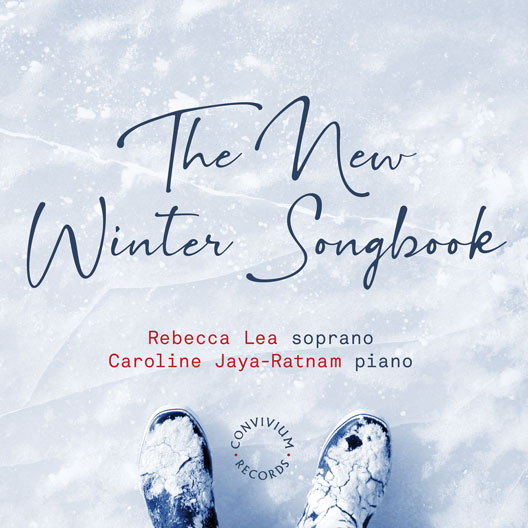
This is a lovely idea, two discs of music by contemporary composers constructed around wintertime. Many, if not all, of the names of the composers will be familiar; soprano Rebecca Lea, however, appears to be new to the Fanfare Archive albeit not to the recoding world at large. She is part of the choral group Londinium, and as such participated in SOMM Recording’s disc of music by Kenneth Leighton, Every Living Creature (Laudse Animantium, op. 61, is really beautiful, incidentally), and she took the solo soprano part in David Matthews’s String Quartet No. 13, op. 136 on the recording with the Kreutzer Quartet on Toccata Classics, and very creditably (there are actually four vocal soloists in that quartet: Jess Dandy, James Robinson, and Will Dawes were her companions).
A delicate piano cascade opens Jamie W. Hall’s Dust of Snow. Rebecca Lee’s soprano reveals itself to be glacially clean, an absolute joy. Vibrato is perfectly applied, to the extent that it is unnoticeable; Errollyn Wallen’s North is a picture postcard in music from a trip to Bergen, Norway: the refrain features the phrase, “I’ll sail by night and I’ll think all day of North.” Wallen’s music is unfailingly approachable and well crafted; if the climax is less than convincing as music, Lee and Jaya-Ratnam give their all. This is a real partnership of equals: Jaya-Ratnam’s playing is perfect in its attention to detail and clarification of texture, the ideal complement to Lea’s cleanliness of delivery.
An English translation of Wilhelm Müller, from Winterreise, but cast in the form of several haiku, Judith Weir’s On White Meadows’ realization is even more fascinating than the concept: I, for one, simply had to hear the song again straight away. Short meditations on Nature inform the song’s trajectory, as does the idea of wandering (“I wander relentless, restless yet seeking rest”). The piano’s repeated, oscillating phrases create a blanket of sonic snow, perhaps. Lea soars as the protagonist stands lost in thought; an amazing, terrific song.
The title Sundowning is arresting. This is by British-Japanese composer Ben Nobuto (who makes his Fanfare debut); it refers to a state of confusion that occurs in people with dementia around the time of sunset. Treating a very personal subject to the composer, lines from It’s a Wonderful Life (1946, a film with a pronounced Christmas element) form the basis of repetitions and rotations. The text is depicted in the accompanying booklet as a sequence of mainly single words, one per line, except for the phrases, “I told you” and “Show me the way.” It opens in the most stunning way: a rapid ascent for piano and voice in absolute unison. Fragmentation, breaths, semi-coughs are all part of this remarkable piece. It is inspired, on all levels, including the humanitarian. The score demands such accuracy from both performers, both in terms of pitch and rhythm, and a finer account is unimaginable. Lea finds exactly the right attack for the high entries, too. Nobuto clearly has a vast and characterful imagination. His Sol (2022), as recorded by the National Youth Choir of Great Britain for NMC on the disc Young Composers 4, offers similar fragmentation, there as a sort of modernist hocketing (that piece considers the Roman god Sol), not to mention the more meditative 2022 piece The nearness of things. Nobuto has worked with a number of progressive ensembles, including the magnificent Manchester Collective, for whom he furnished SERENITY 2.0. A real individual voice.
Talking of individual spirits, and introducing both a force of nature and a wild woman, a piece by Héloïse Werner next. A maximally talented vocalist, Werner sets Emma Werner in Winter Spell; Héloïse is equally at home with English and French (she is resident in the UK, of French and German parentage, hence the mixed-language forename and surname). The music is introspective, the piano’s chords concentrated in a small registral space, the voice free, using much larger intervals. The English is sung, and the French moves from this to syllabic sounds. It is core Héloïse Werner; and Lea absolutely shines. She encompasses all of the challenges without once sounding as if she is imitating Werner; and given that Werner makes her music absolutely her own, this is no mean feat.
The words of Adam Gorb’s Frost Fair reference “bleak Britannia’s air.” Hmm, ain’t that the truth. Actually, the poem (words by John Gay) references the “Second Ice Age,” when the Thames froze over, to the extent that fairs could have been held on it. The music is exuberant, fun and yet all of a complex piece. I have come across Gorb before: on a Divine Art disc, The Fabulous Si John (Fanfare 46:2); there, I enjoyed his “Air for Sir John.” Various other pieces have been covered; this is energizing, highly recommended music.
Composer Eoghan Desmond sets the Reverend William Devereux’s adaptation of a text in The Darkest Midnight, a gentle song in which one finds solace in the stillness of Winter and the “God of Love in May’s arms.” Winter continues, explicitly, with Winter’s Fragments by Jessica Dannheisser, setting Hannah Cooke. The isolation and grief engendered by the third (!) UK lockdown during the COVID pandemic was the catalyst for the poem. This is an effective setting, if not offering the most memorable music on this disc.
Certainly, Cecilia McDowell is no stranger to these pages: here, we have herChristmas Eve at Sea (text, one John Masefield). The opening piano chords, although quiet, are immediately arresting, piquant; Lea’s purity pays huge dividends here. The storytelling is remarkable, both from McDowell and from Lea/Jaya-Ratnam. Held-breath sonorities and a sense of zero rush enhance the tale. Stunning; McDowell does true justice to Masefield’s deep poetry, and surely there is no higher compliment.
The name of Helen Neeves is new to me. She is both composer and soprano, trained at the University of York and later at the Royal Northern College of Music in Manchester. True, you won’t find her in the Archive as a soprano, either. Having composed early in her life, she returned to composition after an extended hiatus, in 2000. Her Cradle Song bravely sets William Blake. Composed in 2002 for the Great Chishill Carol Service, it has enjoyed a BBC Radio 3 broadcast. He indicator is “Lilting, with ease and flexibility,” and Jaya-Ratnam achieves this brilliantly; just as impressive is Lea’s effortless entry (wordlessly, first: “mmm” then “ah,” then melismatically “Sleep, sleep beauty bright”). A whispered lullaby, it cedes to James Weeks’ Natural State. This is the same James Weeks who provided the remarkable Primo Libro (New Focus, We Live the Opposite Daring, Fanfare 47:6). Composed specifically for this release, Natural State bemoans the current state of humanity and its created environment. The text was created “somewhere near Ferryhill, November 2024”; repeated chords on piano, deliberately pedaled to create smudging overtones, underpin a lot of sung recitation. There are parallels to Primo Libro, for sure, but Natural State seems to speak more form the heart; it is less overtly “clever.” The score requires real discipline, particularly on the metric/rhythmic axis, and certainly gets it from its dedicatees here. There is the feeling the piano might suddenly branch out into jazz at one point (it doesn’t; instead ecstatic chords act against the soprano’s gliding, wordless wailing). Memorable. Again.
Composer Martin Bussey’s Twelfth Night does not set Shakespeare; instead, it is Hilaire Belloc who furnishes the words. Delicate piano traceries high up seem less idealized, more strangely disconcerting, as if a dream has shifted. Against those traceries, the vocal line, sometimes quasi-parlando, at other times soaring, tells the tale of, well, us, today. There is beauty, but also, power, here.
The text for Cheryl Frances-Hoad’s The Core of Time takes words from the text for an oratorio, Five Beacons of Light. Environmentally aware, the text needs a setting of depth, and Frances-Hoad certainly steps up to the plate. The registral separation between right- and left-hand chords on piano at the opening is surely significant, gently filled in by arpeggiations. Many lesser sopranos would surely be cowed by the writing for the second stanza (“Down to the bedrock we must go”), but Lea’s arrow is straight and true.
The second disc continues with the extraordinary two-part texture (voice and one-line piano) of Peter Foggitt’s Villanelle: New Year’s Eve. Melancholy pervades; even more fascinating is the song by Electra Perivolaris, Lethe-Oblivion, setting words by her father, John, about liminal spaces and the river lethe (itself a connecting channel between states). Wordless at first, the music blossoms into something both lyrical and timeless, “floating in the air,” as the text says. I loved Perivolaris’s The Mastic Orchard on the natural horn disc Caprice Reimagined (New Focus, Fanfare 49:2); less overtly virtuosic, this piece is more about enchantment in an ancient era and place (Greece). A wonderful piece.
Michael Betteridge writes his own text for Snow Day, a piece that reflects the magic of the first glimpse of snow (not as exciting as the first mince, pie, surely?). The music is rich and yet fantastical, quasi-tremolandos in the piano against the imaginings of the protagonist. Lea and Jaya-Ratnam are in perfect accord. The piano is as crisp as a winter’s day, for sure.
Ariadne (she of Naxos) has inspired so many poets and composers. Here, the poet is Anna Kenyon, the composer David McGregor. It opens so evocatively and immediately establishes the link to the twofer’s script: “We met in Winter.” The music follows the text very closely, making the music easy to grasp without taking away the invention of the setting. Note this is is David McGregor, not Rob Roy McGregor (who has been featured in the Fanfare Archive).
Michael Csanyi-Wills is another composer who can twist between icy frost and hearth warmth, and does so in his setting of Susan Holliday in the lovelySnowdrop. The performance here honors arrival points beautifully.
For a rampant Sinophile such as myself, a setting of the Chinese poet Fei Ming (albeit in English translation by Yilin Wang) is guaranteed to hook me in. The booklet actually includes the original Chinese; but it is the magic of the words with the music, and that idealized way Chinese poetry has with Nature, that is so compelling (not to mention Lea’s soaring upper register, with no trace of harshness to it). A highlight.
One name that needs zero introduction is Owain Park (think Gesualdo Six). HisWinters Distant sets Gareth Mattey. Here, Winter soothes homesickness (be it the poem’s protagonist, or Park himself). Park’s harmonic world is perfect, and is literally that: a self-contained world unto itself. The piece unrolls at its own perfect pace, too.
The name Anita Datta is new to me, but it is lovely to see that this piece, Seasonal Clothing, was inspired by workshops in East London (I am actually writing this in East London right now). A setting of words by Natasha Gauthier, its sense of “rightness” and internal glow is just right to close this fascinating collection of songs.
Please do not hesitate: I hope my detailed scribblings might have inspired investigation. Fabulous singing, fabulous playing, heard in a fine recording from St. Paul’s, Knightsbridge. Recommended.
Review written by:
Review published in:
Other reviews by this author:
Featured artists:
Featured composers:
This is a lovely idea, two discs of music by contemporary composers constructed around wintertime. Many, if not all, of the names of the composers will be familiar; soprano Rebecca Lea, however, appears to be new to the Fanfare Archive albeit not to the recoding world at large. She is part of the choral group Londinium, and as such participated in SOMM Recording’s disc of music by Kenneth Leighton, Every Living Creature (Laudse Animantium, op. 61, is really beautiful, incidentally), and she took the solo soprano part in David Matthews’s String Quartet No. 13, op. 136 on the recording with the Kreutzer Quartet on Toccata Classics, and very creditably (there are actually four vocal soloists in that quartet: Jess Dandy, James Robinson, and Will Dawes were her companions).
A delicate piano cascade opens Jamie W. Hall’s Dust of Snow. Rebecca Lee’s soprano reveals itself to be glacially clean, an absolute joy. Vibrato is perfectly applied, to the extent that it is unnoticeable; Errollyn Wallen’s North is a picture postcard in music from a trip to Bergen, Norway: the refrain features the phrase, “I’ll sail by night and I’ll think all day of North.” Wallen’s music is unfailingly approachable and well crafted; if the climax is less than convincing as music, Lee and Jaya-Ratnam give their all. This is a real partnership of equals: Jaya-Ratnam’s playing is perfect in its attention to detail and clarification of texture, the ideal complement to Lea’s cleanliness of delivery.
An English translation of Wilhelm Müller, from Winterreise, but cast in the form of several haiku, Judith Weir’s On White Meadows’ realization is even more fascinating than the concept: I, for one, simply had to hear the song again straight away. Short meditations on Nature inform the song’s trajectory, as does the idea of wandering (“I wander relentless, restless yet seeking rest”). The piano’s repeated, oscillating phrases create a blanket of sonic snow, perhaps. Lea soars as the protagonist stands lost in thought; an amazing, terrific song.
The title Sundowning is arresting. This is by British-Japanese composer Ben Nobuto (who makes his Fanfare debut); it refers to a state of confusion that occurs in people with dementia around the time of sunset. Treating a very personal subject to the composer, lines from It’s a Wonderful Life (1946, a film with a pronounced Christmas element) form the basis of repetitions and rotations. The text is depicted in the accompanying booklet as a sequence of mainly single words, one per line, except for the phrases, “I told you” and “Show me the way.” It opens in the most stunning way: a rapid ascent for piano and voice in absolute unison. Fragmentation, breaths, semi-coughs are all part of this remarkable piece. It is inspired, on all levels, including the humanitarian. The score demands such accuracy from both performers, both in terms of pitch and rhythm, and a finer account is unimaginable. Lea finds exactly the right attack for the high entries, too. Nobuto clearly has a vast and characterful imagination. His Sol (2022), as recorded by the National Youth Choir of Great Britain for NMC on the disc Young Composers 4, offers similar fragmentation, there as a sort of modernist hocketing (that piece considers the Roman god Sol), not to mention the more meditative 2022 piece The nearness of things. Nobuto has worked with a number of progressive ensembles, including the magnificent Manchester Collective, for whom he furnished SERENITY 2.0. A real individual voice.
Talking of individual spirits, and introducing both a force of nature and a wild woman, a piece by Héloïse Werner next. A maximally talented vocalist, Werner sets Emma Werner in Winter Spell; Héloïse is equally at home with English and French (she is resident in the UK, of French and German parentage, hence the mixed-language forename and surname). The music is introspective, the piano’s chords concentrated in a small registral space, the voice free, using much larger intervals. The English is sung, and the French moves from this to syllabic sounds. It is core Héloïse Werner; and Lea absolutely shines. She encompasses all of the challenges without once sounding as if she is imitating Werner; and given that Werner makes her music absolutely her own, this is no mean feat.
The words of Adam Gorb’s Frost Fair reference “bleak Britannia’s air.” Hmm, ain’t that the truth. Actually, the poem (words by John Gay) references the “Second Ice Age,” when the Thames froze over, to the extent that fairs could have been held on it. The music is exuberant, fun and yet all of a complex piece. I have come across Gorb before: on a Divine Art disc, The Fabulous Si John (Fanfare 46:2); there, I enjoyed his “Air for Sir John.” Various other pieces have been covered; this is energizing, highly recommended music.
Composer Eoghan Desmond sets the Reverend William Devereux’s adaptation of a text in The Darkest Midnight, a gentle song in which one finds solace in the stillness of Winter and the “God of Love in May’s arms.” Winter continues, explicitly, with Winter’s Fragments by Jessica Dannheisser, setting Hannah Cooke. The isolation and grief engendered by the third (!) UK lockdown during the COVID pandemic was the catalyst for the poem. This is an effective setting, if not offering the most memorable music on this disc.
Certainly, Cecilia McDowell is no stranger to these pages: here, we have herChristmas Eve at Sea (text, one John Masefield). The opening piano chords, although quiet, are immediately arresting, piquant; Lea’s purity pays huge dividends here. The storytelling is remarkable, both from McDowell and from Lea/Jaya-Ratnam. Held-breath sonorities and a sense of zero rush enhance the tale. Stunning; McDowell does true justice to Masefield’s deep poetry, and surely there is no higher compliment.
The name of Helen Neeves is new to me. She is both composer and soprano, trained at the University of York and later at the Royal Northern College of Music in Manchester. True, you won’t find her in the Archive as a soprano, either. Having composed early in her life, she returned to composition after an extended hiatus, in 2000. Her Cradle Song bravely sets William Blake. Composed in 2002 for the Great Chishill Carol Service, it has enjoyed a BBC Radio 3 broadcast. He indicator is “Lilting, with ease and flexibility,” and Jaya-Ratnam achieves this brilliantly; just as impressive is Lea’s effortless entry (wordlessly, first: “mmm” then “ah,” then melismatically “Sleep, sleep beauty bright”). A whispered lullaby, it cedes to James Weeks’ Natural State. This is the same James Weeks who provided the remarkable Primo Libro (New Focus, We Live the Opposite Daring, Fanfare 47:6). Composed specifically for this release, Natural State bemoans the current state of humanity and its created environment. The text was created “somewhere near Ferryhill, November 2024”; repeated chords on piano, deliberately pedaled to create smudging overtones, underpin a lot of sung recitation. There are parallels to Primo Libro, for sure, but Natural State seems to speak more form the heart; it is less overtly “clever.” The score requires real discipline, particularly on the metric/rhythmic axis, and certainly gets it from its dedicatees here. There is the feeling the piano might suddenly branch out into jazz at one point (it doesn’t; instead ecstatic chords act against the soprano’s gliding, wordless wailing). Memorable. Again.
Composer Martin Bussey’s Twelfth Night does not set Shakespeare; instead, it is Hilaire Belloc who furnishes the words. Delicate piano traceries high up seem less idealized, more strangely disconcerting, as if a dream has shifted. Against those traceries, the vocal line, sometimes quasi-parlando, at other times soaring, tells the tale of, well, us, today. There is beauty, but also, power, here.
The text for Cheryl Frances-Hoad’s The Core of Time takes words from the text for an oratorio, Five Beacons of Light. Environmentally aware, the text needs a setting of depth, and Frances-Hoad certainly steps up to the plate. The registral separation between right- and left-hand chords on piano at the opening is surely significant, gently filled in by arpeggiations. Many lesser sopranos would surely be cowed by the writing for the second stanza (“Down to the bedrock we must go”), but Lea’s arrow is straight and true.
The second disc continues with the extraordinary two-part texture (voice and one-line piano) of Peter Foggitt’s Villanelle: New Year’s Eve. Melancholy pervades; even more fascinating is the song by Electra Perivolaris, Lethe-Oblivion, setting words by her father, John, about liminal spaces and the river lethe (itself a connecting channel between states). Wordless at first, the music blossoms into something both lyrical and timeless, “floating in the air,” as the text says. I loved Perivolaris’s The Mastic Orchard on the natural horn disc Caprice Reimagined (New Focus, Fanfare 49:2); less overtly virtuosic, this piece is more about enchantment in an ancient era and place (Greece). A wonderful piece.
Michael Betteridge writes his own text for Snow Day, a piece that reflects the magic of the first glimpse of snow (not as exciting as the first mince, pie, surely?). The music is rich and yet fantastical, quasi-tremolandos in the piano against the imaginings of the protagonist. Lea and Jaya-Ratnam are in perfect accord. The piano is as crisp as a winter’s day, for sure.
Ariadne (she of Naxos) has inspired so many poets and composers. Here, the poet is Anna Kenyon, the composer David McGregor. It opens so evocatively and immediately establishes the link to the twofer’s script: “We met in Winter.” The music follows the text very closely, making the music easy to grasp without taking away the invention of the setting. Note this is is David McGregor, not Rob Roy McGregor (who has been featured in the Fanfare Archive).
Michael Csanyi-Wills is another composer who can twist between icy frost and hearth warmth, and does so in his setting of Susan Holliday in the lovelySnowdrop. The performance here honors arrival points beautifully.
For a rampant Sinophile such as myself, a setting of the Chinese poet Fei Ming (albeit in English translation by Yilin Wang) is guaranteed to hook me in. The booklet actually includes the original Chinese; but it is the magic of the words with the music, and that idealized way Chinese poetry has with Nature, that is so compelling (not to mention Lea’s soaring upper register, with no trace of harshness to it). A highlight.
One name that needs zero introduction is Owain Park (think Gesualdo Six). HisWinters Distant sets Gareth Mattey. Here, Winter soothes homesickness (be it the poem’s protagonist, or Park himself). Park’s harmonic world is perfect, and is literally that: a self-contained world unto itself. The piece unrolls at its own perfect pace, too.
The name Anita Datta is new to me, but it is lovely to see that this piece, Seasonal Clothing, was inspired by workshops in East London (I am actually writing this in East London right now). A setting of words by Natasha Gauthier, its sense of “rightness” and internal glow is just right to close this fascinating collection of songs.
Please do not hesitate: I hope my detailed scribblings might have inspired investigation. Fabulous singing, fabulous playing, heard in a fine recording from St. Paul’s, Knightsbridge. Recommended.
