
Carson Cooman: Almanack Pianistico – Review by Fanfare
"The set comes with the inbuilt authority of the composer himself. Recommended to the curious."
28th May 2026
Carson Cooman: Almanack Pianistico – Review by Fanfare
"The set comes with the inbuilt authority of the composer himself. Recommended to the curious."
28th May 2026
Listen or buy this album:
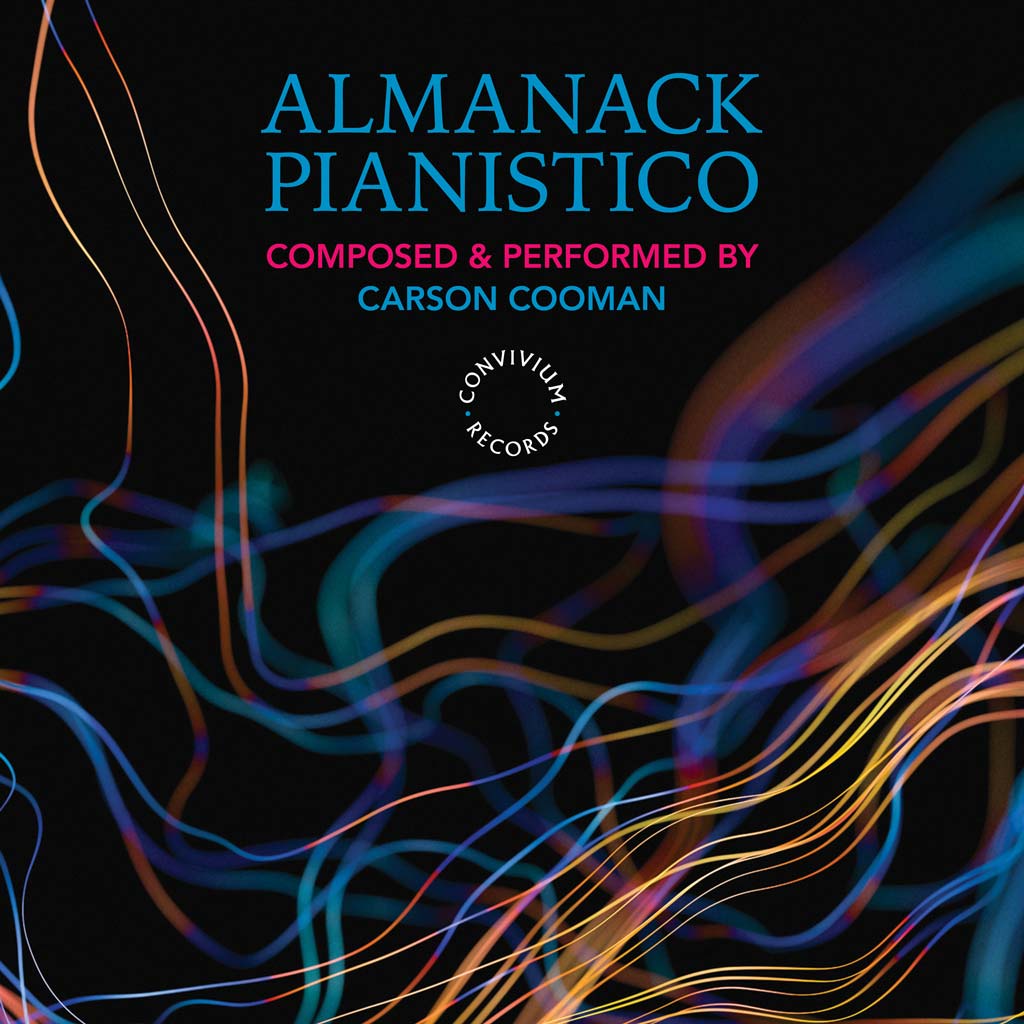
Carson Cooman’s single-word title Almanack comprises 75 pieces for “keyboard” (piano, yes, but alternatively organ, harpsichord, and so on). The “Pianistico” here nails the music down to piano, and Cooman plays 37 pieces on the present disc.
Cooman’s inspirations stretch from American Shaker hymns to Elizabethan keyboardists to Howard Skempton, and to the quietness of the Wandelwise Collective. Cooman’s scores invite in performer choice (and not just of instrument), so these interpretations are but one of many possible.
The first piece is “Mesclun.” The chords put me in mind of the brass at the beginning of the slow movement of the “New World” Symphony (as does the chorale-like piece “Close”); when a melody does arrive, a kind of semi-melody, not fully formed, it cuts against this. “Turba,” which follows, is very different in terms of motion, a sort of moto perpetuo, but occupies a carefully considered harmonic space. “Pine” concentrates on interval sonorities, with “open” intervals particularly striking (the examination of a sonority is a part of the mechanics of this set). The world of Cardew is certainly not a million miles away. “Fourths” is pretty self-explanatory while continuing the composer’s interrogation of the basic stuff of well-tempered music; “Hill Song” is a micro-ballad.
Cooman does create his own micro-cosmos: the Bartók reference is deliberate, especially in the elliptical, quizzical “Popping Third” (a later examination of that interval, “Low Third” is very different, a low tremolando against almost jazzy chords “dropped” on it). “Visible” is altogether more Coomanesque; “Arietta (Two Rooms),” though, is like a glance at the Chopin E-Minor Prelude from op. 28, just with more insistent dyads, while “Horizon Chorale” seems linked to the opening “Mesclun.”
Hard edges do appear (“Flock”), but surely the most intriguing element here is that all these pieces are little postcards from Cooman’s imagination. “Slow Scythe” is slow ascending arpeggiations against a single note that seems to link to the ensuing rise; the melody and construction of “Waypoint” has an almost Mussorgskian ruggedness until its very final cadence; and when it comes to rugged, nothing tops “Diminishing Returns,” which exhibits a sort of late Liszt emphasis on the piano’s bass, here activating a multiplicity of harmonics (nicely caught in the recording). “Prince of Whales” (great title) begins in similar manner before exploring the harshness contained in the piano’s upper registers, later juxtaposing the two, mercilessly. “Strand” is almost remorselessly neutral; it must be a conscious compositional decision, while the complementary neutrality of “Parable” seems to nod more toward the Minimalists, though, perhaps especially Glass (as does “Decisions”).
Cooman’s attempt to capture the excitement of a “Jhala” (the ending, fast section of arāg) is intriguing (and short). A curt nod of an acknowledgment rather than any sort of dive, deep or otherwise. A fragment from one viewpoint; a missed opportunity from another.
This remains an interesting world to get lost in; indeed, the frequent loss of directionality does, cumulatively, give a sense of pleasant discombobulation. Even the more robust movements (“Bass Rocks Surf,” for example) shy away from purely linear thought. There is also an examination of the very ingredients of music: this enables simple gestures to “speak” all the louder (the single melodic lines of “Lightship” a case in point).
When we get explicit dance references (“Quasi-Tango”) they are also distanced, as if in a clinical examination, while Cooman’s band of enigma reaches its zenith in the penultimate track, “Mystery Box.”
The sequence of excerpts ends with chorale, “Valentine,” its quiet, gnomic, austere beauty the whole set, distilled. The set comes with the inbuilt authority of the composer himself. Recommended to the curious.
Review written by:
Review published in:
Other reviews by this author:
Carson Cooman’s single-word title Almanack comprises 75 pieces for “keyboard” (piano, yes, but alternatively organ, harpsichord, and so on). The “Pianistico” here nails the music down to piano, and Cooman plays 37 pieces on the present disc.
Cooman’s inspirations stretch from American Shaker hymns to Elizabethan keyboardists to Howard Skempton, and to the quietness of the Wandelwise Collective. Cooman’s scores invite in performer choice (and not just of instrument), so these interpretations are but one of many possible.
The first piece is “Mesclun.” The chords put me in mind of the brass at the beginning of the slow movement of the “New World” Symphony (as does the chorale-like piece “Close”); when a melody does arrive, a kind of semi-melody, not fully formed, it cuts against this. “Turba,” which follows, is very different in terms of motion, a sort of moto perpetuo, but occupies a carefully considered harmonic space. “Pine” concentrates on interval sonorities, with “open” intervals particularly striking (the examination of a sonority is a part of the mechanics of this set). The world of Cardew is certainly not a million miles away. “Fourths” is pretty self-explanatory while continuing the composer’s interrogation of the basic stuff of well-tempered music; “Hill Song” is a micro-ballad.
Cooman does create his own micro-cosmos: the Bartók reference is deliberate, especially in the elliptical, quizzical “Popping Third” (a later examination of that interval, “Low Third” is very different, a low tremolando against almost jazzy chords “dropped” on it). “Visible” is altogether more Coomanesque; “Arietta (Two Rooms),” though, is like a glance at the Chopin E-Minor Prelude from op. 28, just with more insistent dyads, while “Horizon Chorale” seems linked to the opening “Mesclun.”
Hard edges do appear (“Flock”), but surely the most intriguing element here is that all these pieces are little postcards from Cooman’s imagination. “Slow Scythe” is slow ascending arpeggiations against a single note that seems to link to the ensuing rise; the melody and construction of “Waypoint” has an almost Mussorgskian ruggedness until its very final cadence; and when it comes to rugged, nothing tops “Diminishing Returns,” which exhibits a sort of late Liszt emphasis on the piano’s bass, here activating a multiplicity of harmonics (nicely caught in the recording). “Prince of Whales” (great title) begins in similar manner before exploring the harshness contained in the piano’s upper registers, later juxtaposing the two, mercilessly. “Strand” is almost remorselessly neutral; it must be a conscious compositional decision, while the complementary neutrality of “Parable” seems to nod more toward the Minimalists, though, perhaps especially Glass (as does “Decisions”).
Cooman’s attempt to capture the excitement of a “Jhala” (the ending, fast section of arāg) is intriguing (and short). A curt nod of an acknowledgment rather than any sort of dive, deep or otherwise. A fragment from one viewpoint; a missed opportunity from another.
This remains an interesting world to get lost in; indeed, the frequent loss of directionality does, cumulatively, give a sense of pleasant discombobulation. Even the more robust movements (“Bass Rocks Surf,” for example) shy away from purely linear thought. There is also an examination of the very ingredients of music: this enables simple gestures to “speak” all the louder (the single melodic lines of “Lightship” a case in point).
When we get explicit dance references (“Quasi-Tango”) they are also distanced, as if in a clinical examination, while Cooman’s band of enigma reaches its zenith in the penultimate track, “Mystery Box.”
The sequence of excerpts ends with chorale, “Valentine,” its quiet, gnomic, austere beauty the whole set, distilled. The set comes with the inbuilt authority of the composer himself. Recommended to the curious.
