
Messages – Review by Fanfare
“An interesting collection made indispensable by the inclusion of the first complete recording of the Beach.”
28th July 2026
Messages – Review by Fanfare
“An interesting collection made indispensable by the inclusion of the first complete recording of the Beach.”
28th July 2026
Listen or buy this album:
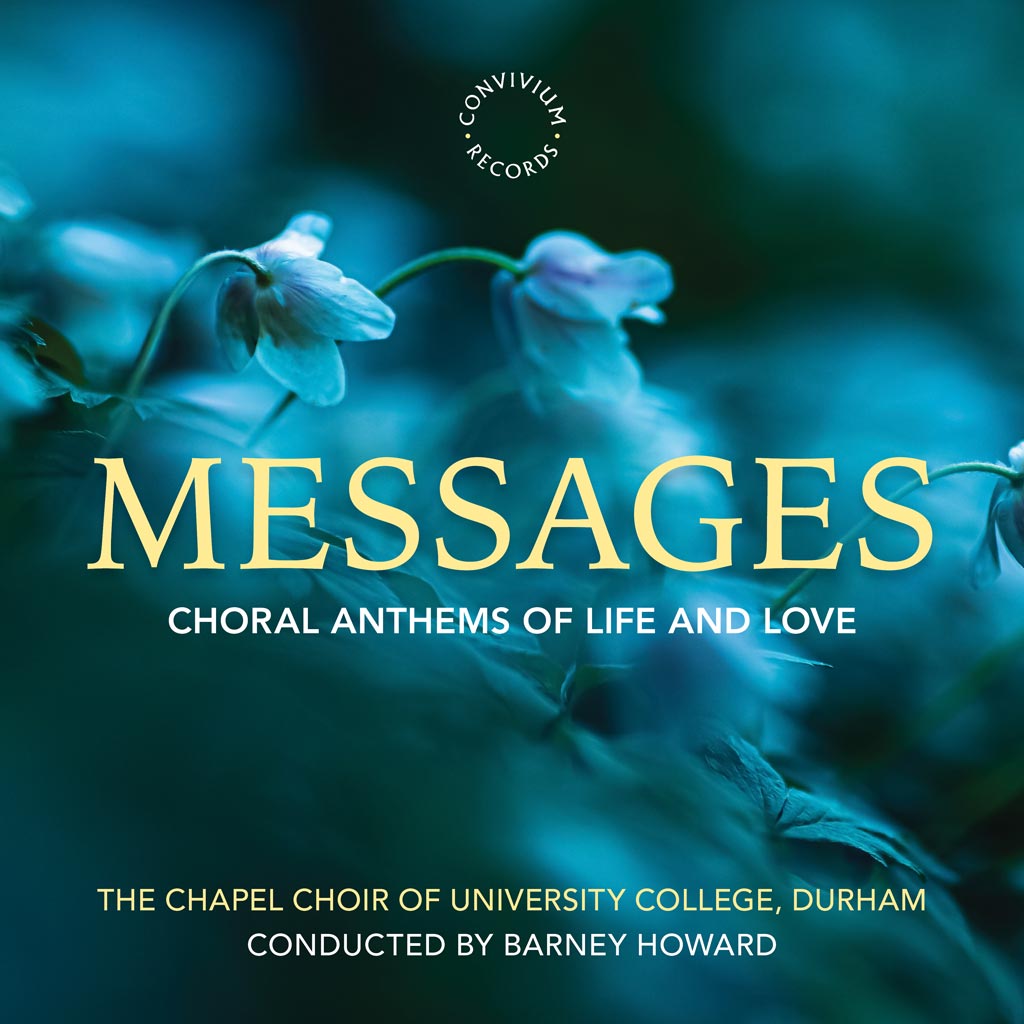
At once a celebration of Durham alumni and of David Knowles, who sang in the choir and whose life is celebrated here, particularly in Ben Rowath’s Messages, which sets comments about David from around his death.
Durham-centric this disc may be, but it begins with some Henry Pucell: Hear My Prayer, O Lord, an anthem included in David Knowles’s funeral at his request. It unfolds beautifully here, the Durham choir in fine voice, no harshness to the upper voices, and nicely rich lower down. Purcell’s beautiful setting of Psalm 102 is the perfect opener; it cedes to the other Purcell anthem, Remember Not, Lord, Our Offences. In both, Purcell’s characteristic harmonic twists that cut to the heart are fully honored: there is the feeling the singers fully enjoy them at least as much as I did.
Written for mixed (SATB) chorus and organ in 1916 to texts from Psalms 92, 67, 98, and 103 respectively, Amy Beach’s Four Canticles receives its first complete recording here. Some might know David Hill’s performance of Nos. 1 and 2 (“Bonum Est Confiteri,” and “Deus Misereatur” respectively) on the Regent album, The Canticle of the Sun, sadly not reviewed in Fanfare. The Hill is a strong performance, with some fine solo contributions from a member of the Charles Wood Singers. The first piece is almost symphonic in conception, a slow ascent from “As it was in the beginning” leading to a bright close. There is a fine soloist among the Charles Wood Singers, too. “Deus Misereatur” is more inward-looking, and there is no doubt the part-writing is beautifully honored by the Charles Wood Singers. But this Durham account offers all four, and a lot of enthusiasm and focus. Although the titles are in Latin, the text is sung in English. The soloist in “Bonum Est Confiteri” in Durham is not as strong as on Regent, but the slightly rustic, rough sound of the Durham organ is most appealing. Hill brings more import to that ascent and the final opening out, though. “Deus Misereatur,” is more from the heart in Durham, with an equal clarity of part-writing. “Cantate Domino” is robust and resolute (“O sing unto the Lord a new song”), some of the harmonies decidedly scrunchy. The writing is testing, especially for the upper voices, but the Durham Chapel Choir is valiant in its efforts. “Benedic, Anima Mea” begins with a perilous soprano solo, a touch seat-of-the-pants here; but the tutti sections are full and joyous, the close hopeful and quietly optimistic.
Ben Rowarth’s in memoriam, Messages, is appropriately circumspect. A clear piece of mourning, hummingly beautiful, that sits in contrast to the one other piece by Rowarth I previously knew, his A New Year Carol (on the Convivium disc, Missa Aedis Christi, Fanfare 48:5). The final diminuendo on Messages is beautiful, the whole piece a real highlight.
Edward Bairstow’s rousing, hymnic The Promise Which was Made Unto The Fathers sets a composite text from Acts, The Song of Solomon, and Psalm 145. A more traditional tutti contrasts with more imaginative organ writing in a solo contrasting section. The choir needs to be more rock-solid of intent in this piece, though; it only achieves full confidence in the final, rousing “Amen.” The more restrained The Day Draws On With Golden Light, also by Bairstow, is more effective, the final “amen” now warmer. And while that sets a fifth-century hymn (in translation), the a cappella Music, When Soft Voices Die takes words by Shelley. This latter performance is ideal: rhythms are perfectly judged, with Bairstow’s setting underlying the ex’s internal flow well. The final Bairstow of this group (but not the album) is Know Ye Not, which takes texts from Romans and the lesser-known Colossians. A confrontative male-voiced opening softens as the words move toward the phrase “the glory of the Father.”
I do find Jackson more imaginative than Bairstow: the difference is instantly audible with the arrival of the former’s Behold, Bless Ye The Lord (Psalm 134). Jackson’s Up To Those Bright and Gladsome Hills finds the wonderful Henry Vaughan elevating Psalm 121, and the music excels accordingly, the organ (and its absences) used as part of the dramatic processes, while Jackson’s Sing Praise to God maintains a joyful atmosphere with no slackening in imagination. The choir tracks the emotional contours of the music well.
It is Bairstow’s The King of Love My Shepherd Is that closes the collection, tender, caressing, all parts beautifully balanced and with no timbral hardenings.
An interesting collection made indispensable by the inclusion of the first complete recording of the Beach.
Review written by:
Review published in:
Other reviews by this author:
At once a celebration of Durham alumni and of David Knowles, who sang in the choir and whose life is celebrated here, particularly in Ben Rowath’s Messages, which sets comments about David from around his death.
Durham-centric this disc may be, but it begins with some Henry Pucell: Hear My Prayer, O Lord, an anthem included in David Knowles’s funeral at his request. It unfolds beautifully here, the Durham choir in fine voice, no harshness to the upper voices, and nicely rich lower down. Purcell’s beautiful setting of Psalm 102 is the perfect opener; it cedes to the other Purcell anthem, Remember Not, Lord, Our Offences. In both, Purcell’s characteristic harmonic twists that cut to the heart are fully honored: there is the feeling the singers fully enjoy them at least as much as I did.
Written for mixed (SATB) chorus and organ in 1916 to texts from Psalms 92, 67, 98, and 103 respectively, Amy Beach’s Four Canticles receives its first complete recording here. Some might know David Hill’s performance of Nos. 1 and 2 (“Bonum Est Confiteri,” and “Deus Misereatur” respectively) on the Regent album, The Canticle of the Sun, sadly not reviewed in Fanfare. The Hill is a strong performance, with some fine solo contributions from a member of the Charles Wood Singers. The first piece is almost symphonic in conception, a slow ascent from “As it was in the beginning” leading to a bright close. There is a fine soloist among the Charles Wood Singers, too. “Deus Misereatur” is more inward-looking, and there is no doubt the part-writing is beautifully honored by the Charles Wood Singers. But this Durham account offers all four, and a lot of enthusiasm and focus. Although the titles are in Latin, the text is sung in English. The soloist in “Bonum Est Confiteri” in Durham is not as strong as on Regent, but the slightly rustic, rough sound of the Durham organ is most appealing. Hill brings more import to that ascent and the final opening out, though. “Deus Misereatur,” is more from the heart in Durham, with an equal clarity of part-writing. “Cantate Domino” is robust and resolute (“O sing unto the Lord a new song”), some of the harmonies decidedly scrunchy. The writing is testing, especially for the upper voices, but the Durham Chapel Choir is valiant in its efforts. “Benedic, Anima Mea” begins with a perilous soprano solo, a touch seat-of-the-pants here; but the tutti sections are full and joyous, the close hopeful and quietly optimistic.
Ben Rowarth’s in memoriam, Messages, is appropriately circumspect. A clear piece of mourning, hummingly beautiful, that sits in contrast to the one other piece by Rowarth I previously knew, his A New Year Carol (on the Convivium disc, Missa Aedis Christi, Fanfare 48:5). The final diminuendo on Messages is beautiful, the whole piece a real highlight.
Edward Bairstow’s rousing, hymnic The Promise Which was Made Unto The Fathers sets a composite text from Acts, The Song of Solomon, and Psalm 145. A more traditional tutti contrasts with more imaginative organ writing in a solo contrasting section. The choir needs to be more rock-solid of intent in this piece, though; it only achieves full confidence in the final, rousing “Amen.” The more restrained The Day Draws On With Golden Light, also by Bairstow, is more effective, the final “amen” now warmer. And while that sets a fifth-century hymn (in translation), the a cappella Music, When Soft Voices Die takes words by Shelley. This latter performance is ideal: rhythms are perfectly judged, with Bairstow’s setting underlying the ex’s internal flow well. The final Bairstow of this group (but not the album) is Know Ye Not, which takes texts from Romans and the lesser-known Colossians. A confrontative male-voiced opening softens as the words move toward the phrase “the glory of the Father.”
I do find Jackson more imaginative than Bairstow: the difference is instantly audible with the arrival of the former’s Behold, Bless Ye The Lord (Psalm 134). Jackson’s Up To Those Bright and Gladsome Hills finds the wonderful Henry Vaughan elevating Psalm 121, and the music excels accordingly, the organ (and its absences) used as part of the dramatic processes, while Jackson’s Sing Praise to God maintains a joyful atmosphere with no slackening in imagination. The choir tracks the emotional contours of the music well.
It is Bairstow’s The King of Love My Shepherd Is that closes the collection, tender, caressing, all parts beautifully balanced and with no timbral hardenings.
An interesting collection made indispensable by the inclusion of the first complete recording of the Beach.
