
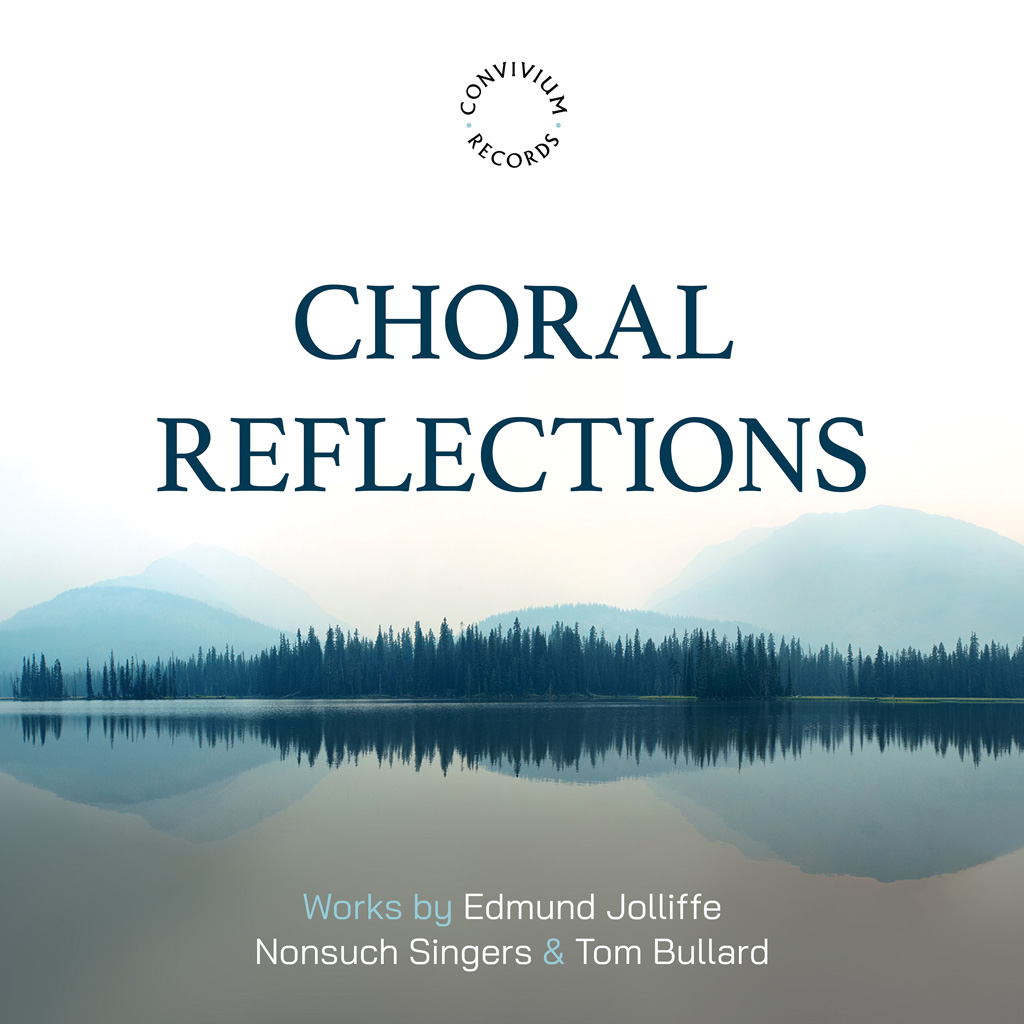
Choral Reflections – Review by Fanfare
“The Nonsuch Singers is a fine group, and Tom Bullard clearly understands the mechanics of Jolliffe's music well... Jolliffe’s music has real substance."
22nd September 2026
Choral Reflections – Review by Fanfare
“The Nonsuch Singers is a fine group, and Tom Bullard clearly understands the mechanics of Jolliffe's music well... Jolliffe’s music has real substance."
22nd September 2026
Listen or buy this album:
Entitled Choral Reflections, this is the first full album of choral music by Edmund Jolliffe, a collection of anthems, carols, and a seven-movement Sleep Cycle. Clarinettists may know Jolliffe from his collection for B flat clarinet and piano, My Family and Other Animals, published by Stainer & Bell.
Perhaps better known for his film and television credits (mostly UK channels and the Discovery Channel), Jolliffe also writes concert music. The structure of this disc is balanced: seven individual, sacred-oriented pieces balance out the seven movements of Sleep Cycle.
The climax of Lux aeterna at the keyword “Domine” appears as the natural outgrowth of the cushioned harmonies around it. Jolliffe is a master of the soft dissonance, while his scoring for this piece, with its emphasis on the lower voices, reflects the profundity of the text. The Nonsuch Singers is a fine group, and Tom Bullard clearly understands the mechanics of Jolliffe’s music well. O nata lux is heard in a chordal setting, its simplicity reflecting that of the text, and rising again naturally to its climaxes. The Nonsuch Singers’ sound is nicely blended, but nevertheless allows for the identification of individual parts. Jolliffe’s setting of “Laudes” seems particularly heartfelt.
It is always odd to write about Christmas carols at the height of a (this time blisteringly hot) summer, but here we are: Still, still, still, performed internationally from New York (Brick Presbyterian Church) to Westminster Abbey. The moment when the tenors take the line, surrounded on both sides by protective harmonies (“He lies in slumber deep, / While angel hosts from / heav’n come winging”) shows the touching depth of which Jolliffe is capable. The hummed close is both logical and musically satisfying.
Taking a text from the late 1560s, O my dear heart includes a lovely solo from soprano Alexia Howard. The piece seems related in mood to Still, still, still and is indeed Chrimbo-related: commissioned by the UK’s Choir and Organ magazine and subsequently published by OUP, it captures joy and wonder in equal measure brilliantly. It is also a study in sustaining a mood, and this the Nonsuch Singers do perfectly.
William Blake’s There is no rose has been set by a whole raft of composers. Jolliffe adds a restrained “Hallelujah.” His setting is directly inspired by Britten’s (from A Ceremony of Carols) but dispenses with harp. Instead, Jolliffe has a solo group, spatially positioned, who are also mobile and later join the tutti (something that can only ever be imperfectly realized on audio recording): another Britten tribute, this time to Hymn to the Virgin. Incredibly, Jolliffe’s setting sits alongside Britten’s in terms of inspiration (A Ceremony of Carols is surely one of the finest pieces in Britten’s somewhat uneven output). The solo singers in Jolliffe’s piece are soprano Laura Parkes, alto Alice Jackson, tenor Michael Snapes, and bass Jonathan Rose. Despite the limitations of stereo- and audio-only release, Jolliffe’s piece remains highly impressive, the single-tone repetitions (mirroring those in the Britten) taking on a sense of the ancient and the eternal. Small wonder this is a prizewinning piece.
Adam lay ybounden is another carol, and another piece premiered at New York’s Brick Presbyterian Church. It is very short (1”35), but that is its strength, Jolliffe’s chordal setting also implying a tie to plainchant; and again, the path to the climax at “Deo gratias” is well plotted and realized (laudably, with no timbral change on the sopranos as they move higher).
Finally for the stand-alone pieces, a setting of Emily Dickinson’s magisterial subversion of Biblical scripture, Abraham to kill him. The name “Abraham” is repeated as a mantra at the opening, in emotive counterpoint to the more consoling text. Some literary criticism aligns Dickinson’s poem with another examination of the Judeo-Christian God’s notorious cruelty, John Donne’s Holy Sonnet “Batter my heart”; but Dickinson’s take is bleaker and, arguably, more powerful for it. Donne’s protagonist actively seeks pain in order to be cleansed and therefore closer to his chosen God, while Jolliffe’s setting seeks to soothe, overtly acknowledging the protagonist’s pain in the overlapping dissonances of the “Abraham” repetitions.
So to Sleep Cycle of 2018, the result of a 10-week residency at the Wurlitzer Foundation, New Mexico. Jolliffe wrote the piece with the Nonsuch Singers in mind. The texts track the stages of sleep and are taken from a variety of writers, including Shakespeare, whose Macbeth also provides the material for the quote in the booklet: “Sleep that knits up / the ravell’d sleeve of time” (Macbeth himself, tormented, in act 2). It is The Tempest that furnishes the first movement, “Be not afeard” (of the “thousand twangling instruments”), set initially rapidly, with “be not afeard” as an entreaty. Marietta Holley (1836–1926) offers up a plea for sleep to press the pain from her furrowed brow; how potent is Jolliffe’s harmonic softening at “Lull me with slumbrous song,” and how expert the soprano’s maintenance of line later in the movement.
Lord Byron knew something about darkness, “the bright sun was extinguish’d,” the title of the next movement, inspired by an actual event brought about by a volcanic eruption. Jolliffe responds to the text memorably. This represents the deepest part of sleep, wherein nightmares may stealthily come, and the performance contains real undercurrents of foundations rocked. Perhaps the setting of the very end is a little obvious: a plosive “crash,” and then slippery descents on “and all was black.”
“What if you slept?” sets Samuel Taylor Coleridge and examines the conflict of dream versus reality, an apt portrayal of the fourth stage of a sleep cycle (at which point, if one is awoken, disorientation is at its height). The performance here has real urgency, the final titular question hanging quizzically in the air. In total contrast comes a setting of Christina Rossetti, “I dream of you to wake (Monna Innominata).” “Only in a dream are we as one” says the poem, and the setting is suffused with the warmth and certainty a dream state can bring.
A poem by Ella Higginson (1862–1940) provides the text for the penultimate movement, “Dream Time,” its softly undulating textures a direct prolongation of the state of the previous poem. There is another (this time unacknowledged in the notes) tip of the hat to Britten in the final movement: Ben Jonson’s “Hymn to Diana,” simply known as “Hymn” in Britten’s op. 31 Serenade for tenor, horn, and strings. Jolliffe highlights the cyclic nature of the text (Diana, a Goddess “excellently bright,” “makes the day of night”). Jolliffe’s setting is markedly less frenetic than Britten’s, enabling a sense of aspiration, of the hope of a new day, to shine forth. The performance reflects this, absolutely glowing in the final statement of “excellently bright.”
I am glad to make the acquaintance of the Nonsuch Singers under their excellent director Tom Bullard; and Jolliffe’s music has real substance.
Review written by:
Review published in:
Other reviews by this author:
Featured artists:
Featured composers:
Entitled Choral Reflections, this is the first full album of choral music by Edmund Jolliffe, a collection of anthems, carols, and a seven-movement Sleep Cycle. Clarinettists may know Jolliffe from his collection for B flat clarinet and piano, My Family and Other Animals, published by Stainer & Bell.
Perhaps better known for his film and television credits (mostly UK channels and the Discovery Channel), Jolliffe also writes concert music. The structure of this disc is balanced: seven individual, sacred-oriented pieces balance out the seven movements of Sleep Cycle.
The climax of Lux aeterna at the keyword “Domine” appears as the natural outgrowth of the cushioned harmonies around it. Jolliffe is a master of the soft dissonance, while his scoring for this piece, with its emphasis on the lower voices, reflects the profundity of the text. The Nonsuch Singers is a fine group, and Tom Bullard clearly understands the mechanics of Jolliffe’s music well. O nata lux is heard in a chordal setting, its simplicity reflecting that of the text, and rising again naturally to its climaxes. The Nonsuch Singers’ sound is nicely blended, but nevertheless allows for the identification of individual parts. Jolliffe’s setting of “Laudes” seems particularly heartfelt.
It is always odd to write about Christmas carols at the height of a (this time blisteringly hot) summer, but here we are: Still, still, still, performed internationally from New York (Brick Presbyterian Church) to Westminster Abbey. The moment when the tenors take the line, surrounded on both sides by protective harmonies (“He lies in slumber deep, / While angel hosts from / heav’n come winging”) shows the touching depth of which Jolliffe is capable. The hummed close is both logical and musically satisfying.
Taking a text from the late 1560s, O my dear heart includes a lovely solo from soprano Alexia Howard. The piece seems related in mood to Still, still, still and is indeed Chrimbo-related: commissioned by the UK’s Choir and Organ magazine and subsequently published by OUP, it captures joy and wonder in equal measure brilliantly. It is also a study in sustaining a mood, and this the Nonsuch Singers do perfectly.
William Blake’s There is no rose has been set by a whole raft of composers. Jolliffe adds a restrained “Hallelujah.” His setting is directly inspired by Britten’s (from A Ceremony of Carols) but dispenses with harp. Instead, Jolliffe has a solo group, spatially positioned, who are also mobile and later join the tutti (something that can only ever be imperfectly realized on audio recording): another Britten tribute, this time to Hymn to the Virgin. Incredibly, Jolliffe’s setting sits alongside Britten’s in terms of inspiration (A Ceremony of Carols is surely one of the finest pieces in Britten’s somewhat uneven output). The solo singers in Jolliffe’s piece are soprano Laura Parkes, alto Alice Jackson, tenor Michael Snapes, and bass Jonathan Rose. Despite the limitations of stereo- and audio-only release, Jolliffe’s piece remains highly impressive, the single-tone repetitions (mirroring those in the Britten) taking on a sense of the ancient and the eternal. Small wonder this is a prizewinning piece.
Adam lay ybounden is another carol, and another piece premiered at New York’s Brick Presbyterian Church. It is very short (1”35), but that is its strength, Jolliffe’s chordal setting also implying a tie to plainchant; and again, the path to the climax at “Deo gratias” is well plotted and realized (laudably, with no timbral change on the sopranos as they move higher).
Finally for the stand-alone pieces, a setting of Emily Dickinson’s magisterial subversion of Biblical scripture, Abraham to kill him. The name “Abraham” is repeated as a mantra at the opening, in emotive counterpoint to the more consoling text. Some literary criticism aligns Dickinson’s poem with another examination of the Judeo-Christian God’s notorious cruelty, John Donne’s Holy Sonnet “Batter my heart”; but Dickinson’s take is bleaker and, arguably, more powerful for it. Donne’s protagonist actively seeks pain in order to be cleansed and therefore closer to his chosen God, while Jolliffe’s setting seeks to soothe, overtly acknowledging the protagonist’s pain in the overlapping dissonances of the “Abraham” repetitions.
So to Sleep Cycle of 2018, the result of a 10-week residency at the Wurlitzer Foundation, New Mexico. Jolliffe wrote the piece with the Nonsuch Singers in mind. The texts track the stages of sleep and are taken from a variety of writers, including Shakespeare, whose Macbeth also provides the material for the quote in the booklet: “Sleep that knits up / the ravell’d sleeve of time” (Macbeth himself, tormented, in act 2). It is The Tempest that furnishes the first movement, “Be not afeard” (of the “thousand twangling instruments”), set initially rapidly, with “be not afeard” as an entreaty. Marietta Holley (1836–1926) offers up a plea for sleep to press the pain from her furrowed brow; how potent is Jolliffe’s harmonic softening at “Lull me with slumbrous song,” and how expert the soprano’s maintenance of line later in the movement.
Lord Byron knew something about darkness, “the bright sun was extinguish’d,” the title of the next movement, inspired by an actual event brought about by a volcanic eruption. Jolliffe responds to the text memorably. This represents the deepest part of sleep, wherein nightmares may stealthily come, and the performance contains real undercurrents of foundations rocked. Perhaps the setting of the very end is a little obvious: a plosive “crash,” and then slippery descents on “and all was black.”
“What if you slept?” sets Samuel Taylor Coleridge and examines the conflict of dream versus reality, an apt portrayal of the fourth stage of a sleep cycle (at which point, if one is awoken, disorientation is at its height). The performance here has real urgency, the final titular question hanging quizzically in the air. In total contrast comes a setting of Christina Rossetti, “I dream of you to wake (Monna Innominata).” “Only in a dream are we as one” says the poem, and the setting is suffused with the warmth and certainty a dream state can bring.
A poem by Ella Higginson (1862–1940) provides the text for the penultimate movement, “Dream Time,” its softly undulating textures a direct prolongation of the state of the previous poem. There is another (this time unacknowledged in the notes) tip of the hat to Britten in the final movement: Ben Jonson’s “Hymn to Diana,” simply known as “Hymn” in Britten’s op. 31 Serenade for tenor, horn, and strings. Jolliffe highlights the cyclic nature of the text (Diana, a Goddess “excellently bright,” “makes the day of night”). Jolliffe’s setting is markedly less frenetic than Britten’s, enabling a sense of aspiration, of the hope of a new day, to shine forth. The performance reflects this, absolutely glowing in the final statement of “excellently bright.”
I am glad to make the acquaintance of the Nonsuch Singers under their excellent director Tom Bullard; and Jolliffe’s music has real substance.
