
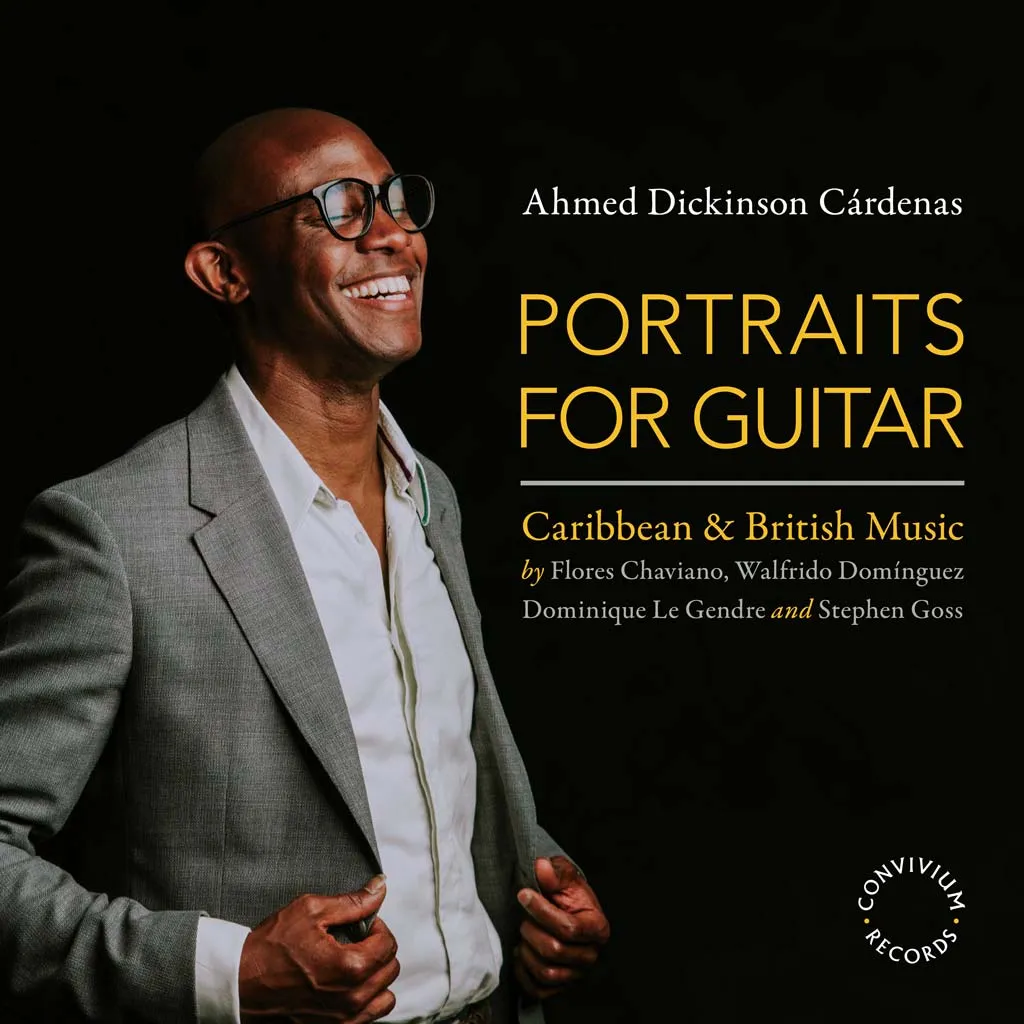
Portraits for Guitar – Review by Fanfare
"A very fine disc, then, brilliantly and always musically performed by Ahmed Dickinson Cárdenas. Recommended."
22nd September 2026
Portraits for Guitar – Review by Fanfare
"A very fine disc, then, brilliantly and always musically performed by Ahmed Dickinson Cárdenas. Recommended."
22nd September 2026
Listen or buy this album:
Afro-Caribbean, European, and Caribbean sound worlds co-exist on this lovely disc. Completing the sense of geographical extravagance is a shower of colors, brilliantly evoked by Cuban-born (and Cuban-trained) Ahmed Dickinson Cárdenas.
Stephen Goss reworked his 2012 Guitar Concerto into the Sonatina heard here. John Williams’ account of the concerto (with the Royal Philharmonic and Paul Daniel and coupled with concertos by Horacio Solinas and Ross Edwards) was positively reviewed by both Jim Svejda and Phillip Scott in Fanfare 38:4. Rightly so: John Williams is fabulous, and the piece is both imaginative and enjoyable (not least the long contemplative plateau of the first movement). Of course, with orchestra, the solo cadenza is maximally emphasized. Goss contrasts an innate lyricism with sparkly, bright passages (the overall marking is actually “Bold and bright”). Cárdenas maintains the luminosity of the opening beautifully, as well as the momentum. The concerto is inspired by London Underground and the first movement specifically by the Circle Line, so I am surprised it moves at all, frankly. That’s only half a joke, but what is not is how special Cárdenas’s performance is, whether momentum-driven or contemplative. He seems to underline the spiciness of the slower section, giving it a certain piquancy that I missed in the Williams. The slow movement, “Marylebone Elegy,” opens with solo guitar in the full version, with the horns and wind (against pizzicato lower strings) entering ever so gently. Clearly it’s a Sunday; it is also an Adagio sostenuto, and an “Homage to Elgar,” this last clearly audible in the harmonies and the sense of very English repose (the top button firmly buttoned up, then). Williams does have a finer sense of line than Cárdenas throughout, and there is a retained guitar “squeak” at just after 30 seconds in the new recording. The two performances are very different experiences, with Williams and his orchestra nailing the Elgar tribute. The finale is an Allegro molto and reflects the busy atmosphere of Canary Wharf, a business district in London’s East (if not the East End) and a short hop from London City Airport. But the finale also has a quieter section. The music references the Spanish “canary” tradition via hemiola, too, and harmonic references can be heard in the slower sections. Cárdenas’ slower tempo actually allows for the energy of the rhythms to chine through (also, his faster sections carry firmer “Spanish” aspects) and his reflections carry much weight, too. Basically, the two performances complement each other both in terms of scoring and interpretation.
Two early works follow by Cuban composer Flores Chaviano (b. 1946). The works we hear here were composed in the 1970s. First, Sonata, Evocación y Boceto, referenced as one in the track listing but tracked separately and counted as three pieces in the booklet text. Considered as a triptych, they comprise the last works Chaviano wrote before he left Cuba. The Sonata is modeled on a guajira, a development of the punto cubano and its characteristic 3+3, then 2+2+2 patterns. The music sways beautifully here; over on Ricardo Gallén (appearing as part of that label’s Laureate Series) is markedly faster in the opening gestures, and draws greater contrasts (sadly, not reviewed in Fanfare previously). Gallén’s recording is finer, too, and he finds the ideal balance of momentum and emotion in the Evocación; Cárdenas is not far off but is just too slow to maintain an equivalent sense of flow. The basic habanera rhythm is more prominent via Cárdenas, whereas in the Gallén it is more of a whispered memory. The final Boceto, catapulted forth on a sea of vibrant rhythms and guitar color, is a wonderful piece (an ideal recital encore, I would suggest). Honors are more evenly distributed here: both Cárdenas and Gallén do the piece proud. In the final analysis, is just that bit more exciting.
Next, a set of variations on a traditional Afro-Cuban song, Yenyere Guma, whose origins are rooted in Central African ritual praxis. While the earlier piece(s) remain excellent music, this piece approaches the status of masterwork: it is so imaginative, and clearly so perfectly constructed. And Cárdenas believes in it 100 percent. The sheet music is published by Schott, should other guitarists want to give it a go.
Born in 1960 in Trinidad and Tobago and now residing in London, UK, Dominique Le Gendre offers Tongay Triptych, inspired by a trip to northern Chile. The first movement, “Tongoy Sea” reflects the sleepy atmosphere: Cárdenas is joined by Helen Sanderson on second guitar in this musical holiday. The music is attractive and skillful; much the same could be said of the performances. “Tololo Sky,” a depiction again includes an extraneous noise (at 1:18) has a light blue sky sort of brightness to it, and as the textures increase towards the end, Cárdenas and Sanderson allow them to speak with tissue lightness The concluding “Elqui, Earth” is a depiction of a sleepy but earthy place. Deliberate knockings on guitar establish a background rhythm against which the melody can evolve. Le Gendre is a natural melodist, and a natural painter in sound.
Another contemporary composer (and guitarist and arranger), Cuban Walfrido Domínguez (born 1954, not to be confused with Alfredo, of Perfidia fame) contributes his 2014 Cuaderno de Viaje No. 5. Although conceived as teaching pieces, they carry real musical weight. Across a sequence of six pieces, Cuban folk instruments (in imitation) meet invocations of nature. The music seems in constant motion, and sometimes it feels like a line is taken for different walks (the first and second pieces open similarly and then head in different directions). Even the third (“Remolino cuatro vientos”) contains similarities. For once, I will quote the booklet notes it sums up what happens in this music: “the guitar becomes both vehicle and narrator, tracing a personal and collective journey through Cuban musical identity. What begins as a technical exploration ultimately unfolds as a poetic voyage, inviting the listener to traverse not only the island, but also the layered histories and rhythms that animate its music.” The attractiveness and sense of rightness around Cárdenas’s performance of the fourth movement, “Aire con aire que el sol abrasa” sums up his approach to the entire set, while the slight darkening of the final “Aire de agua” implies a deepening that is to be continued …
… not here, however; the disc concludes with more Le Gendre, this time for solo guitar, the Six Sketches of 2025, composed for the present guitarist (although dedicated to the Hollick Family Foundation). This was the composer’s first work for guitar for 45 years. The piece fulfils its own remit perfectly: six self-contained units that “prioritises expression over reflex.” Cárdenas’s playing is beautifully sweet-toned, bringing a timelessness to the third (there are no titles) and a bitter-sweet tang to the dissonances of the fourth.
A very fine disc, then, brilliantly and always musically performed by Ahmed Dickinson Cárdenas. Recommended.
Review written by:
Review published in:
Other reviews by this author:
Featured artists:
Featured composers:
Afro-Caribbean, European, and Caribbean sound worlds co-exist on this lovely disc. Completing the sense of geographical extravagance is a shower of colors, brilliantly evoked by Cuban-born (and Cuban-trained) Ahmed Dickinson Cárdenas.
Stephen Goss reworked his 2012 Guitar Concerto into the Sonatina heard here. John Williams’ account of the concerto (with the Royal Philharmonic and Paul Daniel and coupled with concertos by Horacio Solinas and Ross Edwards) was positively reviewed by both Jim Svejda and Phillip Scott in Fanfare 38:4. Rightly so: John Williams is fabulous, and the piece is both imaginative and enjoyable (not least the long contemplative plateau of the first movement). Of course, with orchestra, the solo cadenza is maximally emphasized. Goss contrasts an innate lyricism with sparkly, bright passages (the overall marking is actually “Bold and bright”). Cárdenas maintains the luminosity of the opening beautifully, as well as the momentum. The concerto is inspired by London Underground and the first movement specifically by the Circle Line, so I am surprised it moves at all, frankly. That’s only half a joke, but what is not is how special Cárdenas’s performance is, whether momentum-driven or contemplative. He seems to underline the spiciness of the slower section, giving it a certain piquancy that I missed in the Williams. The slow movement, “Marylebone Elegy,” opens with solo guitar in the full version, with the horns and wind (against pizzicato lower strings) entering ever so gently. Clearly it’s a Sunday; it is also an Adagio sostenuto, and an “Homage to Elgar,” this last clearly audible in the harmonies and the sense of very English repose (the top button firmly buttoned up, then). Williams does have a finer sense of line than Cárdenas throughout, and there is a retained guitar “squeak” at just after 30 seconds in the new recording. The two performances are very different experiences, with Williams and his orchestra nailing the Elgar tribute. The finale is an Allegro molto and reflects the busy atmosphere of Canary Wharf, a business district in London’s East (if not the East End) and a short hop from London City Airport. But the finale also has a quieter section. The music references the Spanish “canary” tradition via hemiola, too, and harmonic references can be heard in the slower sections. Cárdenas’ slower tempo actually allows for the energy of the rhythms to chine through (also, his faster sections carry firmer “Spanish” aspects) and his reflections carry much weight, too. Basically, the two performances complement each other both in terms of scoring and interpretation.
Two early works follow by Cuban composer Flores Chaviano (b. 1946). The works we hear here were composed in the 1970s. First, Sonata, Evocación y Boceto, referenced as one in the track listing but tracked separately and counted as three pieces in the booklet text. Considered as a triptych, they comprise the last works Chaviano wrote before he left Cuba. The Sonata is modeled on a guajira, a development of the punto cubano and its characteristic 3+3, then 2+2+2 patterns. The music sways beautifully here; over on Ricardo Gallén (appearing as part of that label’s Laureate Series) is markedly faster in the opening gestures, and draws greater contrasts (sadly, not reviewed in Fanfare previously). Gallén’s recording is finer, too, and he finds the ideal balance of momentum and emotion in the Evocación; Cárdenas is not far off but is just too slow to maintain an equivalent sense of flow. The basic habanera rhythm is more prominent via Cárdenas, whereas in the Gallén it is more of a whispered memory. The final Boceto, catapulted forth on a sea of vibrant rhythms and guitar color, is a wonderful piece (an ideal recital encore, I would suggest). Honors are more evenly distributed here: both Cárdenas and Gallén do the piece proud. In the final analysis, is just that bit more exciting.
Next, a set of variations on a traditional Afro-Cuban song, Yenyere Guma, whose origins are rooted in Central African ritual praxis. While the earlier piece(s) remain excellent music, this piece approaches the status of masterwork: it is so imaginative, and clearly so perfectly constructed. And Cárdenas believes in it 100 percent. The sheet music is published by Schott, should other guitarists want to give it a go.
Born in 1960 in Trinidad and Tobago and now residing in London, UK, Dominique Le Gendre offers Tongay Triptych, inspired by a trip to northern Chile. The first movement, “Tongoy Sea” reflects the sleepy atmosphere: Cárdenas is joined by Helen Sanderson on second guitar in this musical holiday. The music is attractive and skillful; much the same could be said of the performances. “Tololo Sky,” a depiction again includes an extraneous noise (at 1:18) has a light blue sky sort of brightness to it, and as the textures increase towards the end, Cárdenas and Sanderson allow them to speak with tissue lightness The concluding “Elqui, Earth” is a depiction of a sleepy but earthy place. Deliberate knockings on guitar establish a background rhythm against which the melody can evolve. Le Gendre is a natural melodist, and a natural painter in sound.
Another contemporary composer (and guitarist and arranger), Cuban Walfrido Domínguez (born 1954, not to be confused with Alfredo, of Perfidia fame) contributes his 2014 Cuaderno de Viaje No. 5. Although conceived as teaching pieces, they carry real musical weight. Across a sequence of six pieces, Cuban folk instruments (in imitation) meet invocations of nature. The music seems in constant motion, and sometimes it feels like a line is taken for different walks (the first and second pieces open similarly and then head in different directions). Even the third (“Remolino cuatro vientos”) contains similarities. For once, I will quote the booklet notes it sums up what happens in this music: “the guitar becomes both vehicle and narrator, tracing a personal and collective journey through Cuban musical identity. What begins as a technical exploration ultimately unfolds as a poetic voyage, inviting the listener to traverse not only the island, but also the layered histories and rhythms that animate its music.” The attractiveness and sense of rightness around Cárdenas’s performance of the fourth movement, “Aire con aire que el sol abrasa” sums up his approach to the entire set, while the slight darkening of the final “Aire de agua” implies a deepening that is to be continued …
… not here, however; the disc concludes with more Le Gendre, this time for solo guitar, the Six Sketches of 2025, composed for the present guitarist (although dedicated to the Hollick Family Foundation). This was the composer’s first work for guitar for 45 years. The piece fulfils its own remit perfectly: six self-contained units that “prioritises expression over reflex.” Cárdenas’s playing is beautifully sweet-toned, bringing a timelessness to the third (there are no titles) and a bitter-sweet tang to the dissonances of the fourth.
A very fine disc, then, brilliantly and always musically performed by Ahmed Dickinson Cárdenas. Recommended.
