
Gerald Finzi: Three Sacred Anthems – Review by Fanfare
“A short album, but a significant one... It is good to have Finzi’s op. 27 in these arrangements, performed with enthusiasm.”
27th June 2026
Gerald Finzi: Three Sacred Anthems – Review by Fanfare
“A short album, but a significant one... It is good to have Finzi’s op. 27 in these arrangements, performed with enthusiasm.”
27th June 2026
Listen or buy this album:
Firstly, we don’t hear enough music by Gerald Finzi, one of the great British composers. His Clarinet Concerto is one of the finest for that instrument, the Eclogue for piano and orchestra is well worth investigating, and, as we can hear here, his choral music is special too: Finzi’s music seems imbued with a depth and mysticism that plumbs deeper than many of his immediate compatriots, and nowhere is that truer than in his church choral works. Texts for these op. 27 anthems are by the Metaphysical poet Edward Taylor (1642–1729, of English origin but known for his colonial activities). Given Finzi’s “Anglican Agnostic” stance, all of this makes complete sense.
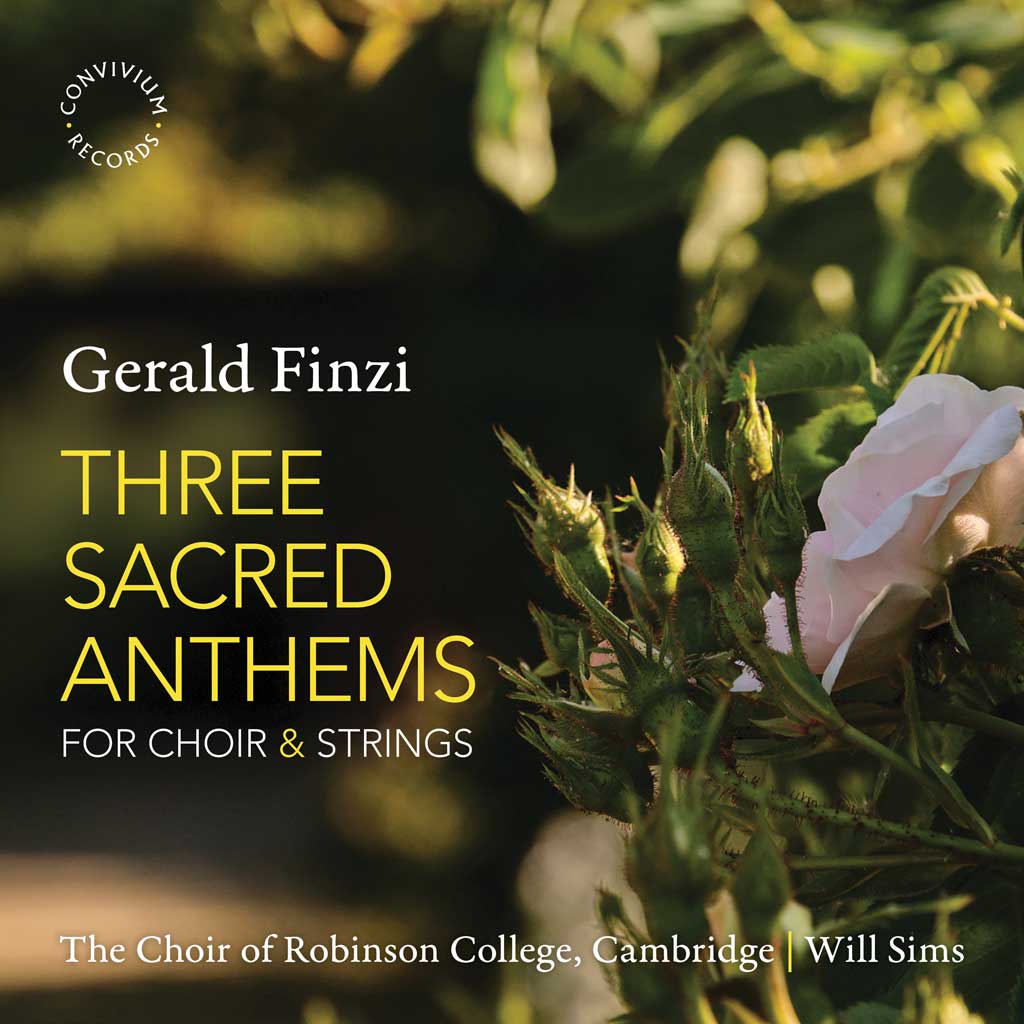
Simply entitled Three Sacred Anthems, this is a short album, but a significant one, performed by the Choir of Robinson College, Cambridge under Will Simms. The first anthem is “My Lovely One,” a marriage anthem dating from 1946 to a text from Taylor’s Sacramental meditations. It is good to have an instrumental ensemble here, the strings tender and translucent; the melody, a sigh after a neighbor-note figure, seems to have a supplicatory aspect to it. Arrivals on a major third are well managed, too. The text is the final stanza of Meditation 12, “Glorious in his apparel.” The tempo is a perfect Andante sostenuto. “Oh let thy beauty give a glorious touch upon my heart” is stunning here. Finzi constructs a gem from simple material, and ensures also that the three sections are linked via common pulse (with dotted fourth note equalling fourth note).
Keeping it Cambridge, the Naxos performance by the Choir of St. John’s, Cambridge on an all-Finzi Naxos disc is with organ, again at a nice tempo; over at Westminster Abbey, James O’Donnell on Hyperion takes it slower, perhaps to allow the music to speak in the cavernous acoustic: but the fact remains the music must move. The Paul Spicer recording on Chandos is also loving of its subject but contains the finest choral singing: the sheer perfection of the upper voices’ slurs is arresting in itself. Robert McColley was right to later welcome this into his Want List after encountering the recording in Fanfare 15:2 (1991).
“God is Gone Up” (1951, for Ascension), performed with orchestra and organ in its original orchestration, is perhaps not as well caught at higher dynamic levels. There is a majesty to this music that is just missed. Tenors sound strained, the recorded balance places the instrumentalists a touch too forward, and the triumphant “and let the King of Glory enter in” loses its majesty. The reflective central section works best. The piece’s indicator tells the whole story of what is needed: Allegro non troppo maestoso; anything less fails. The upward sweep of the strings in the final measures is less than convincing, too. The St. John’s organ sounds amazing on Naxos, and the choir absolutely lets rip as “God is gone up with a triumphal shout,” relishing the dissonances at “Sing praises out.” The Chandos recording allows a little more space, which robs the music of some of its majesty. Most impressive of all, though, is the Choir of Clare College, Cambridge on their Harmonia Mundi disc, Ascendit Deus. With organ, for sure, but how the sense of excited exultation is supremely caught.
Finally, “Welcome, Sweet and Sacred Feast” (1953), opening in a bath of sweet strings, the players here phrasing beautifully. Again, placing the orchestra further back would have cleared balance issues, and again tenors seem challenged in their upper-mid and higher registers. Like Lo, the full and final sacrifice, this is a Eucharist setting. But this is also the most dramatic of the three anthems, with its string tremolos, and that aspect is fully realized, enabling the later solo strings to make full effect. I just wish that the magical arrival at “O rose of Sharon!” was more significant. While Will Simms has the measure of the piece, structurally, this piece can strike deeper, as it does via Magdalen College, Oxford and Mark Williams (to go to the opposing “team”!) on their phenomenal album on Coro, Arise my love, where it is performed with organ.
There is perhaps a hint of irony in that last comparison, as the arranger, Peter Hayward, was an academical clerk there in the 1970s when he first heard “Welcome Sweet and Sacred Feast”; this was the first to be arranged for strings, and was premiered in 2005. It was Simms’ enthusiasm that led to the arrangement of “My Lovely One,” and both are heard here in premiere recordings. It is good to have Finzi’s op. 27 in these arrangements, performed with enthusiasm.
Review written by:
Review published in:
Other reviews by this author:
Firstly, we don’t hear enough music by Gerald Finzi, one of the great British composers. His Clarinet Concerto is one of the finest for that instrument, the Eclogue for piano and orchestra is well worth investigating, and, as we can hear here, his choral music is special too: Finzi’s music seems imbued with a depth and mysticism that plumbs deeper than many of his immediate compatriots, and nowhere is that truer than in his church choral works. Texts for these op. 27 anthems are by the Metaphysical poet Edward Taylor (1642–1729, of English origin but known for his colonial activities). Given Finzi’s “Anglican Agnostic” stance, all of this makes complete sense.
Simply entitled Three Sacred Anthems, this is a short album, but a significant one, performed by the Choir of Robinson College, Cambridge under Will Simms. The first anthem is “My Lovely One,” a marriage anthem dating from 1946 to a text from Taylor’s Sacramental meditations. It is good to have an instrumental ensemble here, the strings tender and translucent; the melody, a sigh after a neighbor-note figure, seems to have a supplicatory aspect to it. Arrivals on a major third are well managed, too. The text is the final stanza of Meditation 12, “Glorious in his apparel.” The tempo is a perfect Andante sostenuto. “Oh let thy beauty give a glorious touch upon my heart” is stunning here. Finzi constructs a gem from simple material, and ensures also that the three sections are linked via common pulse (with dotted fourth note equalling fourth note).
Keeping it Cambridge, the Naxos performance by the Choir of St. John’s, Cambridge on an all-Finzi Naxos disc is with organ, again at a nice tempo; over at Westminster Abbey, James O’Donnell on Hyperion takes it slower, perhaps to allow the music to speak in the cavernous acoustic: but the fact remains the music must move. The Paul Spicer recording on Chandos is also loving of its subject but contains the finest choral singing: the sheer perfection of the upper voices’ slurs is arresting in itself. Robert McColley was right to later welcome this into his Want List after encountering the recording in Fanfare 15:2 (1991).
“God is Gone Up” (1951, for Ascension), performed with orchestra and organ in its original orchestration, is perhaps not as well caught at higher dynamic levels. There is a majesty to this music that is just missed. Tenors sound strained, the recorded balance places the instrumentalists a touch too forward, and the triumphant “and let the King of Glory enter in” loses its majesty. The reflective central section works best. The piece’s indicator tells the whole story of what is needed: Allegro non troppo maestoso; anything less fails. The upward sweep of the strings in the final measures is less than convincing, too. The St. John’s organ sounds amazing on Naxos, and the choir absolutely lets rip as “God is gone up with a triumphal shout,” relishing the dissonances at “Sing praises out.” The Chandos recording allows a little more space, which robs the music of some of its majesty. Most impressive of all, though, is the Choir of Clare College, Cambridge on their Harmonia Mundi disc, Ascendit Deus. With organ, for sure, but how the sense of excited exultation is supremely caught.
Finally, “Welcome, Sweet and Sacred Feast” (1953), opening in a bath of sweet strings, the players here phrasing beautifully. Again, placing the orchestra further back would have cleared balance issues, and again tenors seem challenged in their upper-mid and higher registers. Like Lo, the full and final sacrifice, this is a Eucharist setting. But this is also the most dramatic of the three anthems, with its string tremolos, and that aspect is fully realized, enabling the later solo strings to make full effect. I just wish that the magical arrival at “O rose of Sharon!” was more significant. While Will Simms has the measure of the piece, structurally, this piece can strike deeper, as it does via Magdalen College, Oxford and Mark Williams (to go to the opposing “team”!) on their phenomenal album on Coro, Arise my love, where it is performed with organ.
There is perhaps a hint of irony in that last comparison, as the arranger, Peter Hayward, was an academical clerk there in the 1970s when he first heard “Welcome Sweet and Sacred Feast”; this was the first to be arranged for strings, and was premiered in 2005. It was Simms’ enthusiasm that led to the arrangement of “My Lovely One,” and both are heard here in premiere recordings. It is good to have Finzi’s op. 27 in these arrangements, performed with enthusiasm.
