
O Maria, virgo pia – Review by Fanfare
“An interesting, Oriel-centric release... there are gems here, and the choir certainly gives its all.”
29th July 2026
O Maria, virgo pia – Review by Fanfare
“An interesting, Oriel-centric release... there are gems here, and the choir certainly gives its all.”
29th July 2026
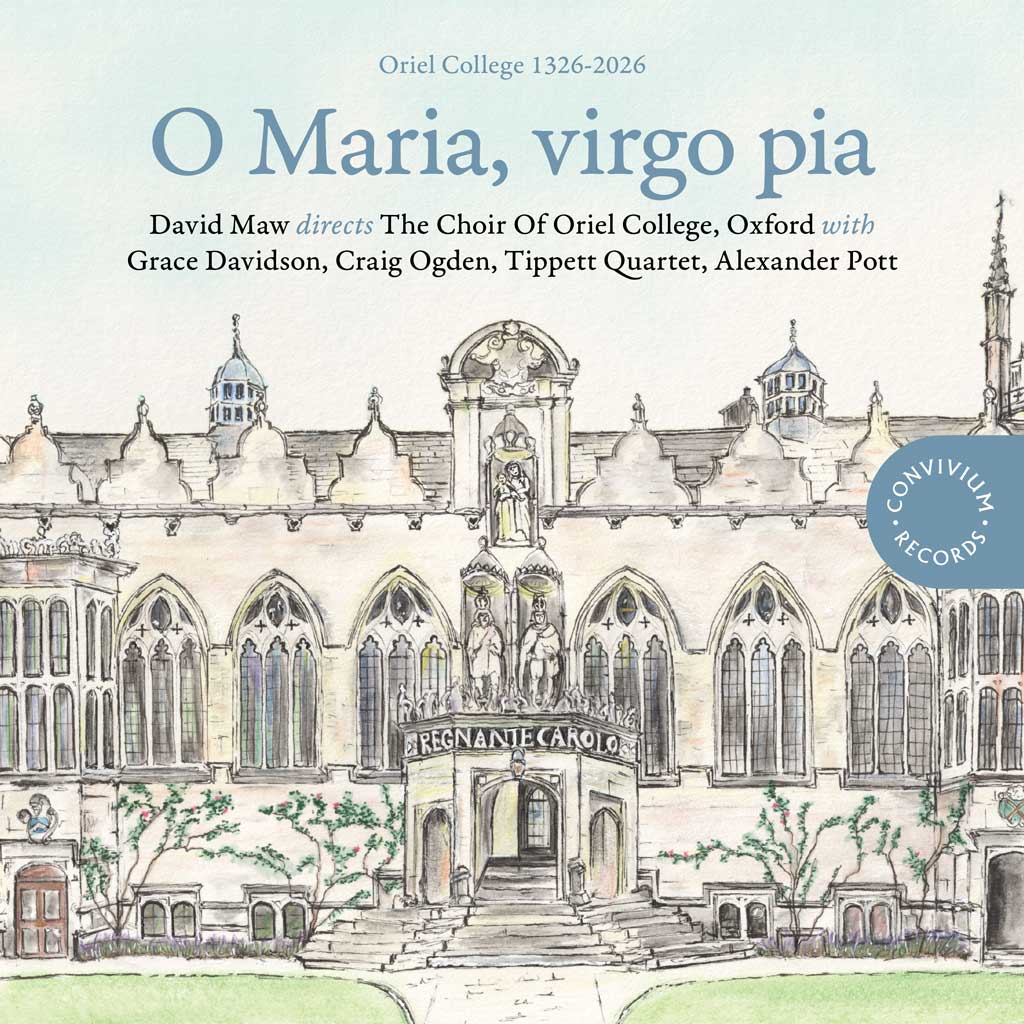
Listen or buy this album:
Oriel College’s founding dedication was to the Virgin Mary, hence the disc title and the text references in the music. This disc marks the Oxford College’s 700th anniversary. From a starting point of Marian chant, the disc explores connections to this place, via fellows and commissioned works.
Two settings of O Maria, virgo pia bookend the disc, the first anonymous. Although the group Anonymous 4 has recorded this on their album The Lily and the Lamb (the “Lily” is the Virgin Mary), Oriel’s more robust (and quicker) performance gives this a rawness that makes for a very involving experience. This appears as music of now, despite its origins lost somewhere in the 12th century.
This is not Oriel’s first recording of Judith Bingham’s Oriel Service, what was then a stand-alone piece but is now the first part of the Oriel Service, which includes the Nunc dimittis: it also appeared on the 2017 disc, Lumen de lumine, also directed by David Maw (what we have here is a fresh, 2025 re-recording). Slightly more reflective now, the organ contributions seem almost to gild the choir, dissonances interiorize the emotions. Bingham uses the anonymous chant as the basis for the piece. The Magnificat was commissioned to celebrate 30 years of female students at the college; the Nunc dimittis was commissioned by Moira Wallace to celebrate her provostship. Bingham’s setting is notably serene.
David Maw’s own I sing of a maiden features solo strings, somewhat reminiscent of The Lark Ascending and a real discovery of a voice in William Anderson’s beautifully toned tenor; it is a far better piece than David Briggs’s rather stodgy setting of an English translation of Phos hilaron, Hail Gladdening Light.
The first movement of Edmund Fellowes’s Hymn of the Third Choir begins with bracing string quartet launching a robust “Praise to the holiest.” This is a big ask. Why? Because the text is from Newman’s Dream of Gerontius. Yes, that one. Fellowes’s take is clearly in the church tradition, the performance laudable not least for the sopranos’ maintenance of tone as the pitch rises. “The angels as beseemingly” is a pleasant setting for soprano (Grace Davidson) and strings; the real interest lies in the interplay of lines in the quartet. Choir-only scoring offers nice contrast in “But to the younger race,” lines of hope reflected harmonically and strong with quietly fervent belief by the Oriel singers. The return of the text “Praise to the Holiest” occasions a fugue, now with strings doubling voices. Amazingly, this is Fellowes’s first entry in theFanfare Archive. Fellowes’s Benedictus (with English text, and with organ) is surely not the most gracious setting to sing: words occasionally crowd together.
Guitarist Craig Ogden, a choir “Distinguished Visiting Musician,” joins the choir for James Whitbourn’s Solitude. I did like that composer’s Festival Alleluia (an all-Whitbourn Naxos disc conducted by Christopher Finch, reviewed in Fanfare by Ronald E. Grames in 39:3); this is an effective piece, too (so much so, I played it again straight away), harmonically harmless to be sure, but perfectly conceived, and perfectly written for these forces, too (the guitar is far from a pleasant plucker in the background). A memorable piece.
Mark R. Taylor’s a cappella setting of a text by Arthur Hugh Clough Say not, the struggle nought availeth (he was for a time Fellow of Oriel) is a perfect balance of ancient and modern, the sighing phrases gloriously realised by the Oriel choir. It sits, like a willow aslant a brook, at a tangent from full hymnal occupancy. If I find (Professor) John Caldwell’s 2011 Candlemas setting of Phos hilaron rather less striking, it is nevertheless well constructed, and the choir negotiates the “clustering” (as in crowding) of the pitch space well.
Arriving as a blaze of light, Herbert Chappell’s Psalm 150 emerges as a masterpiece. The organ (Alexander Pott) is a major part of the piece, glowing, resplendent. Interesting to hear the lines’ relationship to plainchant with a more modernist twist. Fabulous. Chappell, incidentally, was only the second person to achieve a music degree at Oriel, in 1956 (the first was in 1953). Muscular organ binds the Chappell with Philip Cook’s The Glory of Zion (a wonderful softening here, too). There is perhaps a touch of hesitancy to some of the choral lines (perhaps as, at the time, the organ’s function is that of chthonic destabilizer); but William Anserson’s tenor solo not only rights the ship, it acts as salve.
The sharp surprises of Hugh Collins Rice’s Verbum caro introduce a piece of depth and mystery, a piece that refuses to be anchored by expectation or, for that matter, too much by tradition.
Maw’s own Magnificat features a wonderful soprano offering melismatic “Magnificats”; the timelessness contrasts with the main body of the choir’s almost Orff-like delivery of the text, at speed. The drama of “fecit potentiam” is palpable; this is music of immediacy. An interesting piece, if not one I would feel compelled to return to soon. The final item, Cheryl Frances-Hoad’s O Maria, virgo pia for a cappella choir, takes us full circle while celebrating 40 years of female students at the college in 2025.
An interesting, Oriel-centric release. Inevitably, when celebrating music associated with place, the music itself will be variable, and such is indeed the case. But there are gems here, and the choir certainly gives its all.
Review written by:
Review published in:
Other reviews by this author:
Featured artists:
Featured composers:
Oriel College’s founding dedication was to the Virgin Mary, hence the disc title and the text references in the music. This disc marks the Oxford College’s 700th anniversary. From a starting point of Marian chant, the disc explores connections to this place, via fellows and commissioned works.
Two settings of O Maria, virgo pia bookend the disc, the first anonymous. Although the group Anonymous 4 has recorded this on their album The Lily and the Lamb (the “Lily” is the Virgin Mary), Oriel’s more robust (and quicker) performance gives this a rawness that makes for a very involving experience. This appears as music of now, despite its origins lost somewhere in the 12th century.
This is not Oriel’s first recording of Judith Bingham’s Oriel Service, what was then a stand-alone piece but is now the first part of the Oriel Service, which includes the Nunc dimittis: it also appeared on the 2017 disc, Lumen de lumine, also directed by David Maw (what we have here is a fresh, 2025 re-recording). Slightly more reflective now, the organ contributions seem almost to gild the choir, dissonances interiorize the emotions. Bingham uses the anonymous chant as the basis for the piece. The Magnificat was commissioned to celebrate 30 years of female students at the college; the Nunc dimittis was commissioned by Moira Wallace to celebrate her provostship. Bingham’s setting is notably serene.
David Maw’s own I sing of a maiden features solo strings, somewhat reminiscent of The Lark Ascending and a real discovery of a voice in William Anderson’s beautifully toned tenor; it is a far better piece than David Briggs’s rather stodgy setting of an English translation of Phos hilaron, Hail Gladdening Light.
The first movement of Edmund Fellowes’s Hymn of the Third Choir begins with bracing string quartet launching a robust “Praise to the holiest.” This is a big ask. Why? Because the text is from Newman’s Dream of Gerontius. Yes, that one. Fellowes’s take is clearly in the church tradition, the performance laudable not least for the sopranos’ maintenance of tone as the pitch rises. “The angels as beseemingly” is a pleasant setting for soprano (Grace Davidson) and strings; the real interest lies in the interplay of lines in the quartet. Choir-only scoring offers nice contrast in “But to the younger race,” lines of hope reflected harmonically and strong with quietly fervent belief by the Oriel singers. The return of the text “Praise to the Holiest” occasions a fugue, now with strings doubling voices. Amazingly, this is Fellowes’s first entry in theFanfare Archive. Fellowes’s Benedictus (with English text, and with organ) is surely not the most gracious setting to sing: words occasionally crowd together.
Guitarist Craig Ogden, a choir “Distinguished Visiting Musician,” joins the choir for James Whitbourn’s Solitude. I did like that composer’s Festival Alleluia (an all-Whitbourn Naxos disc conducted by Christopher Finch, reviewed in Fanfare by Ronald E. Grames in 39:3); this is an effective piece, too (so much so, I played it again straight away), harmonically harmless to be sure, but perfectly conceived, and perfectly written for these forces, too (the guitar is far from a pleasant plucker in the background). A memorable piece.
Mark R. Taylor’s a cappella setting of a text by Arthur Hugh Clough Say not, the struggle nought availeth (he was for a time Fellow of Oriel) is a perfect balance of ancient and modern, the sighing phrases gloriously realised by the Oriel choir. It sits, like a willow aslant a brook, at a tangent from full hymnal occupancy. If I find (Professor) John Caldwell’s 2011 Candlemas setting of Phos hilaron rather less striking, it is nevertheless well constructed, and the choir negotiates the “clustering” (as in crowding) of the pitch space well.
Arriving as a blaze of light, Herbert Chappell’s Psalm 150 emerges as a masterpiece. The organ (Alexander Pott) is a major part of the piece, glowing, resplendent. Interesting to hear the lines’ relationship to plainchant with a more modernist twist. Fabulous. Chappell, incidentally, was only the second person to achieve a music degree at Oriel, in 1956 (the first was in 1953). Muscular organ binds the Chappell with Philip Cook’s The Glory of Zion (a wonderful softening here, too). There is perhaps a touch of hesitancy to some of the choral lines (perhaps as, at the time, the organ’s function is that of chthonic destabilizer); but William Anserson’s tenor solo not only rights the ship, it acts as salve.
The sharp surprises of Hugh Collins Rice’s Verbum caro introduce a piece of depth and mystery, a piece that refuses to be anchored by expectation or, for that matter, too much by tradition.
Maw’s own Magnificat features a wonderful soprano offering melismatic “Magnificats”; the timelessness contrasts with the main body of the choir’s almost Orff-like delivery of the text, at speed. The drama of “fecit potentiam” is palpable; this is music of immediacy. An interesting piece, if not one I would feel compelled to return to soon. The final item, Cheryl Frances-Hoad’s O Maria, virgo pia for a cappella choir, takes us full circle while celebrating 40 years of female students at the college in 2025.
An interesting, Oriel-centric release. Inevitably, when celebrating music associated with place, the music itself will be variable, and such is indeed the case. But there are gems here, and the choir certainly gives its all.
