
This Place – Review by Fanfare
“All credit to Patrick Allies and the Imperial singers... Clearly the result of deep consideration, this is a touching examination not only of place, but also of grief. Recommended.”
22nd September 2026
This Place – Review by Fanfare
“All credit to Patrick Allies and the Imperial singers... Clearly the result of deep consideration, this is a touching examination not only of place, but also of grief. Recommended.”
22nd September 2026
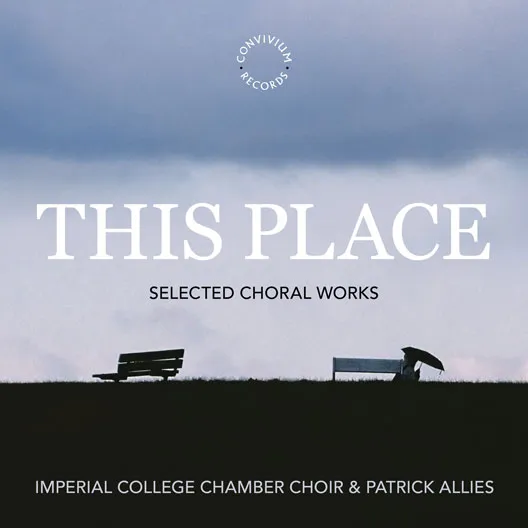
Listen or buy this album:
The theme of “place” here takes in ideas of home, nostalgia, longing, belonging, and peace; it is also intended to refer to the place of the choir and indeed college within the overall University of London (spread over various campuses), and the place the students find within the choir itself. The initial kernel of an idea came from Derri Lewis’s Locus iste.
The disc begins, though, with David Tranchell’s light setting of a newspaper clipping about an abandoned dog (“the nameless, collarless, black-and-white mongrel.” All credit to Patrick Allies and the Imperial singers that depiction is so clear that we can just sit back and enjoy the tale.
Inspired by the Indian tabla drum and originally written for a choir of homeless singers, Reena Esmail’s Tārekita is a colorful, melodic adventure (the drum is imitated via the syllables of the title). Imperial College Choir sings with complete abandon while maintaining a perfect balance between the various parts, calibrating the overall crescendo well. In total contrast is the single line that opens James Erb’s take on the well-known “Shenandoah,” a real example of homesickness in music. Male voices echo female as a perfect mirror, both offering the smoothest of legato before they join in warm harmony.
Derri Lewis’ Locus iste (This Place), which presents those words in both Latin and English, moves toward an explosion of energy, only tamed by a return to the opening. The piece requires real control from the choir, an absolute evenness of breath, and the music floats beautifully here. A consoling sense of chordal togetherness suffuses McFerrin’s The Lord is my Shepherd (The 23rd Psalm). Each phrase is carefully considered, balanced, and shaped in this account.
A setting of George Herbert, David Hurd’s Love Bade Me Welcome is entirely homophonic, and entirely heartfelt, old words in a contemporary, tonal setting. American composer Jake Runestad sets Alfred Noyses in his Let My Love Be Heard, a meditation on grief.
The most well-known piece here is surely Howells’s Here is the Little Door. Imperial College offers a performance of interior emotion, of phrases that rise and fall in perfect accord with harmony and text and which rises inevitably to Howell’s celebration of the power of the unison.
Part of a collaboration with the Iceland Philharmonic Choir (which visited the choir’s home in South Kensington, just around the corner from the Royal Albert Hall), Tryggvi M. Baldinsson’s Kvöldvers is a Christmas hymn in which Jesus’ light guides in the season’s darkness. More interior still is Lux aeterna by Pallav Bagchi. This continues a tradition of performing music by choir members: Bagchi studied aeronautical engineering at Imperial, and the music is beautiful: so harmonically aware, so sensitive to the text, absolutely the equal of the music which surrounds it.
The arrangements of traditional songs are well managed, Paulus’s The Road Home fitting snuggly in the disc’s ethos, while Ben Parry’s arrangement of Star of County Down is a tale of youthful infatuation told in jazzy terms. Great fun, with a heart of lyricism that must (and does) out. Buoyancy of rhythm informs Hark, I hear the Harps Eternal, set by Alice Parker, its “Alleluia”s elevating; as is the angelic chorus of Galina Grigorjeva’s In Paradisum (nicely independent in thought from Fauré’s Requiemsetting). Spiritual is represented by Undine Smith Moore’s imaginative setting of We Walk through the Valley, a rich mix of chordal and occasional but poignant counterpoint. Again, words are so naturally presented, and always intelligible. No trace of strain to the sopranos on their high “shall walk in peace,” either.
It is Sibelius, through the prism of Patrick Allies, who provides the close: the beloved hymn Be Still, My Soul, appropriately stirring and with a lovely moment of fragmentation that seems to shoot straight to the heart while underlining the title’s continuation: “Be still, my soul, when dearest friends depart.” It is a thought-provoking, gentle way to close.
Clearly the result of deep consideration, this is a touching examination not only of place, but also of grief. Recommended.
Review written by:
Review published in:
Other reviews by this author:
Featured artists:
Featured composers:
The theme of “place” here takes in ideas of home, nostalgia, longing, belonging, and peace; it is also intended to refer to the place of the choir and indeed college within the overall University of London (spread over various campuses), and the place the students find within the choir itself. The initial kernel of an idea came from Derri Lewis’s Locus iste.
The disc begins, though, with David Tranchell’s light setting of a newspaper clipping about an abandoned dog (“the nameless, collarless, black-and-white mongrel.” All credit to Patrick Allies and the Imperial singers that depiction is so clear that we can just sit back and enjoy the tale.
Inspired by the Indian tabla drum and originally written for a choir of homeless singers, Reena Esmail’s Tārekita is a colorful, melodic adventure (the drum is imitated via the syllables of the title). Imperial College Choir sings with complete abandon while maintaining a perfect balance between the various parts, calibrating the overall crescendo well. In total contrast is the single line that opens James Erb’s take on the well-known “Shenandoah,” a real example of homesickness in music. Male voices echo female as a perfect mirror, both offering the smoothest of legato before they join in warm harmony.
Derri Lewis’ Locus iste (This Place), which presents those words in both Latin and English, moves toward an explosion of energy, only tamed by a return to the opening. The piece requires real control from the choir, an absolute evenness of breath, and the music floats beautifully here. A consoling sense of chordal togetherness suffuses McFerrin’s The Lord is my Shepherd (The 23rd Psalm). Each phrase is carefully considered, balanced, and shaped in this account.
A setting of George Herbert, David Hurd’s Love Bade Me Welcome is entirely homophonic, and entirely heartfelt, old words in a contemporary, tonal setting. American composer Jake Runestad sets Alfred Noyses in his Let My Love Be Heard, a meditation on grief.
The most well-known piece here is surely Howells’s Here is the Little Door. Imperial College offers a performance of interior emotion, of phrases that rise and fall in perfect accord with harmony and text and which rises inevitably to Howell’s celebration of the power of the unison.
Part of a collaboration with the Iceland Philharmonic Choir (which visited the choir’s home in South Kensington, just around the corner from the Royal Albert Hall), Tryggvi M. Baldinsson’s Kvöldvers is a Christmas hymn in which Jesus’ light guides in the season’s darkness. More interior still is Lux aeterna by Pallav Bagchi. This continues a tradition of performing music by choir members: Bagchi studied aeronautical engineering at Imperial, and the music is beautiful: so harmonically aware, so sensitive to the text, absolutely the equal of the music which surrounds it.
The arrangements of traditional songs are well managed, Paulus’s The Road Home fitting snuggly in the disc’s ethos, while Ben Parry’s arrangement of Star of County Down is a tale of youthful infatuation told in jazzy terms. Great fun, with a heart of lyricism that must (and does) out. Buoyancy of rhythm informs Hark, I hear the Harps Eternal, set by Alice Parker, its “Alleluia”s elevating; as is the angelic chorus of Galina Grigorjeva’s In Paradisum (nicely independent in thought from Fauré’s Requiemsetting). Spiritual is represented by Undine Smith Moore’s imaginative setting of We Walk through the Valley, a rich mix of chordal and occasional but poignant counterpoint. Again, words are so naturally presented, and always intelligible. No trace of strain to the sopranos on their high “shall walk in peace,” either.
It is Sibelius, through the prism of Patrick Allies, who provides the close: the beloved hymn Be Still, My Soul, appropriately stirring and with a lovely moment of fragmentation that seems to shoot straight to the heart while underlining the title’s continuation: “Be still, my soul, when dearest friends depart.” It is a thought-provoking, gentle way to close.
Clearly the result of deep consideration, this is a touching examination not only of place, but also of grief. Recommended.
