
Sweet Chance – Review by Fanfare
“A fine recital. Tanya Houghton is an imaginative musician as well as first-rank harpist, and it is her vision that enables this release to thrive. Recommended.”
22nd September 2026
Sweet Chance – Review by Fanfare
“A fine recital. Tanya Houghton is an imaginative musician as well as first-rank harpist, and it is her vision that enables this release to thrive. Recommended.”
22nd September 2026
Listen or buy this album:
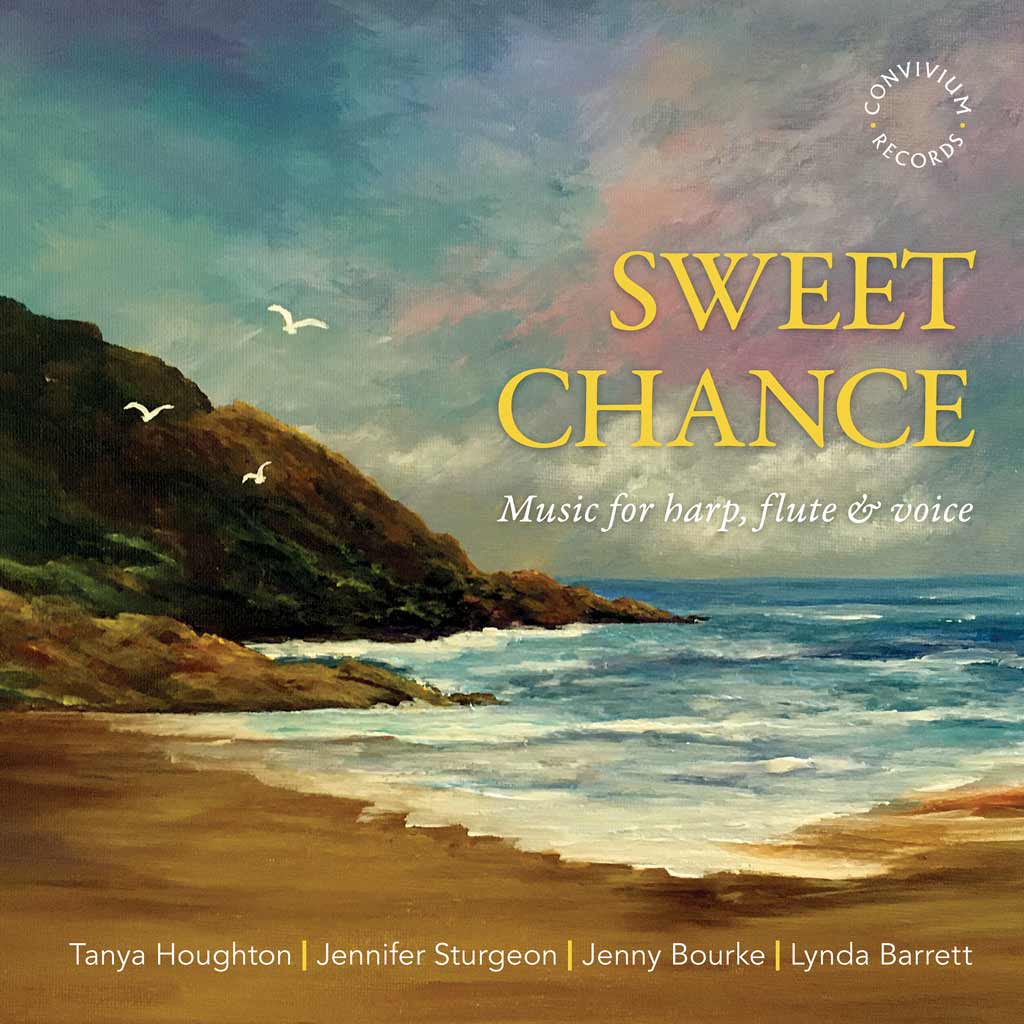
Music born of circumstance, of chance meetings … such is the foundation of Sweet Chance, also the title of an included song. Travel, chance encounters, and more inform the pieces here. From outer space to the English countryside to Christmastide, Tanya Houghton takes us on a journey often in tandem with Jennifer Staunton’s flute, and occasionally joined by soprano Lynda Barrett and mezzo Jenny Bourke.
The piece by Caroline Lizotte makes this composer’s Fanfare debut: Suite Galactique, which begins with “Exosphere,” a movement that rises from the depths up to that outermost layer of the Earth’s atmosphere. There is a deep calm about this, and Houghton’s performance gives the music all the space (no pun intended) to expand. Québecoise harpist and composer Lizette obviously writes brilliantly for her own instrument, offering a piece of loveliness, delivering the promised otherworldliness of the title. She clearly is intrigued by planets and space: she has also written a Stellar Sonata (2019) for electroacoustic harp. No electronics here, just Houghton, beautifully recorded. The central “Hymne du bon combat” once more begins low, but now the resonance is there to set up a contrast to the higher register (and in doing so set up a registral gap, a sense of emptiness filled, gradually, by gentle arpeggiations. The vocalise comes as something of a surprise, at once perfectly judged and yet somehow reminiscent of Star Trek. Finally, “Scherzo del Pueblo,” a “jostling marketplace of sound” to quote the booklet notes. Lizotte plays with sonority, inviting in the mildly unexpected.
Jenny Bourke sings exceptionally in Howells’s King David. The song itself is the very epitome of Englishness, the vocal line with its modal tinge invoking a land of pleasantry with a deep past. Bourke’s breath control is magnificent, enabling the song to unfold gloriously. More intimate is Hahn’s “L’Heure exquise,” Lynda Barrett’s pure soprano the perfect partner for the celestial transparency of the harp.
If you’re going to put in an instrumental, harp interlude, you might as well make it the best: Britten’s magical offering from A Ceremony of Carols (for some reason Convivium’s documentation omits the indefinite article). Houghton’s performance is stunning, full of understanding about the resonance of “bells,” of Britten’s poignant use here and in so much of his music of the processional. And that sense of poignancy is prolonged in The Last Rose of Summer, Bourke on terrific form and with more control of line than Barrett.
Michael Head (1900–1976) might not be the most famous of English composers, but let’s not forget that his A Piper was included in a recent Hall of Fame review by Huntley Dent around two Saga discs by Dame Janet Baker with pianist Martin Isepp (Fanfare 49:4). Have a listen to Dame Janet and Isepp: it is indeed a glorious performance, and asks why we do not listen to more music by this composer. And listen to this, too: Sweet Chance, Lynda Barrett at her cleanest and with sterling diction.
The final piece is the longest: the 14-minute Naiades by William Alwyn for flute and harp. This “Fantasy Sonata” dates from 1971. Premiered by the dedicatees, Christopher Hyde-Smith and Marisa Robles at the Bath Festival in May that year, it is highly atmospheric, brilliantly written, and here performed with real finesse. Alwyn had this to say about the piece: “My studio overlooks the River Blyth – tidal waters flanked by a broad expanse of reedy marshes, haunt of shrill seabirds. To wander there on a Summer evening, when the reeds are a rustling sheet of gold and the water the colour of the ‘wine-dark’ sea, is to believe again in Pan and Syrinx, sense the presence of Undine, and hear the Naiads sporting in the shallows, hidden from mortal sight by the shrouding reeds. But all music, however descriptive, is in essence ‘absolute’ music; and this piece, a sonata in one movement, is no exception.”
We hear the play of elementals in this music; this is not all English Pastoralism by any stretch of the imagination, more the Impressionism of Ravel. That said, there are sonorities hard as flint over the piece’s six sections.
On Chandos, Kate Hill and Jason Jones offer a fine performance on an all-Alwyn disc (and his music really is worth investigating). This is brilliantly recorded, although some might prefer the instruments placed a little further back. Importantly, there is a recording by the originators, Christopher Hyde-Smith and Marisa Robles, on Lyrita (on a two-CD all-Alwyn set). No one else quite captures the elusive flavor of the opening, mysterious but certainly not over-blurry; I am far less taken by the hyper-real and, in comparison, more superficial recording by Eva Oertie and Consuelo Giulianelli on their Sony disc, Lake Reflections; better are Emily and Catherine Beynon on Metier on their descriptively named disc Music for Flute and Harp.
It is difficult to recommend anyone over Hyde-Smith and Robles, but the present reading attains near-equal footing. The various sections are clearly delineated in mood, something honored here, as are the more overt gestures. Perhaps just a touch more of the dance would seal the deal, but this remains a fine close to a fine recital. Tanya Houghton is an imaginative musician as well as first-rank harpist, and it is her vision that enables this release to thrive. Recommended.
Review written by:
Review published in:
Other reviews by this author:
Music born of circumstance, of chance meetings … such is the foundation of Sweet Chance, also the title of an included song. Travel, chance encounters, and more inform the pieces here. From outer space to the English countryside to Christmastide, Tanya Houghton takes us on a journey often in tandem with Jennifer Staunton’s flute, and occasionally joined by soprano Lynda Barrett and mezzo Jenny Bourke.
The piece by Caroline Lizotte makes this composer’s Fanfare debut: Suite Galactique, which begins with “Exosphere,” a movement that rises from the depths up to that outermost layer of the Earth’s atmosphere. There is a deep calm about this, and Houghton’s performance gives the music all the space (no pun intended) to expand. Québecoise harpist and composer Lizette obviously writes brilliantly for her own instrument, offering a piece of loveliness, delivering the promised otherworldliness of the title. She clearly is intrigued by planets and space: she has also written a Stellar Sonata (2019) for electroacoustic harp. No electronics here, just Houghton, beautifully recorded. The central “Hymne du bon combat” once more begins low, but now the resonance is there to set up a contrast to the higher register (and in doing so set up a registral gap, a sense of emptiness filled, gradually, by gentle arpeggiations. The vocalise comes as something of a surprise, at once perfectly judged and yet somehow reminiscent of Star Trek. Finally, “Scherzo del Pueblo,” a “jostling marketplace of sound” to quote the booklet notes. Lizotte plays with sonority, inviting in the mildly unexpected.
Jenny Bourke sings exceptionally in Howells’s King David. The song itself is the very epitome of Englishness, the vocal line with its modal tinge invoking a land of pleasantry with a deep past. Bourke’s breath control is magnificent, enabling the song to unfold gloriously. More intimate is Hahn’s “L’Heure exquise,” Lynda Barrett’s pure soprano the perfect partner for the celestial transparency of the harp.
If you’re going to put in an instrumental, harp interlude, you might as well make it the best: Britten’s magical offering from A Ceremony of Carols (for some reason Convivium’s documentation omits the indefinite article). Houghton’s performance is stunning, full of understanding about the resonance of “bells,” of Britten’s poignant use here and in so much of his music of the processional. And that sense of poignancy is prolonged in The Last Rose of Summer, Bourke on terrific form and with more control of line than Barrett.
Michael Head (1900–1976) might not be the most famous of English composers, but let’s not forget that his A Piper was included in a recent Hall of Fame review by Huntley Dent around two Saga discs by Dame Janet Baker with pianist Martin Isepp (Fanfare 49:4). Have a listen to Dame Janet and Isepp: it is indeed a glorious performance, and asks why we do not listen to more music by this composer. And listen to this, too: Sweet Chance, Lynda Barrett at her cleanest and with sterling diction.
The final piece is the longest: the 14-minute Naiades by William Alwyn for flute and harp. This “Fantasy Sonata” dates from 1971. Premiered by the dedicatees, Christopher Hyde-Smith and Marisa Robles at the Bath Festival in May that year, it is highly atmospheric, brilliantly written, and here performed with real finesse. Alwyn had this to say about the piece: “My studio overlooks the River Blyth – tidal waters flanked by a broad expanse of reedy marshes, haunt of shrill seabirds. To wander there on a Summer evening, when the reeds are a rustling sheet of gold and the water the colour of the ‘wine-dark’ sea, is to believe again in Pan and Syrinx, sense the presence of Undine, and hear the Naiads sporting in the shallows, hidden from mortal sight by the shrouding reeds. But all music, however descriptive, is in essence ‘absolute’ music; and this piece, a sonata in one movement, is no exception.”
We hear the play of elementals in this music; this is not all English Pastoralism by any stretch of the imagination, more the Impressionism of Ravel. That said, there are sonorities hard as flint over the piece’s six sections.
On Chandos, Kate Hill and Jason Jones offer a fine performance on an all-Alwyn disc (and his music really is worth investigating). This is brilliantly recorded, although some might prefer the instruments placed a little further back. Importantly, there is a recording by the originators, Christopher Hyde-Smith and Marisa Robles, on Lyrita (on a two-CD all-Alwyn set). No one else quite captures the elusive flavor of the opening, mysterious but certainly not over-blurry; I am far less taken by the hyper-real and, in comparison, more superficial recording by Eva Oertie and Consuelo Giulianelli on their Sony disc, Lake Reflections; better are Emily and Catherine Beynon on Metier on their descriptively named disc Music for Flute and Harp.
It is difficult to recommend anyone over Hyde-Smith and Robles, but the present reading attains near-equal footing. The various sections are clearly delineated in mood, something honored here, as are the more overt gestures. Perhaps just a touch more of the dance would seal the deal, but this remains a fine close to a fine recital. Tanya Houghton is an imaginative musician as well as first-rank harpist, and it is her vision that enables this release to thrive. Recommended.
